 Anacortes Siding
 Two Products Homeowners Often Cross-Shop
If you're replacing siding in Anacortes, you've probably come across both James Hardie fiber cement and LP SmartSide engineered wood in your research. Both are marketed as upgrades over vinyl, both come primed or pre-finished, and both show up in the same price conversations with contractors around Skagit County. That makes them look like interchangeable choices. They aren't. The two products are built from fundamentally different materials, and that difference matters more here on the water than it does in a lot of other places.
This page lays out how each product is made, how each one actually performs against salt air, driving rain, and the long moss season that defines a Fidalgo Island winter, and why our crews install James Hardie exclusively. We're not going to tell you LP SmartSide is a bad product — it has a legitimate niche. We'll tell you honestly why it's not the product we put our name behind.
What Each Product Actually Is
James Hardie Fiber Cement
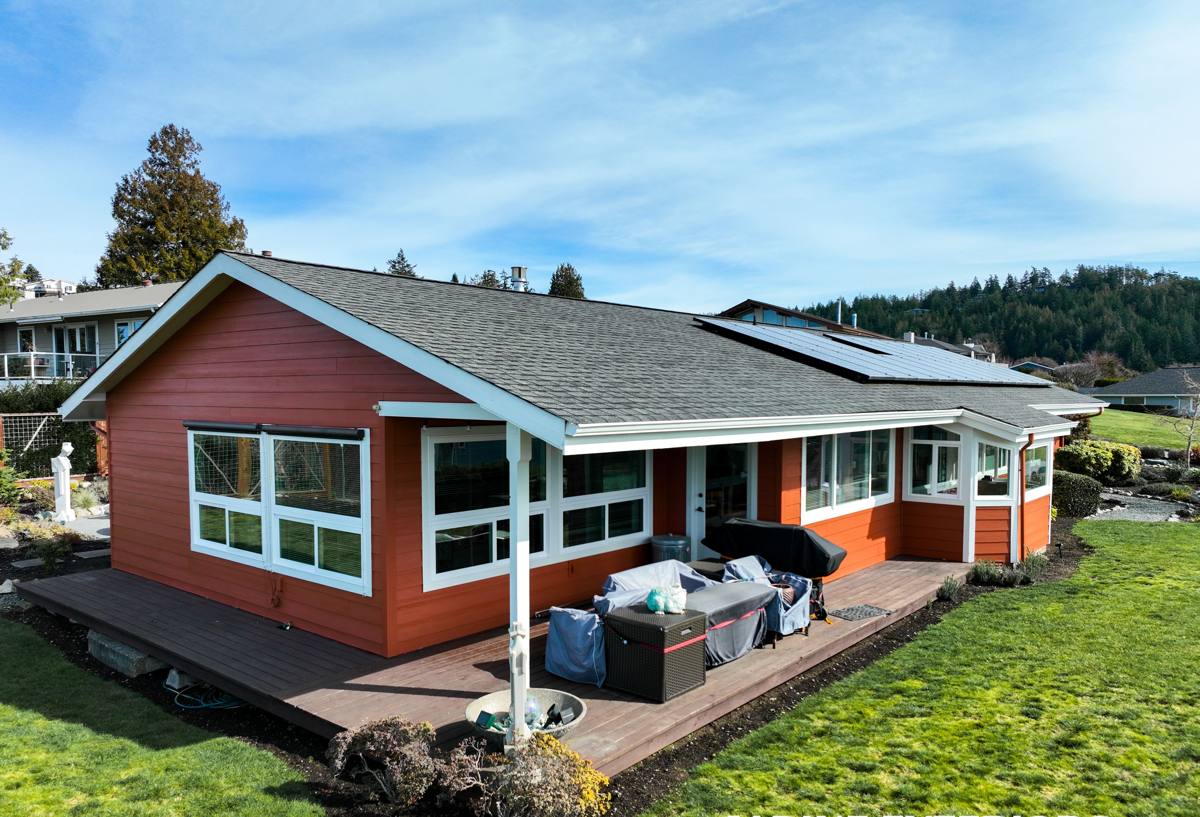
James Hardie siding is made from Portland cement, sand, and cellulose fiber, cured into a dense, stable board. It contains no wood pulp that can absorb water and swell — the cellulose fibers are there for tensile strength, not as a moisture pathway. It's factory-primed or finished with Hardie's ColorPlus baked-on coating, then cut and installed on site.
LP SmartSide
LP SmartSide is an engineered wood product — strand-based substrate (similar in concept to OSB) treated with zinc borate for insect and fungal resistance, then coated with a resin-saturated overlay and primer. It's wood at its core, just processed and treated wood rather than solid lumber. That treatment is a real improvement over old-school primed spruce or hardboard siding from decades past, and LP has worked hard to engineer out a lot of the old wood-siding failure points.
The core distinction that drives everything else on this page: one product is cement-based and does not have organic material that rots, and the other is wood-based and, however well treated, is still wood.
Why That Distinction Matters on Fidalgo Island
Anacortes sits right on the water, and the climate here isn't generic Pacific Northwest damp — it's a specific combination that's harder on siding than most inland Skagit County towns see. Salt-laden air off Rosario Strait and Guemes Channel accelerates coating breakdown and metal fastener corrosion. Driving rain off the water hits walls at an angle, not just straight down, which pushes water into laps, seams, and end joints that a purely vertical-rain climate wouldn't stress as hard. And the long, wet, low-sun moss season here means anything with a rough or absorbent surface stays damp longer between dry spells, which is exactly the condition organic materials don't want.
None of that is a dealbreaker for engineered wood siding in general — LP SmartSide is installed successfully all over the wetter parts of the country. But it raises the stakes on two things that are non-negotiable with wood-based products: getting every cut edge sealed, and staying on top of maintenance for the life of the siding. In a climate that gives you fewer fully-dry weeks per year to do that maintenance in, the margin for error shrinks.
Moisture Behavior: The Real Difference
This is the section that matters most, so we'll be direct about it.
Fiber cement doesn't swell, doesn't rot, and doesn't feed fungal growth, because there's no organic material for moisture or fungus to act on. A cut edge on a Hardie board that isn't perfectly sealed is a cosmetic and paint-adhesion issue, not a structural one.
Engineered wood siding is treated to resist moisture and decay far better than untreated wood, but it is still a wood-based substrate. LP SmartSide's own installation instructions are explicit that every cut edge, especially field cuts made on site, must be sealed with primer before installation. That's a correct and necessary step — but it's also a step that depends entirely on the installation crew doing it every single time, on every cut, on a job site where it's easy to get busy and skip it on a piece that's going up high on a gable end nobody will inspect closely. In a marine climate with more wet weeks per year, an unsealed cut edge has more opportunities to take on moisture before it dries out again.
We're not claiming LP SmartSide is prone to failure when installed correctly. We're saying the product's moisture resistance is conditional on installation discipline in a way fiber cement's simply isn't, and on a home a few blocks from the water, we didn't want to be the ones betting on that discipline every time.
Fire Performance
James Hardie fiber cement is non-combustible — it's cement, sand, and cellulose fiber, and it doesn't support flame spread the way wood products do. LP SmartSide, being wood-based, is combustible, though the engineered construction and treatments give it different fire behavior than raw lumber. This isn't the top concern for most Anacortes homeowners the way it is in eastern Washington wildfire country, but it's a real, easily verified difference and worth knowing if it factors into your insurance conversations or personal risk tolerance.
Finish, Color, and Long-Term Appearance
James Hardie's ColorPlus finish is baked on at the factory under controlled conditions, with a 15-year finish warranty backing the color and coating itself — separate from the substrate warranty. It resists fading and chipping better than field-applied paint because it's cured, not air-dried, and touch-up product is formulated to match.
LP SmartSide ships primed, not finished, which means the topcoat is applied by the installer or a painter after installation, using whatever exterior paint is chosen for the job. That gives you more flexibility on exact color, but it also means the finish quality depends on the paint job, and that topcoat will need repainting on a normal exterior-paint cycle rather than lasting on a factory-cured schedule. In a salt-air environment, repaint cycles tend to run shorter than they would inland.
Installation Sensitivity: Side by Side
| Factor | James Hardie Fiber Cement | LP SmartSide |
|---|---|---|
| Cut edge treatment | Recommended but not moisture-critical | Mandatory — every field cut must be primed/sealed |
| Substrate reaction to trapped moisture | None — inorganic material | Can swell or degrade if moisture is trapped long-term |
| Fastener corrosion resistance needed | Standard corrosion-resistant fasteners | Standard corrosion-resistant fasteners |
| Finish application | Factory-applied, cured | Field-applied topcoat over factory primer |
| Fire classification | Non-combustible | Combustible, treated |
| Typical repaint/recoat interval | Long — ColorPlus rated well beyond typical repaint cycles | Standard exterior paint cycle, often shorter near salt air |
Warranty Structure
James Hardie backs its fiber cement siding with a non-prorated limited warranty on the substrate (commonly in the 30-year range depending on product line) and a separate 15-year ColorPlus finish warranty, and the warranty is transferable to a subsequent homeowner if the home sells — a real factor if you're not planning to be in your Anacortes home forever. LP offers its own limited warranty on SmartSide products as well; the specifics and transferability terms differ from Hardie's, and we'd encourage anyone comparing the two to read both warranty documents in full rather than take a summary from either side. What we can say from a contractor's standpoint is that warranty terms on wood-based products often carry more exclusions tied to installation and maintenance compliance — sealed cuts, maintained caulking, timely repainting — than a non-organic substrate does.
Cost Considerations
| Cost Factor | James Hardie | LP SmartSide |
|---|---|---|
| Material cost | Generally higher upfront | Generally lower upfront |
| Installation labor | Requires cement-board scoring/cutting technique and tooling | Cuts more like conventional wood siding |
| Maintenance cost over 20 years | Lower — no repainting if ColorPlus finish is maintained per spec | Higher — periodic repainting is part of the ownership cost |
| Expected service life | Long, well-documented track record | Solid but shorter track record than fiber cement broadly |
The upfront price gap is real, and for some budgets it matters. But it's worth pricing the full ownership cost, not just the install invoice — a wood-based product with a repaint cycle built into it costs money on a schedule long after the crew leaves.
Where LP SmartSide Makes Sense
To be fair to the product: LP SmartSide has genuine advantages in certain situations. It's lighter than fiber cement, which can simplify handling on some retrofit jobs. Some homeowners prefer how it cuts and details for certain trim profiles. And for a home in a drier, less coastal climate with an owner committed to staying on top of paint maintenance, it can be a reasonable, lower-cost option. Anacortes, sitting where it does on the water, just isn't that climate — and that's the specific reason we don't offer it.
Why We Standardized on James Hardie
We made a decision as a company to install James Hardie fiber cement exclusively, across every job, rather than offering both products and letting price alone decide. The reasoning is straightforward: in a marine climate with salt air, driving rain, and a moss season that keeps things damp for months at a stretch, we wanted a siding material where the worst-case installation slip-up is a cosmetic touch-up, not a moisture problem working its way into an organic substrate. Fiber cement gives us that margin. It also gives homeowners a factory-cured finish that holds its color longer, a non-combustible material, and a warranty structure that transfers cleanly if the home sells. We'd rather install one product correctly, every time, than offer two and manage the trade-offs on each.
Questions to Ask Any Siding Contractor
- Which siding material do you install, and why did you settle on it — is it a company standard or a per-job upsell?
- If wood-based siding is proposed, how is cut-edge sealing verified on your crew, not just described in the spec sheet?
- Is the finish factory-applied and warrantied, or field-applied and dependent on a separate paint contract?
- What does the manufacturer's warranty actually exclude, and is it transferable if you sell the home?
- Does the contractor have manufacturer-specific installation training for the product they're proposing?
- How does the proposed product perform specifically in a salt-air, high-rainfall environment like Anacortes — not just "the Pacific Northwest" broadly?
If you're weighing siding options for a home in Anacortes or elsewhere in Skagit County, we're happy to walk your property, point out what your current siding and exposure are telling us, and give you a straightforward, no-pressure estimate for a James Hardie installation.