 Anacortes Siding
 Serving Oak Harbor From Just Across the Water
Oak Harbor sits across Deception Pass from our home base on Fidalgo Island, and we send crews out to the Whidbey Island side regularly for siding, roofing, window, and deck work. It's a short drive for us, but it's not a different climate — the same marine air, the same wind off the Salish Sea, and the same wet winters that wear down exteriors in Anacortes and Skagit County show up in Oak Harbor too. We don't treat it as an afterthought market. It's part of our regular route, and we know what the local building stock tends to need.
This page is about what siding actually has to hold up against out here, how we approach a siding job on a home near the water, and why we've standardized on one product system instead of offering a menu of options.
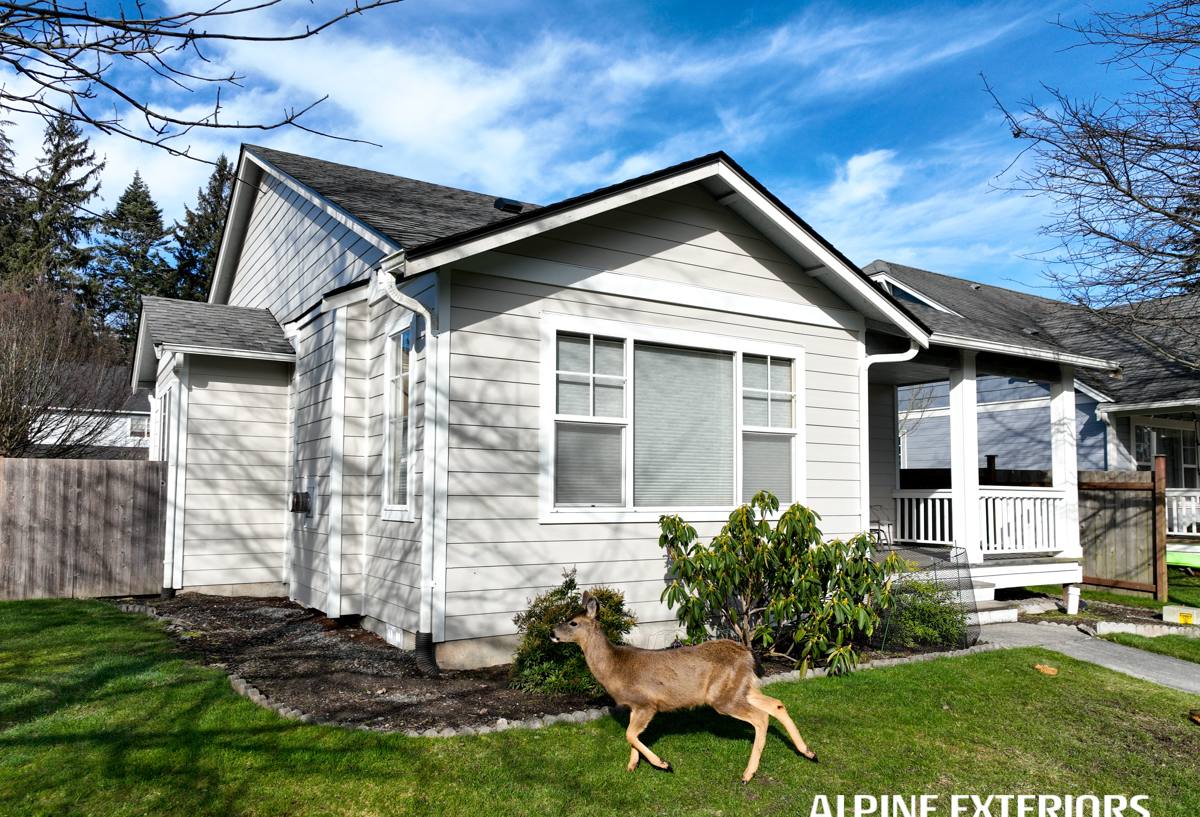
What the Marine Climate Does to Siding in Oak Harbor
Homes in this part of Washington deal with a specific combination of stressors that inland siding doesn't have to survive. None of them are dramatic on their own — it's the accumulation over years that causes trouble.
Salt Air and Corrosion
Proximity to Puget Sound means airborne salt settles on exterior surfaces, fasteners, and trim. Over time, salt exposure accelerates corrosion in lower-grade fasteners and metal flashing, and it can degrade certain paint and coating systems faster than they'd wear inland. This is one of the reasons fastener choice and flashing detail matter as much as the siding material itself.
Driving, Wind-Driven Rain
Storms coming off the water don't just fall straight down — wind pushes rain sideways into wall assemblies, seams, and butt joints. Siding and trim details that would be adequate in a calmer climate can let moisture work its way behind the cladding here. Proper lap spacing, caulking at the right joints (and not at the wrong ones), and correctly installed weather-resistive barriers matter more in a wind-driven-rain environment than most homeowners realize.
A Long Moss and Dampness Season
Between the marine humidity and shaded, tree-lined lots common in this area, many homes go months without their north- and west-facing walls fully drying out. That prolonged dampness is exactly the condition organic-based siding products struggle with — it's where moss, algae, and soft, swelling trim show up first. Siding material that doesn't absorb and hold moisture has a real, measurable advantage here.
Why We Only Install James Hardie Fiber Cement
We get asked why we don't offer vinyl, LP SmartSide, or a cheaper fiber cement alternative. The honest answer is that we used to see the long-term callbacks on all of them, and in a climate like this one, the trade-offs stopped being worth it to us as installers who have to stand behind the work.
Vinyl siding is inexpensive and low-maintenance in the sense that it doesn't need painting, but it's a plastic product that expands, contracts, and can crack in cold snaps or take wind damage in exposed, waterfront locations. Engineered wood products like LP SmartSide use wood strand cores that, however well-treated, are still wood — meaning any breach in the coating or a poorly sealed cut edge gives moisture a path in, and moisture is exactly what this climate provides in abundance. We're not saying these products fail on every home. We're saying that in a marine environment with a long wet season, the margin for installation error or coating wear shrinks, and we'd rather not build a business around a product that punishes small mistakes over a 20-year timeline.
James Hardie fiber cement is cement, sand, and cellulose fiber — it doesn't rot, it isn't attractive to pests, and it's non-combustible. The factory-applied ColorPlus finish is baked on under controlled conditions, which holds up better against UV and salt exposure than field-applied paint. Hardie also engineers specific product lines for different climate zones, which matters for a place like Oak Harbor.
The HZ5 Product Line: Built for This Climate
James Hardie makes region-specific "HardieZone" formulations. The HZ5 line is engineered for climates with more moisture and freeze-thaw cycling, which fits western Washington better than the standard HZ10 formulation used in milder, drier regions. We install HZ5 products on Oak Harbor homes for that reason — it's a small spec detail that a lot of homeowners never hear about, but it's the kind of thing that separates a siding job built for this coastline from one built for a catalog photo.
Hardie's lap siding, board-and-batten, and shingle-style panels are all available in the ColorPlus finish palette, so homeowners get a real range of looks without stepping outside the product system we trust.
How We Approach a Siding Installation
The work under the siding determines how the siding performs. We don't skip steps to save a day of labor, because the steps we'd skip are the ones that keep water out.
Inspection and Moisture Check
Before we quote a full install, we look at the existing siding, trim, and — where old siding is coming off — the sheathing underneath. On homes that have sat with failing siding for a while, it's common to find soft sheathing or rot at window sills and bottom plates that needs to be addressed before new siding goes on.
Removal and Sheathing Repair
Any damaged sheathing gets cut out and replaced rather than covered over. Covering rot with new siding just hides a problem that keeps spreading.
Flashing and Weather-Resistive Barrier
This is the step that matters most in a wind-driven-rain climate. We install a weather-resistive barrier and correct flashing at windows, doors, and horizontal trim so water that reaches the wall assembly has a path back out rather than a path in.
Hardie Installation and Finish
We install to James Hardie's published fastening and clearance specifications — proper nail placement, correct gaps at butt joints, and ground clearance to keep the bottom edge of the siding away from prolonged soil moisture. That last detail is a common failure point on older installs we replace.
What Affects the Cost of a Siding Project Here
| Factor | Why It Matters | Typical Impact |
|---|---|---|
| Sheathing condition | Rot or moisture damage found during tear-off requires repair before new siding goes on | Can add material and labor cost once the wall is opened up |
| Home size and wall complexity | More corners, dormers, and trim details mean more cutting and labor time | Larger, more detailed homes cost more per square foot, not just in total |
| Siding profile chosen | Lap siding, shingle-style, and board-and-batten involve different labor and material amounts | Shingle and batten styles generally run higher than standard lap |
| Story height and access | Second-story and steep-lot homes need more scaffolding or lift time | Adds labor time and equipment cost |
| Trim and accessory work | Window trim, corner boards, and fascia replaced alongside siding | Bundling this work with siding is usually more efficient than doing it separately |
We give homeowners a real number after we've actually looked at the walls — not a phone estimate based on square footage alone.
Beyond Siding: Roofing, Windows, and Decks
Siding is rarely the only thing wearing out on a home that's been through a decade or two of Pacific Northwest weather. We also handle roofing, window replacement, and deck construction, which matters for two practical reasons. First, a lot of moisture problems we find behind siding actually originate at the roofline or a failed window flashing — fixing the siding without addressing that source doesn't solve the underlying issue. Second, homeowners doing a full exterior refresh save time and coordination hassle working with one crew instead of scheduling separate contractors for each trade.
Why a Local Crew Matters
A crew that works this coastline regularly knows which walls take the worst of the wind-driven rain, where moss builds up fastest, and how the marine air affects fastener and flashing choices over time. That's not something you get from a national franchise crew rotating through on a subcontract. We're back in this area often enough to see how our own installs hold up years later, which keeps us honest about what actually works here versus what just looks good on installation day.
Before You Hire: A Practical Checklist
- Ask what siding material and specific product line they install, and why — a vague answer is a warning sign
- Confirm they'll inspect and repair sheathing rather than sidewall-over existing damage
- Ask how they detail flashing at windows, doors, and horizontal trim breaks
- Check that ground clearance and fastener specs will meet the manufacturer's published requirements
- Get the warranty terms in writing — both the manufacturer's product warranty and the contractor's workmanship warranty
- Ask whether they're familiar with the specific challenges of a marine, wind-exposed site
If your Oak Harbor home's siding is showing moss, soft trim, or fading that's outlasted its finish, we're happy to take a look and give you a straightforward, no-pressure estimate — no obligation, just an honest read on what your home actually needs.