 Anacortes Siding
 Exterior Work in Ship Harbor: A Different Set of Rules
Homes near Ship Harbor sit close enough to the water that the exterior gets treated differently than a house a few miles inland. Salt-laden air moves off Rosario Strait and the ferry lanes, wind-driven rain comes in sideways more often than straight down, and the tree cover that makes this part of Skagit County so pretty also keeps north-facing walls and rooflines shaded and damp for long stretches of the year. None of that is a reason to panic about your siding. It is a reason to be specific about what you put on the house and how it gets installed.
We work throughout Anacortes and the surrounding Skagit County waterfront, and Ship Harbor is one of the areas where we see the clearest pattern: houses built or sided without the marine environment in mind age faster than they should. The fix isn't complicated, but it does mean choosing materials and details that match the actual conditions, not just the regional average.
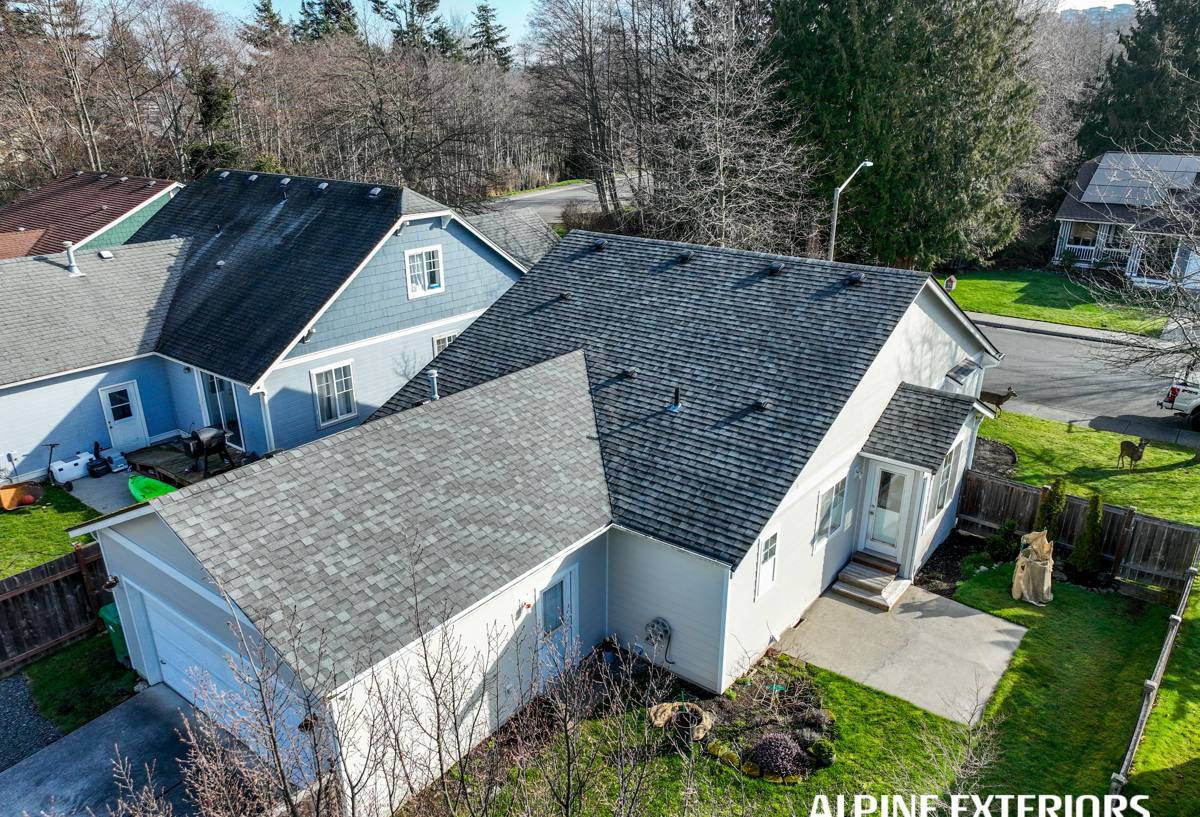
What Salt Air and Moss Season Actually Do to a House
Salt Air
Airborne salt doesn't just sit on a surface — it's hygroscopic, meaning it pulls moisture out of the air and holds it against whatever it lands on. On metal fasteners, flashing, and hardware, that means accelerated corrosion. On paint and coatings, it means faster chalking, fading, and adhesion failure, especially on the sides of a house facing the water or open wind.
Driving Rain
Anacortes gets less annual rainfall than Seattle, but the rain that does fall near Ship Harbor often comes with wind off the strait, which pushes water sideways into wall assemblies rather than letting it run straight down. That matters enormously for siding performance — a product or installation detail that handles vertical rain fine can still let water behind the cladding when the rain is horizontal.
Moss and Shade
Mature tree cover near Ship Harbor keeps a lot of roofs and north walls in shade for much of the year. Combined with our long wet season, that's exactly the environment moss and algae need. On roofing it accelerates granule loss and shortens shingle life. On siding it holds moisture against the surface longer than an equivalent wall in full sun, which matters most for products that are sensitive to sustained moisture exposure.
Why We Install Only James Hardie Fiber Cement Siding
We don't install vinyl, LP SmartSide, primed spruce or cedar lap, or fiber cement alternatives like Cemplank or Allura. That's a deliberate standard, not a sales pitch, and it matters more in a location like Ship Harbor than it would somewhere drier and more sheltered.
- Vinyl can warp, fade unevenly, and become brittle over time — and in a coastal wind environment, poorly fastened vinyl is more prone to rattling loose or blowing off during storms.
- Engineered wood products (like LP SmartSide) use a wood-strand substrate that performs well when maintained but is more sensitive to sustained moisture exposure than fiber cement — a real consideration in a shaded, moss-prone microclimate.
- Primed spruce and cedar are natural wood products that require diligent, ongoing maintenance — repainting, caulking, and moisture monitoring — to hold up against salt air and driving rain. Skip a maintenance cycle or two and the deterioration compounds quickly.
- Other fiber cement brands (Cemplank, Allura) are legitimate products, but we've standardized on James Hardie specifically for its factory-applied ColorPlus finish, its climate-engineered HZ5 formulation (built for wetter, harsher climates like ours), and its transferable warranty structure.
Fiber cement is non-combustible, dimensionally stable, and doesn't absorb moisture the way wood-based products do. It holds paint and factory finish longer in coastal conditions, and it doesn't feed moss or algae growth the way some wood substrates can. That combination — stability, finish durability, and low maintenance — is why it's the only siding we put our name behind.
James Hardie: What's Actually on the Wall
James Hardie's HardiePlank lap siding, HardiePanel vertical siding, and HardieShingle products are all available with the ColorPlus Technology finish — a baked-on, multi-coat color process applied at the factory rather than on-site. That matters in a marine environment because factory-cured finishes adhere and weather more consistently than field-applied paint, which is exactly where salt air and UV exposure do the most damage over time.
For homes closer to the water, we typically spec Hardie's HZ5 product line, engineered for regions with more moisture, humidity swings, and freeze-thaw cycling than the HZ10 line used in drier climates. It's a formulation difference most homeowners never think about, but it's part of why we don't treat "fiber cement" as a single generic category — the specific product and climate zone matter.
Roofing, Windows, and Decks: The Rest of the Envelope
Siding doesn't work in isolation. A house near Ship Harbor is one weather-facing system, and the roof, windows, decking, and siding all need to work together to keep water out and moisture moving in the right direction.
Roofing
Shaded, moss-prone roofs near the water need attention to ventilation, flashing at valleys and penetrations, and materials that resist algae and moss growth — not just a reroof with the same detailing that let the problem start in the first place.
Windows
Older windows near the coast often show their age through failed seals and corroded hardware well before the glass itself gives out. Replacement windows installed with proper flashing integration into the wall assembly are one of the most effective upgrades for both comfort and moisture control.
Decks
Exterior decks facing the water take the same salt exposure as siding, plus foot traffic and standing water from horizontal surfaces. Fastener corrosion resistance and drainage detailing matter as much as the decking material itself.
Because we handle all four trades, we can look at a Ship Harbor home as one system — flashing at a window head that ties into the siding water-resistive barrier, a roof edge detail that affects how water sheds onto the wall below, a deck ledger connection that has to be sealed correctly against the house. Coordinating that across separate contractors is where a lot of moisture problems start.
What Correct Installation Looks Like
James Hardie siding is only as good as the installation behind it. Manufacturer specifications exist for a reason, and skipping them is one of the most common ways a good product underperforms in a wet, coastal climate.
- Proper clearance between siding and grade, decks, patios, and roof lines to prevent wicking
- Correct fastener type, spacing, and penetration depth — not just "close enough"
- Rain-screen or drainage plane detailing so incidental moisture behind the siding can escape
- Flashing integration at every window, door, and penetration, sequenced so water sheds outward at every layer
- Factory-cut and properly caulked joints, with touch-up limited to Hardie-approved products
- Field-cut edges sealed per manufacturer spec to protect the cut edge from moisture intrusion
Any one of these skipped can undercut the material's performance, especially on a wall that takes direct wind-driven rain off the water.
Cost Factors for Ship Harbor Homes
Every project is different, and we don't quote sight-unseen, but these are the variables that most often move the number on a coastal Anacortes home:
| Factor | Why It Matters Here |
|---|---|
| Existing siding removal | Wood or vinyl tear-off, plus any water damage found underneath, adds scope |
| Wall complexity | Dormers, multiple gables, and water-facing elevations need more flashing detail |
| Product line (HZ5 vs. standard) | Climate-engineered formulations cost more but perform better on exposed walls |
| Trim and accessory package | Corner boards, frieze boards, and window trim in matching ColorPlus finish |
| Access and site conditions | Tree cover, slope, and proximity to neighboring structures affect labor time |
| Bundled scope | Combining siding with roofing, window, or deck work can reduce overlapping setup costs |
Why a Local Crew Matters More Here Than It Sounds
A crew that works across Skagit County regularly knows which walls in a given neighborhood take the worst weather, what a roofline near mature trees actually needs versus what a spec sheet assumes, and how to sequence a job around this area's wet season instead of fighting it. That's the difference between a generic install and one built for how a Ship Harbor home actually gets weathered year to year.
Signs It's Time to Look at Your Exterior
You don't need visible damage to justify a conversation. Worth a look if you're seeing:
- Persistent moss or algae staining on siding or roof surfaces that returns after cleaning
- Paint that's chalking, peeling, or fading faster on water-facing walls than the rest of the house
- Soft spots, swelling, or visible seams opening up on existing siding
- Window frames with corroded hardware or drafts that weren't there a few years ago
- A deck showing fastener rust or discoloration around ledger connections
If you're weighing a siding, roofing, window, or deck project for a home near Ship Harbor, we're happy to take a look and talk through what your specific walls and roofline actually need — no pressure, no generic sales pitch. Use the form below to request a free estimate.