 Anacortes Siding
 Building Decks That Hold Up in Ship Harbor
Ship Harbor sits right where Fidalgo Island meets the water, and that location comes with a specific set of problems for anything built outdoors. Salt-laden air off Rosario Strait and the ferry lanes, wind-driven rain that finds its way into every joint and gap, and a long stretch of gray, damp months that turn north-facing surfaces green with moss — all of it works on a deck the same way it works on a boat hull. A deck built the way it might be built in a dry inland climate simply won't last out here. We build decks for this specific stretch of Skagit County, and that means every material choice and every connection detail gets picked with salt, moisture, and moss in mind, not just looks.
A deck in Ship Harbor isn't just an outdoor living space — for a lot of homes it's the main way you experience the view and the marine air that make this location worth living in. It should hold up to that environment for decades, not just look good for the first few seasons before rot, corrosion, or slick moss growth turn it into a liability.
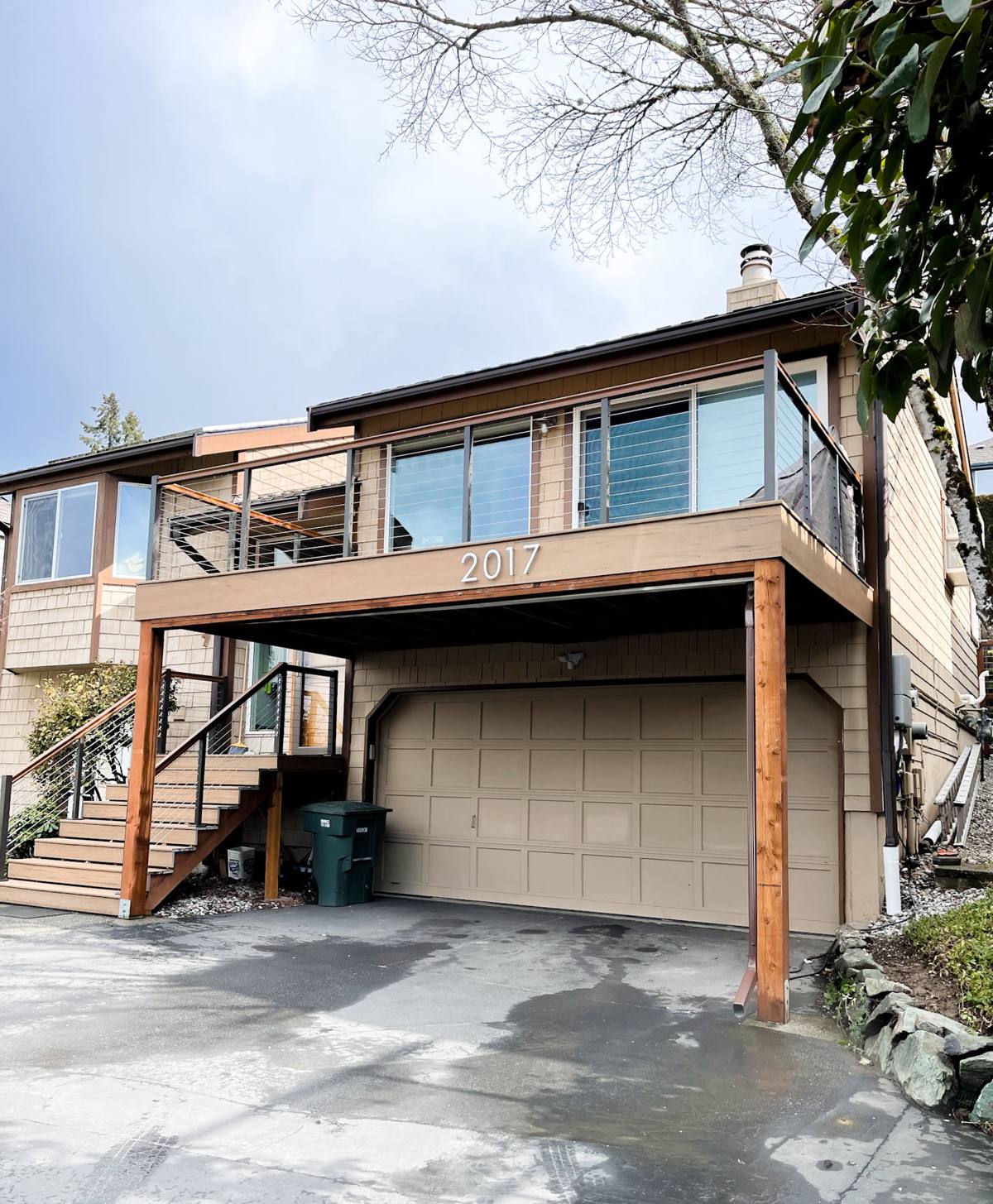
What the Climate Actually Does to a Deck
Salt Air and Corrosion
Airborne salt doesn't just affect homes sitting right on the waterfront — it travels on wind and settles on any exposed metal in the area, including fasteners, brackets, and railing hardware set back from the water. Standard zinc-coated screws and joist hangers corrode faster here than in a typical inland yard. Once a fastener starts rusting, it weakens, stains the wood around it, and eventually fails — often invisibly, since the corrosion happens where the screw meets the framing, out of sight.
Driving Rain and Trapped Moisture
Storms coming off the water don't fall straight down — they drive sideways into ledger boards, railing posts, and any horizontal surface that isn't properly flashed or sloped. Water that gets behind fascia boards or into unsealed end-cuts doesn't dry out quickly in this climate, and that's where rot starts, usually from the inside out where you can't see it until the damage is advanced.
Moss, Algae, and a Long Damp Season
Skagit County's wet season stretches long, and shaded or north-facing decks stay damp for weeks at a time. That's exactly what moss and algae need to establish. Beyond looking bad, a mossy deck surface gets genuinely slick and dangerous underfoot, and moss holds moisture against the decking material, accelerating whatever rot or decay process is already underway.
Choosing the Right Decking Material for This Location
There's no single "best" decking material for every home — it depends on budget, how much upkeep you want to do, and how exposed the deck is to wind and salt. Here's how the common options actually perform in a Ship Harbor setting:
| Material | Salt Air / Moisture Behavior | Moss Resistance | Maintenance | Typical Lifespan Here |
|---|---|---|---|---|
| Pressure-treated pine/fir | Resists rot with proper coating; end-cuts need re-sealing | Low — needs regular cleaning | Annual cleaning, re-seal every 1-2 years | 15-20 years, less if neglected |
| Cedar | Naturally rot-resistant, ages gracefully in marine air | Moderate — still needs periodic cleaning | Seasonal cleaning, occasional oil/stain | 20-25 years with upkeep |
| Composite decking | Excellent — doesn't absorb moisture or swell | Better, though surface film can still grow on shaded boards | Periodic washing, no sealing/staining | 25-30+ years, per manufacturer warranty |
| PVC/capped composite | Best overall moisture and salt performance | Best — smooth cap sheds growth more easily | Lowest — occasional washing | 25-30+ years, per manufacturer warranty |
Composite and capped-composite boards generally make the most sense for exposed or shaded Ship Harbor lots because they don't absorb moisture the way wood does, which removes a lot of the rot and moss-holding problem at the source. That said, a well-built cedar or pressure-treated deck with a real maintenance routine can still perform well here — the honest trade-off is upkeep time versus upfront cost, and we'll walk through that math with you rather than push one product.
Framing and Substructure: The Part That Determines Lifespan
Decking boards are what you see, but the framing underneath is what determines whether a deck lasts ten years or thirty. In a marine climate, the substructure needs a few things a lot of decks skip:
- Ledger flashing that actually sheds water away from the house rim joist, not just a bead of caulk
- Joist tape or a moisture barrier on top of every joist, so standing water under the decking boards doesn't sit directly on bare framing lumber
- Stainless steel or heavy hot-dip galvanized fasteners and structural hardware — standard coated screws corrode too quickly in salt air
- Proper footing depth for frost and load, set on solid, undisturbed soil
- Post bases that hold posts up off the concrete, so wood never sits in a puddle after a storm
- Airflow underneath the deck so the framing can actually dry out between rain events instead of staying damp for weeks
None of this is visible once the deck is finished, which is exactly why it's the part that gets cut corners on cheap builds. It's also the part that determines whether you're dealing with a soft, rotting joist in twelve years or a solid deck in thirty.
Railings, Fasteners, and Hardware for Coastal Exposure
Railings and hardware take the brunt of salt air because they're the most exposed, highest-surface-area metal on the whole structure. We spec stainless steel or marine-grade hardware for railing brackets, post connections, and any fastener that's going to be visible or load-bearing, rather than the standard exterior-rated hardware that's fine in a drier climate but shortens its service life considerably out here. Most jurisdictions, including Anacortes, require guardrails once a deck's walking surface sits more than 30 inches above grade, and those railings need to be built to hold real lateral load — not just pass a quick push test on installation day.
Our Deck Building Process
- On-site assessment — we look at sun exposure, prevailing wind and rain direction, drainage, and how the deck ties into your home before recommending anything.
- Material and layout discussion — we go over decking material trade-offs, railing style, and layout based on how you actually plan to use the space.
- Permitting — we handle the permit application through the City of Anacortes or Skagit County, whichever applies to your property.
- Framing and substructure build — footings, posts, ledger flashing, joists, and hardware installed to hold up under this specific climate, not a generic spec.
- Decking, railing, and finish work — boards, fascia, railings, and stairs installed with attention to fastener placement and water shedding at every seam.
- Final walkthrough — we go over the finished deck with you, including what maintenance it actually needs and on what schedule.
Keeping a Ship Harbor Deck Looking Good Long-Term
Even the best-built deck needs some seasonal attention in this climate. A realistic maintenance routine here looks like:
- Sweeping debris and standing water off the surface regularly during the wet months, especially on shaded sections
- A yearly wash-down to remove algae and moss before it gets established, particularly on north-facing or tree-shaded areas
- Checking railing posts and stair connections annually for any looseness or corrosion at fastener points
- Re-sealing or re-staining wood decking on the schedule the material actually needs, not just when it starts looking gray
- Keeping gutters and downspouts near the deck clear, since overflow dumping onto or near the structure defeats good drainage design
A few hours of upkeep a year is a lot cheaper than replacing rotted framing five years earlier than it should have failed.
Permits and Local Considerations
Most new decks and significant deck rebuilds in and around Anacortes require a building permit, and inspections typically check footing depth, ledger attachment, and guardrail construction before it's signed off. Skagit County's proximity to the water can also mean additional review depending on setbacks and site conditions on a given lot. We handle the permit process as part of the job so you're not left figuring out which department to call — but it's worth knowing upfront that a deck built without permits, even if it looks fine, can become a real problem when you go to sell the house.
Why Hire a Crew That Already Works Ship Harbor
A contractor who only occasionally works this close to the water can miss the details that matter most here — the flashing detail that keeps a ledger from rotting, the fastener grade that won't rust out in five years, the framing gap that lets air move under the deck instead of trapping moisture. We build decks throughout Anacortes and Skagit County and see, year over year, which details hold up against salt air and driving rain and which ones don't. That's not a marketing line — it's the difference between a deck that needs major repair in a decade and one that's still solid in thirty years.
If you're planning a new deck or replacing one that's showing its age, we're happy to come take a look and talk through what your specific lot and exposure actually call for. There's a free, no-pressure estimate form below — reach out and we'll walk the site with you before you commit to anything.