 Anacortes Siding
 One Product Line, No Exceptions
Most siding contractors will install whatever a homeowner asks for — vinyl one week, LP SmartSide the next, cedar after that. We don't work that way. Every job we take on in Anacortes and the rest of Skagit County gets James Hardie fiber cement siding, full stop. No vinyl, no engineered wood, no primed spruce, no Cemplank or Allura fiber cement. This page explains the reasoning, not as a sales pitch, but as the honest logic behind a decision that limits our own product menu on purpose.
That decision wasn't made in an office. It was made looking at what actually fails on houses in this part of Washington, and what holds up decade after decade in a marine climate that doesn't forgive shortcuts.
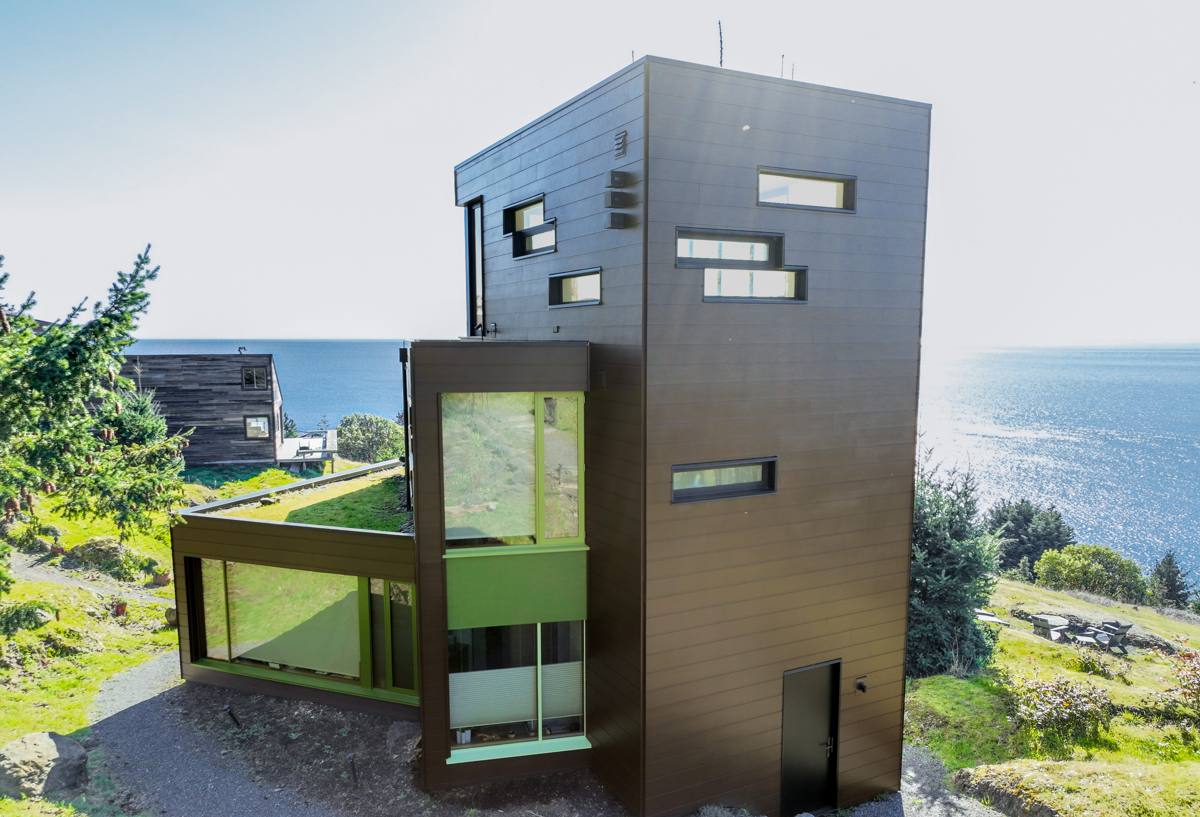
What Anacortes Siding Actually Has to Survive
Anacortes sits on Fidalgo Island, surrounded by saltwater on three sides, and that geography shapes everything about how a house ages here. Siding on this peninsula deals with a combination of stresses that inland Skagit County homes don't face to the same degree.
Salt Air and Marine Exposure
Airborne salt is corrosive and hygroscopic — it pulls moisture out of the air and holds it against whatever surface it lands on. Fasteners, trim, and siding faces near the water take a slow, steady beating that shows up as accelerated fading, chalking, and fastener corrosion long before a comparable product would fail twenty miles inland.
Driving Rain and Wind-Driven Moisture
Storms coming off the Strait of Juan de Fuca and Rosario Strait don't just drop rain straight down — wind pushes it sideways into lap joints, butt seams, and anywhere a siding system has a weak point. A product that performs fine in a calm, dry climate can behave very differently when rain is being driven horizontally into a wall assembly six months out of the year.
Moss, Mildew, and the Shade Problem
Skagit County's tree cover and long damp season create ideal conditions for moss and mildew growth on north-facing walls and anywhere shade keeps siding from drying out. Some siding materials tolerate that constant damp-then-dry cycle far better than others, and the difference becomes obvious after five or six wet seasons, not on installation day.
Why We Stopped Installing Everything Else
We didn't start out as a Hardie-only company. Like most contractors, we installed a range of products because customers asked for them and they were cheaper up front. Over time, a pattern became impossible to ignore: the callbacks, the warranty disputes, and the five-years-later "why does my siding look like this" conversations almost never involved fiber cement installed correctly. They involved products that looked fine in the showroom but weren't built for this specific climate.
That's not a knock on every manufacturer's engineering — it's an observation about what a marine Pacific Northwest climate does to a wall over 20-30 years, and which products we were comfortable standing behind for that long. Vinyl softens, warps, and fades under UV and heat cycling, and it isn't remotely fire resistant. LP SmartSide is an engineered wood product — better than raw plywood siding, but wood-based products still rely on intact factory coatings and rigorous edge-sealing to keep moisture out, and a marine climate finds every gap. Primed spruce and cedar require ongoing homeowner maintenance — repainting, caulking, moisture monitoring — that most people don't keep up with on a schedule strict enough for this climate.
James Hardie fiber cement isn't magic. It requires correct installation just like anything else. But it starts from a material composition — sand, cement, and cellulose fiber — that simply doesn't absorb, swell, rot, or attract insects the way wood-based products can, and it doesn't degrade under UV and salt exposure the way vinyl does.
What James Hardie Actually Is
Fiber cement is a composite of Portland cement, sand, and cellulose fiber, cured under controlled factory conditions. That composition is what gives it its core advantages over the alternatives:
- It's non-combustible — it doesn't contribute fuel to a fire, which matters both for insurance conversations and for basic peace of mind.
- It doesn't rot, and it isn't a food source for termites or carpenter ants.
- It holds its shape through wet-dry cycling far better than wood-based siding, which matters directly in a climate this damp.
- It's dense and rigid, which helps it resist the impact damage that can dent vinyl or gouge softer materials.
HZ5: Engineered for This Exact Climate
James Hardie doesn't sell one universal product nationwide — the company engineers regional formulations based on climate zone, and the Pacific Northwest falls under the HZ5 designation. HZ5 products are formulated specifically for cold, wet, high-moisture climates, with an emphasis on moisture resistance and freeze-thaw durability. That's a meaningful distinction from a generic fiber cement product engineered for a drier, milder region and shipped everywhere. When we spec a job in Anacortes, we're using a product line built with this exact climate in mind, not a one-size-fits-all national product.
ColorPlus: Why Factory Finish Matters Here
One of the most underrated parts of the Hardie system is the ColorPlus factory finish — a baked-on, multi-coat finish applied in a controlled facility rather than brushed or sprayed on site. In a salt-air, high-UV-cycling environment, the difference between a factory-cured finish and a field-applied coat of paint is significant. Field-applied paint is only as good as the weather conditions on the day it was applied and the surface prep underneath it; factory finishing removes that variable entirely and comes with its own dedicated finish warranty separate from the substrate warranty.
Comparing What's Actually on the Table
| Factor | James Hardie Fiber Cement | Vinyl | LP SmartSide / Engineered Wood | Cedar / Primed Spruce |
|---|---|---|---|---|
| Combustibility | Non-combustible | Combustible, can soften/melt under heat | Combustible | Combustible |
| Moisture behavior | Doesn't swell or rot; engineered for wet climates (HZ5) | Doesn't absorb, but can trap moisture behind panels if installed poorly | Wood-based; relies on intact coating and sealed edges | Absorbs moisture; needs regular refinishing |
| Salt air / UV exposure | Factory ColorPlus finish resists fading and chalking | Fades and can become brittle over time | Coating degrades with UV exposure over time | Grays and weathers; needs recoating |
| Maintenance | Occasional wash; repaint only if not ColorPlus | Low, but limited repair options once damaged | Moderate — coating and caulking upkeep | High — regular sealing/painting required |
| Typical lifespan when installed to spec | Decades, often 30+ years | 20-30 years, variable | 25-30 years with maintenance kept up | 15-25 years with diligent maintenance |
None of the alternatives are "bad" products in every situation. They're products we've chosen not to install here because of how this specific climate treats them over time, and because we'd rather stand behind one system we trust fully than offer a menu of products we have reservations about.
The Warranty Behind the Decision
James Hardie backs its siding with a long, transferable limited warranty on the substrate, plus a separate finish warranty on ColorPlus color products. Transferability matters more than homeowners usually expect — if the house sells within the warranty period, that coverage can transfer to the new owner, which is a real selling point in a market like Anacortes where waterfront and island properties change hands regularly. A warranty is only as good as the installation behind it, though, which is why manufacturer-required installation practices aren't optional on our jobs — they're how the warranty stays valid at all.
What Correct Installation Actually Involves
Fiber cement's durability advantage only holds up if it goes on correctly. This is where a lot of Hardie installations underperform — not because of the material, but because of shortcuts in the install. Our installation standard includes:
- Proper water-resistive barrier and flashing detail behind every siding plane, not just at obvious joints
- Correct fastener type, spacing, and penetration depth per Hardie's published installation specs
- Minimum clearance gaps at grade, roof lines, and abutting surfaces to allow drainage and drying
- Caulked and sealed joints only where Hardie's install guide calls for it — not everywhere, and not nowhere
- Correct blade and dust-control practices when cutting fiber cement on site
- Manufacturer-specified overlap and gapping at butt joints to accommodate expansion and contraction
Skip any one of these and you can end up with the exact moisture problems Hardie siding is supposed to prevent — which is why "who's installing it" matters as much as "what's being installed."
Where This Leaves You as a Homeowner
If you're planning a siding replacement in Anacortes or elsewhere in Skagit County, you're going to run into contractors who'll install whatever's cheapest or whatever you ask for. That's a legitimate business model, and there are situations where a different product makes sense for a different budget or a different house. We've simply chosen not to be that kind of contractor. We install one system, we install it to the manufacturer's spec, and we can speak to exactly why it's on your house — because we've made the same call for every home we've sided in this county.
If you'd like to talk through what that looks like for your specific house — roofline, sun exposure, proximity to the water, budget range — we're glad to put together a free, no-pressure estimate using the form below.