 Anacortes Siding
 Burlington's Exterior Challenge: A Wet Valley Between Two Waters
Burlington sits inland in the Skagit Valley, a few miles from the salt water of Padilla Bay and the Puget Sound shoreline that runs through Anacortes. That distance doesn't buy Burlington homes much protection from the weather that defines this part of Skagit County. The valley traps moisture. Fog settles in low along the Skagit River in the fall and winter, driving rain comes through sideways off the Sound with the prevailing westerlies, and the combination of farmland humidity and marine air keeps exterior surfaces damp for long stretches of the year. Add in the fact that many Burlington neighborhoods are shaded by mature evergreens, and you get long moss season that can run from October through April in a typical year.
None of that is unique to any one house. It's the baseline condition every exterior surface in this area has to survive, year after year, decade after decade. Siding, trim, roofing, windows, and deck materials that aren't built for a wet valley climate show it early — usually in ways that are cosmetic at first and structural later.
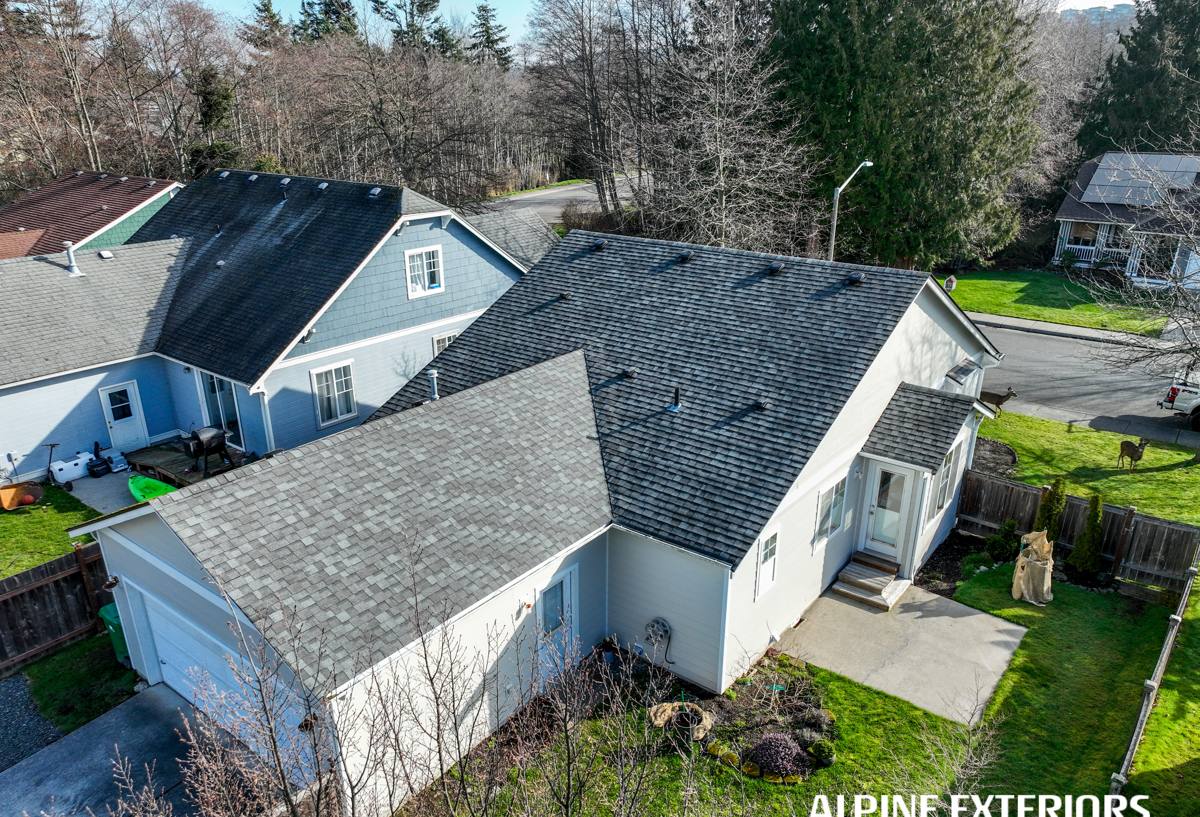
What We See on Burlington Homes
Working across Skagit County, including Burlington specifically, we see a consistent pattern of problems tied directly to moisture and organic growth rather than storm damage or age alone:
- Moss and algae staining on north- and west-facing walls, especially under eaves and near tree cover
- Swollen or delaminating panel siding where seams and butt joints have taken on water repeatedly
- Paint failure on wood trim and fascia from cycles of soaking and drying
- Soft or spongy trim boards where caulking has failed and water has tracked behind the surface
- Roof moss buildup that holds moisture against shingles longer than the shingles are rated to handle
- Window sills and lower sashes with early rot from standing water and condensation
These aren't dramatic failures. They're slow ones — the kind that get worse a little at a time until a homeowner is looking at a much bigger repair than they expected. The fix isn't a different maintenance schedule. It's building with materials engineered for exactly this kind of exposure, and installing them the right way the first time.
Why We Only Install James Hardie Siding
We get asked fairly often why we don't offer vinyl, LP SmartSide, or other fiber cement brands like Cemplank or Allura. The honest answer is that we made a decision as a company to standardize on one product because it's the one we trust to perform in this exact climate, and we'd rather do one thing well than offer a menu of products with different failure modes.
The Trade-Offs We Weighed
| Material | Where it struggles in a wet valley climate |
|---|---|
| Vinyl siding | Can warp or buckle with temperature swings; seams and laps are a common path for moisture intrusion; doesn't hold paint if a color change is ever wanted |
| LP SmartSide (engineered wood) | Wood-based core is vulnerable if the factory edge seal or field-cut edges aren't treated correctly; edge swelling shows up over time in consistently damp climates |
| Cemplank / Allura fiber cement | Similar base material to Hardie, but without the same regional engineering, factory finish warranty structure, or track record we've built our installation standards around |
| Primed spruce / cedar | Requires the most ongoing maintenance of any option — repainting, caulking, and moisture monitoring on a recurring cycle to avoid rot |
Every one of these products has a place in the market, and none of them are "bad" products in the abstract. But we install exteriors that have to survive Skagit County winters without a homeowner needing to think about them, and James Hardie fiber cement is the product we've found does that most consistently.
What Makes Hardie Different
- Non-combustible core — fiber cement doesn't burn, which matters as wildfire smoke and fire risk become bigger considerations even in western Washington
- Engineered for Pacific Northwest moisture — Hardie's HZ5 product line is specifically formulated for climates with sustained damp and freeze-thaw cycling, which describes Burlington's winters well
- ColorPlus factory finish — baked-on color that resists fading and chipping far better than field-applied paint, and doesn't require repainting on the same cycle wood siding does
- Dimensionally stable — fiber cement doesn't expand and contract with moisture the way wood-based products can, which keeps seams tighter over time
- Strong transferable warranty — Hardie's warranty structure is one of the more homeowner-friendly ones in the industry, and it transfers if the home is sold
Beyond Siding: A Full Exterior Envelope
Siding is only part of what keeps water out of a house. We work on roofing, windows, and decks as well, because a home's exterior only performs as well as its weakest component. A brand-new siding job installed over a failing roof, or paired with old single-pane windows leaking air and moisture at the frame, doesn't solve the underlying problem.
Roofing
In a moss-prone climate like Burlington's, roofing decisions matter as much as material choice. Proper ventilation, flashing detail, and moss-resistant material selection all affect how long a roof lasts before moss and moisture start compromising the shingles underneath.
Windows
Older windows in Skagit County homes are frequently a bigger source of moisture and energy loss than homeowners realize. Failed seals, rotting sashes, and poor flashing at the window opening let water track into wall cavities — often the same wall cavities that end up showing siding damage from the inside out.
Decks
Outdoor living spaces take the most direct hit from driving rain and standing moisture of anything on the property. Deck framing, ledger board flashing, and surface material all need to be chosen and installed with drainage as the first priority, not an afterthought.
Why a Local Crew Matters in Burlington
Exterior work in Skagit County isn't the same job as exterior work in a drier inland climate, and it isn't quite the same as work right on the water in Anacortes either. A crew that works this specific region regularly knows how to detail flashing and house-wrap for valley fog and driving rain, how to plan installation timing around wet-season weather windows, and what moisture patterns to expect based on a home's orientation and tree cover. That local knowledge shows up in the details — the ones that determine whether an exterior holds up for thirty years or needs attention again in five.
What a Burlington Siding Project Looks Like
Every home is different, but most projects follow a similar sequence:
- On-site assessment of existing siding, trim, and any moisture or rot issues found during removal
- Inspection and repair of sheathing and house-wrap before any new material goes up
- Installation of James Hardie panels or lap siding per manufacturer specification, including proper fastening, clearances, and joint treatment
- Trim, flashing, and caulking detail work at every penetration — windows, doors, vents, and corners
- Final walkthrough covering care, expected performance, and warranty registration
Quick Checklist: Signs Your Burlington Home May Need Exterior Attention
- Visible moss or dark streaking on siding, especially on shaded or north-facing walls
- Soft spots, bubbling, or separation at siding seams and butt joints
- Paint that's peeling or chalking faster than it did in previous years
- Increased drafts or fogging between window panes
- Roof moss that's visibly thickening year over year
- Deck boards that stay damp long after rain has stopped elsewhere on the property
Cost Factors Homeowners Ask About
| Factor | How it affects the project |
|---|---|
| Home size and siding profile | Panel vs. lap siding and total square footage drive material and labor quantities |
| Existing condition | Rotted sheathing or trim discovered during tear-off adds repair scope before new siding goes up |
| Trim and detail complexity | Homes with more corners, dormers, and window openings require more flashing and finish work |
| Color and finish selection | ColorPlus factory finishes vs. field-painted options affect both cost and long-term maintenance |
| Access and site conditions | Tree cover, slope, and staging space can affect labor time |
We don't publish blanket pricing because every home's condition and scope is different, but we walk every Burlington estimate through these factors so homeowners understand what's driving the number before work starts.
Let's Take a Look at Your Home
If you're noticing moss buildup, siding that's starting to show its age, or you're just planning ahead for a Burlington home that needs to hold up to another wet Skagit County winter, we're happy to take a look. The estimate is free, there's no pressure, and you'll get a straight answer about what your home actually needs — use the form below to get started.