 Anacortes Siding
 Cap Sante's Exposure Is Different From the Rest of Anacortes
Cap Sante sits up on the headland overlooking the marina and Guemes Channel, and that elevation and water exposure change what a house has to deal with year-round. Homes here catch wind and salt-laden air coming straight off the water, with less tree cover to break it up than you'll find a few blocks inland. That combination — wind-driven rain, salt air, and long stretches of damp shade on the north and east-facing walls — is hard on exterior materials that aren't built for it.
We've worked on homes throughout Anacortes and Skagit County long enough to know that a siding product that performs fine in a sheltered subdivision can fail early on a bluff-top lot facing the strait. Cap Sante is one of those spots where the climate isn't an abstract talking point — it's the reason a homeowner is calling us about premature paint failure, soft trim, or siding that's swelling at the seams years before it should.
What Salt Air and Driving Rain Actually Do to a House
Salt Air
Airborne salt is corrosive to fasteners and hard on painted finishes. On homes close to the water, we regularly see faster fade and chalking on lower-grade paint jobs, and accelerated corrosion on any exposed metal trim, flashing, or fasteners that weren't rated for a marine-adjacent environment. It's not dramatic — it's a slow, steady wear pattern that shows up as a house starts looking tired well ahead of schedule.
Driving Rain
Wind off the water doesn't just bring rain — it drives it sideways into wall assemblies, seams, and butt joints that would stay dry in a calmer setting. Any siding product with weak moisture tolerance at the joints, or that depends on field-applied paint to keep water out, is going to show trouble first on an exposed elevation like this.
Moss and Sustained Dampness
Skagit County's long wet season means north and east walls, and anything shaded by roof overhangs or neighboring structures, stay damp for extended stretches. That's exactly the environment moss and mildew thrive in, and it's exactly the environment where wood-based or wood-fiber siding products are most likely to hold moisture against the substrate instead of shedding it.
Why We Only Install James Hardie Fiber Cement
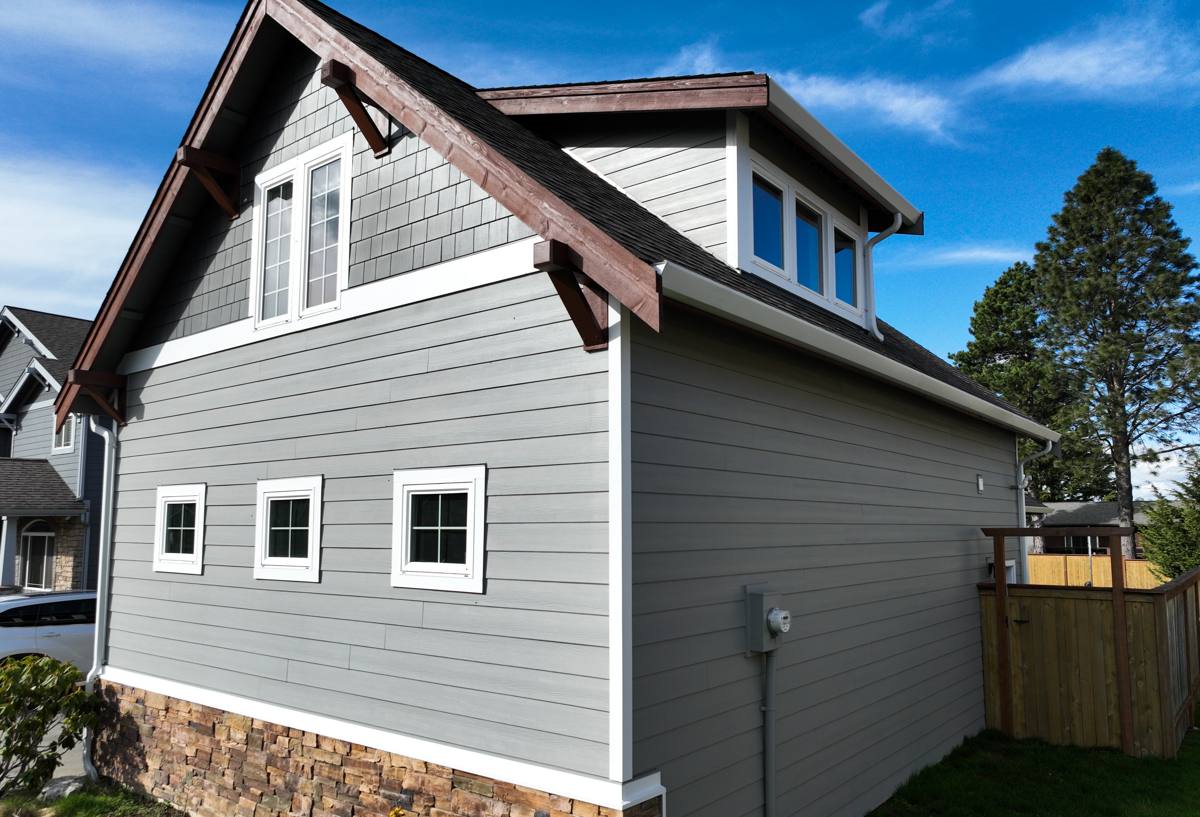
We made a decision as a company to install one siding system: James Hardie fiber cement, factory-finished with ColorPlus Technology. We don't install vinyl, LP SmartSide, primed spruce, cedar, or other fiber cement brands like Cemplank or Allura. That's not a marketing angle — it's because in this climate, the product a homeowner picks has real consequences ten and twenty years down the road, and we'd rather stand behind one system we trust completely than offer a menu of options with different failure modes.
What Makes Hardie the Right Call Here
- Non-combustible core — fiber cement doesn't feed a fire the way wood-based products can.
- Moisture behavior — Hardie's cement composition doesn't swell, rot, or delaminate the way wood-fiber siding can when it takes on water at cut edges or joints.
- Factory-applied ColorPlus finish — baked-on color that resists fading and chalking better than field-applied paint, which matters when salt air is accelerating finish wear.
- HZ5 engineering — Hardie's HZ5 product line is formulated for harsher, wetter climate zones, which fits the Pacific Northwest coast better than a generic all-climate formulation.
- Transferable warranty — a real, documented warranty that follows the house if it sells, backed by a large manufacturer rather than a regional mill.
We're not going to tell you competing products are junk — vinyl is cheap and low-maintenance in the right setting, and engineered wood siding has genuine fans. But on a bluff-top or waterfront lot in this county, we've made the call that those trade-offs aren't worth it, and we'd rather be honest about that upfront than sell a homeowner something we don't believe will hold up.
How Correct Installation Matters as Much as the Product
Fiber cement performs the way it's supposed to only when it's installed to Hardie's published specifications — and on an exposed site like Cap Sante, the installation details matter more than usual.
- Proper clearance from grade, decks, and roof lines so water has somewhere to go
- Correct fastener spacing and type — stainless or hot-dip galvanized fasteners matter more near salt air
- Rain screen or drainage plane behind the siding where the wall assembly calls for it
- Sealed and flashed butt joints, corners, and penetrations — the exact spots wind-driven rain finds first
- Factory-cut edges kept intact wherever possible, with cut edges properly sealed and primed on site
A Hardie board installed with shortcuts on these details can still develop problems. That's a big part of why we treat the installation crew as just as important as the material choice.
Comparing Siding Options for a Cap Sante Home
| Factor | Vinyl | LP SmartSide / Engineered Wood | James Hardie Fiber Cement |
|---|---|---|---|
| Salt air / coastal exposure | Can become brittle over time; seams are a weak point | Wood-fiber core vulnerable to moisture at cut edges and seams | Engineered for HZ5 coastal/wet-climate performance |
| Wind-driven rain | Depends heavily on installation and caulking upkeep | Swelling risk if water gets behind or into edges | Dense cement composition resists moisture intrusion |
| Fire resistance | Can soften/melt near heat sources | Combustible wood-fiber core | Non-combustible core |
| Finish longevity | Color can fade; not repaintable in the same way | Relies on field or factory paint upkeep | Factory-baked ColorPlus finish, long fade resistance |
| Typical warranty | Varies widely by manufacturer/grade | Manufacturer-specific, often shorter | Long, transferable manufacturer warranty |
Roofing, Windows, and Decks: The Same Exposure Applies
Siding isn't the only thing taking a beating on a Cap Sante lot. We do roofing, window replacement, and deck work in the same area, and the same climate logic applies across all of it:
Roofing
Wind uplift and driving rain make proper flashing, underlayment, and fastening critical on an exposed roof plane. A roof that's slightly under-detailed inland can leak on a windward slope near the water.
Windows
Old or poorly flashed windows are one of the most common sources of hidden water intrusion we find behind siding on coastal homes. Replacing failing windows at the same time as siding is often the more efficient path, since the wall gets opened up either way.
Decks
Decks facing the water take direct sun, salt air, and rain with very little protection. Fastener choice and board spacing for drainage matter more here than on a sheltered inland deck.
Because we handle all four trades, we can look at a Cap Sante home as one exterior system instead of four separate contractors each optimizing their own piece.
What to Expect From a Local Crew
A crew that works Anacortes and Skagit County regularly has already seen how homes in exposed waterfront settings age over time — what fails first, what holds up, and where the previous installation likely cut corners. That local pattern recognition is worth something when we're diagnosing an existing problem or planning a new install, and it's part of why we keep our work inside this region rather than spreading thin across unfamiliar markets.
A Practical Pre-Project Checklist for Cap Sante Homeowners
- Note which walls face the water or prevailing wind — those get the closest inspection
- Check for chalking, fading, or soft spots near ground level and around window trim
- Look at north- and east-facing walls for moss buildup or slow-drying dampness
- Ask any contractor bidding the job what fastener type they use near salt air
- Confirm in writing whether siding, trim, flashing, and paint/finish are all under warranty, and for how long
Cost Factors Worth Understanding Upfront
Every Cap Sante home is different, but a few factors consistently move the price of a siding project up or down: how much of the existing wall assembly needs repair before new siding goes on, how much trim and detail work the home has, access and staging on a sloped or view lot, and whether windows or roofing are being addressed in the same project. We'll walk through all of that plainly during an estimate — no inflated numbers, no lowball bid that turns into surprise change orders once the walls are open.
Get a Straight Answer for Your Home
If you're dealing with tired, failing, or aging siding on a Cap Sante property, or you're planning ahead before the next wet season hits, we're happy to take a look and give you an honest read on what's going on and what it would take to fix it right. There's no pressure and no obligation — just fill out the form below for a free estimate.