 Anacortes Siding
 Cap Sante Siding Works Harder Than Siding Almost Anywhere Else in Anacortes
Cap Sante sits right where Fidalgo Bay meets the Guemes Channel, and that location is exactly what makes it beautiful and exactly what makes it hard on exterior siding. Homes up on the bluff and down near the marina take a combination of salt-laden air, wind-driven rain, and shaded, damp corners that most inland Skagit County neighborhoods simply don't deal with to the same degree. Siding here doesn't fail because it's old. It fails because the environment finds every small gap, seam, and weak point faster than it would anywhere else in town.
That's the context behind every repair call we take in this part of Anacortes. Before we talk about fixing anything, it helps to understand what's actually working against the siding on your house.
Salt air off the water
Airborne salt is corrosive to fasteners, trim flashing, and any exposed metal components tied into a siding system. On homes closer to the water, we regularly see accelerated corrosion on nails, hidden fasteners, and flashing where a home a mile inland would still look fine. Salt exposure doesn't rot wood or fiber cement by itself, but it accelerates the failure of the metal and caulking details that keep water out in the first place, which is often where a "small" repair need actually starts.
Driving rain and wind exposure
Cap Sante's elevation and exposure to the water mean rain rarely falls straight down here. Wind-driven rain gets pushed sideways into seams, laps, and butt joints that were never designed to take water head-on. Over years, that pattern finds every place where caulking has shrunk, where a nail has backed out slightly, or where a joint wasn't lapped correctly during the original install. The damage shows up as a small stain or a soft spot long before anyone notices a problem from the ground.
A long moss season
Shaded north- and east-facing walls, tree cover, and the persistent damp common to this part of Skagit County add up to a moss and algae season that runs much longer here than in drier parts of Washington. Moss holds moisture directly against the siding surface for extended periods, which is hard on any material, but especially hard on siding that already has a compromised seam, gap, or coating failure underneath the growth.
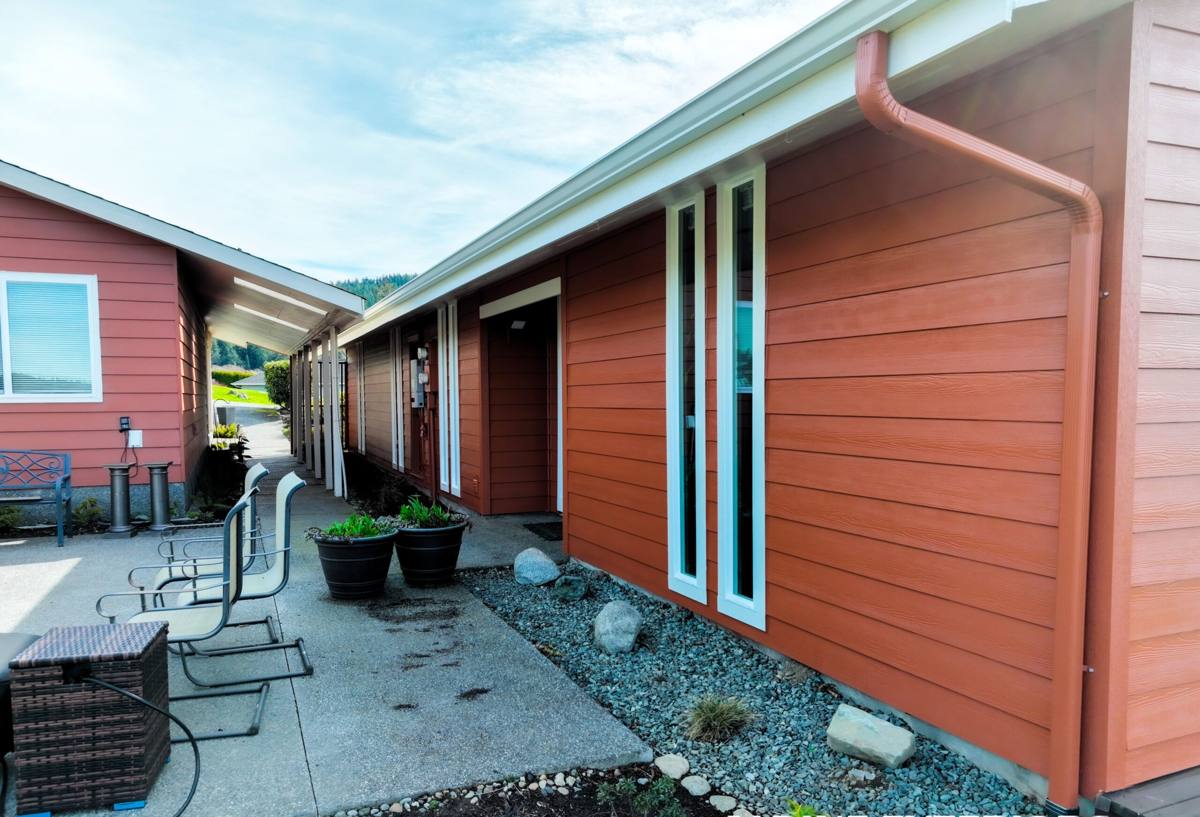
Signs Your Siding Needs Repair, Not Just a Cleaning
A lot of Cap Sante homeowners call us thinking they need a pressure wash or a repaint, when what they're actually looking at is a repair need. Here's what tells the difference:
- Soft or spongy spots when you press on the siding, especially near the bottom courses or around window and door trim
- Visible gaps at seams or corners that weren't there when the siding was newer
- Persistent staining or dark streaking that comes back shortly after cleaning
- Paint or coating that's bubbling, peeling, or separating from the surface rather than just fading
- Moss or algae that keeps returning to the same section of wall every year
- Fastener heads that are rusting, staining, or backing out of the surface
- Any section that feels noticeably colder or damper to the touch than the surrounding wall
Any one of these on its own might be minor. Several of them together, especially on a wall that faces the water or sits in constant shade, usually means moisture has already gotten past the surface.
What a Correct Siding Repair Actually Involves
A repair that's done right is not just cutting out a bad board and nailing in a new one. In a climate like Cap Sante's, a repair that skips the diagnosis step tends to fail again within a season or two.
Finding the actual cause, not just the symptom
Damaged siding is usually a symptom of a water path problem somewhere else: a failed flashing detail, a caulk joint that gave out, a fastener that's no longer sealing its hole, or a grade or gutter issue pushing water back at the wall. Replacing the visible damaged section without addressing what let water in will just move the problem a few feet over and a year or two down the road.
Checking what's happening behind the siding
Once siding has been wet for a while, the question becomes whether the sheathing, house wrap, or framing behind it has also taken on moisture. This is the step that gets skipped most often on a rushed repair, and it's the one that matters most in a wet coastal environment where hidden moisture doesn't dry out quickly on its own.
Matching materials and finish correctly
A patch that doesn't match the surrounding siding's profile, reveal, or color stands out immediately, and a mismatched material at a repair seam can actually create a new water entry point. Correct repair work respects the original lines of the house and ties in cleanly, both in appearance and in how water is shed at the new joint.
Repair or Replace? How We Help Cap Sante Homeowners Decide
Not every damaged section needs to become a full re-side, and not every repair is worth doing on siding that's already at the end of its useful life. We look at a few honest factors before recommending either path:
| Factor | Leans Toward Repair | Leans Toward Replacement |
|---|---|---|
| Extent of damage | Isolated to one or two sections or walls | Showing up across multiple walls or elevations |
| Underlying moisture | Surface-level, sheathing tests dry | Sheathing or framing shows sustained moisture |
| Age of existing siding | Mid-life, otherwise sound | Near or past its expected service life |
| Material on the house now | Fiber cement in good condition elsewhere | Wood, vinyl, or aging composite showing wear broadly |
| Cost of repair vs. remaining life | Repair cost is a small fraction of replacement | Repair cost starts approaching a meaningful share of a full re-side |
We'll tell you plainly which side of that table your home falls on. If a targeted repair will genuinely hold up in a Cap Sante-facing wall, that's what we recommend. If the damage is a sign the whole system is failing, we'll say that too rather than patching something that needs a real fix.
Our Process for a Cap Sante Siding Repair
- On-site inspection. We look at the damaged area and the surrounding wall, not just the spot you called about, since related problems are common on homes with this kind of exposure.
- Moisture check. We check whether water has traveled behind the siding and how far, since that determines the real scope of the repair.
- Scope and honest recommendation. You get a clear explanation of what needs to happen, why, and what it will cost, before any work starts.
- Correcting the water path. Flashing, caulking, and fastening details get fixed as part of the repair, not left as an afterthought.
- Repair and finish match. New material is installed to match the existing siding's profile and reveal, with finish work that blends into the wall rather than standing out as an obvious patch.
- Final walk-through. We show you exactly what was done and why, and flag anything else on the home worth keeping an eye on.
Where James Hardie Fits Into a Repair Job
We install James Hardie fiber cement exclusively, and that shapes how we approach repairs, too. If your home already has Hardie siding, repairs are usually straightforward: fiber cement doesn't rot, doesn't attract insects, and holds its ColorPlus factory finish well, so a properly matched repair section blends in and performs the same as the surrounding wall for years to come.
If your home currently has wood, vinyl, or another composite siding, we'll still repair what's there and be straight with you about it. But we won't pretend those materials handle Cap Sante's combination of salt air, driving rain, and moss the same way fiber cement does. Wood siding is the most vulnerable to sustained moisture and rot in this environment. Vinyl can warp or become brittle with age and temperature swings, and its seams are a common weak point for wind-driven rain. When a home reaches the point where repairs are becoming frequent rather than occasional, we'll tell you that honestly, and we'll explain why fiber cement is what we'd put on the house instead, not because it's the only thing we sell, but because it's genuinely the better match for this coastline.
Why Hiring a Crew That Already Works in Cap Sante Matters
Siding repair advice that's correct for a dry inland neighborhood isn't always correct here. A crew that regularly works homes near the water in Anacortes already knows which walls take the worst of the wind-driven rain, which details tend to fail first in salt air, and how long moss actually sits on a shaded wall before it becomes a moisture problem rather than a cosmetic one. That local pattern recognition is the difference between a repair that's cosmetic and one that actually holds up through another wet Skagit County winter.
It also matters for something more practical: a crew that already knows the area can usually get eyes on a problem faster, gives you a straighter answer about whether it's urgent, and isn't guessing at how this specific stretch of coastline behaves.
Keeping Cap Sante Siding in Shape After a Repair
A good repair buys you years, but a few simple habits stretch that further in this climate:
- Rinse salt residue and moss off shaded or water-facing walls a couple of times a year
- Keep gutters clear so water isn't overflowing and running down the siding face
- Trim back vegetation that's keeping any wall shaded and damp longer than it needs to be
- Recaulk trim and joint lines proactively rather than waiting for a visible gap
- Walk the exterior after major windstorms and check for anything that looks freshly loose or displaced
- Have any soft spot or recurring stain looked at promptly rather than waiting for it to spread
None of this requires special equipment or a big time commitment. It's mostly about catching small things before this environment turns them into bigger ones.
If you're seeing any of the signs above on a Cap Sante home, or you just want an honest opinion on whether it's a repair or something bigger, we're happy to take a look. Reach out for a free, no-pressure estimate using the form below.