 Anacortes Siding
 Deck Replacement in Sedro-Woolley: A Skagit Valley Problem
Sedro-Woolley sits inland from Anacortes, at the point where the flat farmland of the Skagit Valley starts climbing into the foothills of the North Cascades. That setting gives the town a different weather pattern than the coastal parts of the county, but not an easier one. Storms moving in off Puget Sound get funneled and intensified as they push up the valley, humidity lingers longer between rain events than it does in more open, breezier spots, and salt-laden air off the Sound still reaches this far inland on the windier weather systems that roll through several times a year. Add a moss season that runs most of the year and a decent amount of freeze-thaw cycling from the nearby foothills, and you have a climate that's genuinely hard on an outdoor wood or composite structure — even though it doesn't look like a "coastal" climate on paper.
A deck takes that punishment directly. It has no roof, no siding, and no wall cavity to buffer it — it's a structure built to sit outside in exactly the conditions that wear exterior work down fastest. When a deck in Sedro-Woolley starts failing, it's rarely one thing going wrong. It's usually years of moisture, moss, and freeze-thaw cycling working on a structure that either wasn't built for this specific climate or has simply reached the end of what any deck can take. This page covers what a full deck replacement actually involves here, how to tell when replacement is the right call instead of another round of repairs, and how our process works for a Sedro-Woolley project specifically.
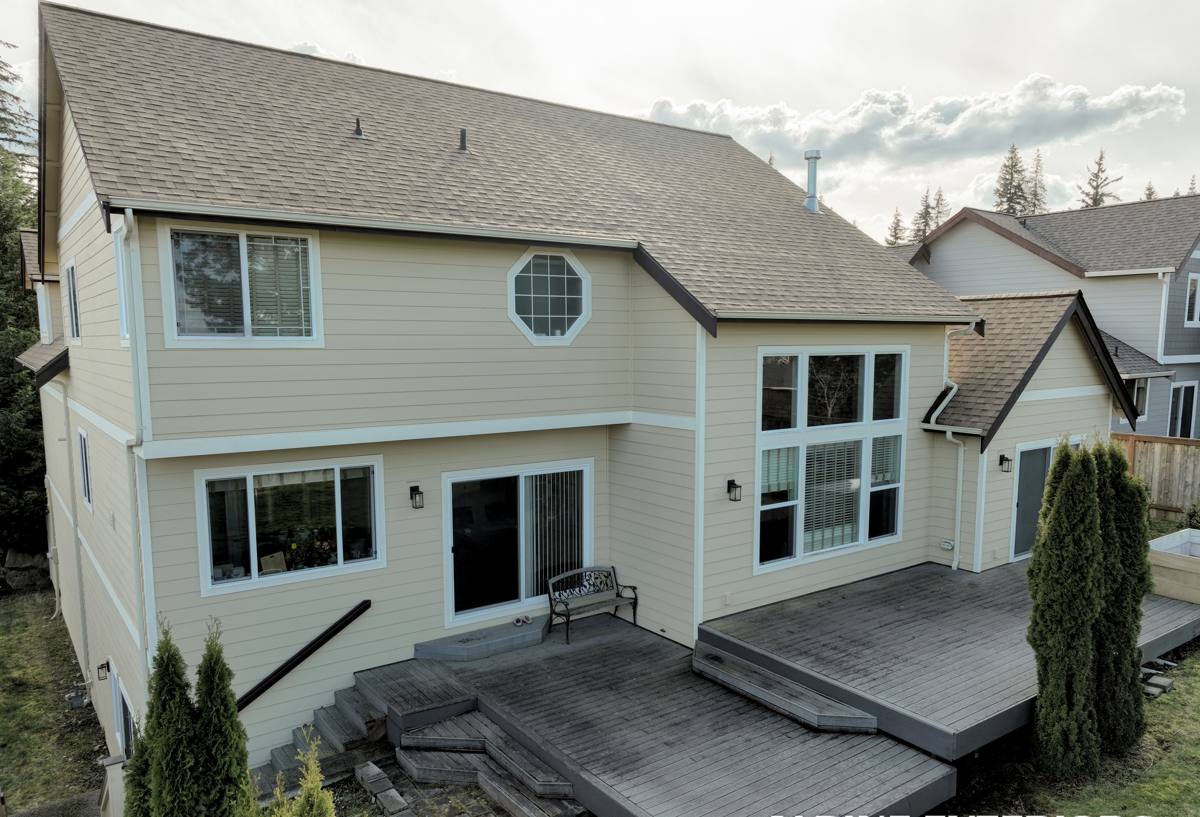
What This Valley Climate Does to an Aging Deck
Driving Rain Funneled Up the Valley
Weather systems coming off Puget Sound often get compressed and pushed harder as they move up the Skagit Valley, and Sedro-Woolley catches a real share of that driving rain. Wind-driven rain doesn't fall straight down — it gets forced sideways into railing joints, under ledger connections, and between deck boards that have lost their gap over the years to swelling, sagging, or old age. An aging deck that handled light rain fine for a decade can start taking on water fast once boards cup, fasteners loosen, or flashing at the house connection starts failing.
A Moss Season That Runs Most of the Year
Mild temperatures, filtered shade from surrounding trees, and near-constant valley moisture add up to a moss and mildew season that barely lets up here. A horizontal deck surface holds water longer than a vertical wall does, which makes it one of the first places moss and algae take hold — especially on north-facing decks or ones tucked under tree cover. Once moss establishes, it holds moisture against the boards underneath it, which speeds up whatever rot or fastener corrosion was already starting.
Salt Air's Reach Up the Valley
Sedro-Woolley isn't a waterfront town, but Skagit County's salt-laden air off Puget Sound still travels up the valley on windier weather patterns, adding a low but steady corrosion load to exposed fasteners, brackets, and railing hardware over the years. It's a smaller factor here than it would be on a deck in Anacortes itself or another coastal Skagit County spot, but it adds up on a structure that's already dealing with sustained moisture — and it's one more reason generic, big-box fastener hardware tends to underperform here over time.
Freeze-Thaw From the Foothills
Sedro-Woolley's proximity to the foothills means slightly cooler overnight temperatures and more freeze-thaw cycling in winter than towns closer to the Sound. Wood and some composite materials that have absorbed moisture are prone to cracking, splitting, and surface breakdown when that moisture freezes and expands repeatedly through the winter. It's a slow process — the kind that's easy to miss year to year until a board or joist that looked fine last spring is visibly compromised.
Signs Your Deck Has Reached Replacement, Not Repair
Not every deck problem means a full tear-off. A loose board or a cracked baluster can often be repaired on its own. But a handful of signs usually mean the structure as a whole has reached the end of its service life, and repairing piece by piece is just delaying a bigger, more expensive failure:
- Soft or spongy decking boards in more than one or two isolated spots, especially near the house or at board ends
- Joists or beams that feel soft, spongy, or visibly split when checked from underneath
- Posts that wobble at the base, or railings that have noticeably more give than they used to
- Persistent moss or dark staining that returns within weeks of cleaning, no matter how often it's washed
- Visible gaps, separation, or staining at the ledger board where the deck attaches to the house
- Fasteners that are rusted, backing out, or leaving rust streaks down the boards
- A deck that's more than 20-25 years old and has never had the substructure inspected or replaced
Any one of these on its own might just call for a repair. Several of them together, especially involving the framing or ledger connection, generally mean the deck needs to come off and be rebuilt from the substructure up.
Choosing the Right Decking Material for a Replacement Here
Once a deck comes off, material choice matters more in a climate like Sedro-Woolley's than it would in a drier, more sheltered location, because the gap in performance between a well-suited product and a poorly-suited one shows up faster here. The three categories most homeowners weigh are pressure-treated or cedar wood, capped composite, and cellular PVC.
Wood
Pressure-treated lumber and cedar are the traditional choice and look good when new, but both need regular sealing or staining to hold up against sustained valley moisture, and both are more vulnerable to fastener corrosion over time. Left unmaintained even a season or two, wood decking in this climate is usually the first material to show moss, graying, and soft spots.
Capped Composite
Capped composite boards have a plastic shell around a wood-fiber composite core, which resists moisture absorption, staining, and fade far better than uncapped composite or wood. In a moisture-heavy, moss-prone climate like Sedro-Woolley's, that cap layer is doing real work — it's the difference between a deck that needs occasional washing and one that needs ongoing sealing to stay ahead of the weather.
Cellular PVC
PVC decking contains no wood fiber at all, so it doesn't absorb moisture the way even capped composite can at cut edges or fastener holes. It typically costs more than composite and can flex more under heavy point loads, but for a shaded, slow-drying deck location, some homeowners find the added moisture resistance worth the extra cost.
| Material | Handling Valley Moisture | Moss Resistance | Upkeep |
|---|---|---|---|
| Cellular PVC | Excellent — no wood fiber to absorb moisture | Strong, smooth non-porous surface | Occasional washing |
| Capped composite | Strong — cap layer resists moisture and staining | Good on most lines | Occasional washing |
| Uncapped composite | Moderate — some moisture absorption at exposed fiber | Fair; more prone to buildup over time | Periodic cleaning |
| Cedar | Moderate — natural resistance, but needs sealing | Fair when sealed and maintained | Regular oiling or sealing |
| Pressure-treated wood | Weak against sustained valley moisture over time | Poor without regular treatment | Regular sealing or staining |
What a Correct Deck Replacement Involves
The new decking surface gets most of the attention when homeowners picture a replacement, but in this valley climate, the framing, fasteners, and drainage details underneath are what actually determine how long the rebuild lasts. A replacement done right for a Sedro-Woolley home includes:
- Removing the old decking, railing, and as much of the substructure as shows any sign of moisture damage, rather than reusing questionable framing to save time
- Framing material rated for sustained moisture exposure, sized correctly for the actual span and load
- Corrosion-resistant fasteners throughout — this valley's combination of moisture and periodic salt-laden air is hard enough on standard hardware that it's worth spending the extra on fasteners rated for it
- Correct board gapping for drainage and material movement, so rain and condensation can actually drain and dry between boards instead of sitting
- New ledger board flashing where the deck ties into the house — this connection point is one of the most common places we find hidden moisture damage on a failed deck
- Joist spacing matched to the specific decking product's span rating rather than reused from the old deck's layout
- Footings and post bases checked for movement, rot, or inadequate depth, and corrected as part of the rebuild rather than left as-is
- Grading and ventilation underneath the new deck so moisture doesn't sit against the framing between storms
How Our Replacement Process Works
Inspection First, Estimate Second
Before we quote anything, we get underneath and around the existing deck to see what's actually happening structurally — soft framing, ledger condition, footing stability, and how much of the substructure is salvageable versus what needs to come out. In Sedro-Woolley specifically, we pay close attention to shaded, tree-adjacent decks and any structure over 15-20 years old, since that's where we most often find substructure damage that isn't visible from the walking surface.
Full Tear-Off, Not a Partial Patch
Once we've confirmed replacement is the right call, we remove the old decking, railing, and any compromised framing down to sound structure. Covering questionable framing with new decking is the single most common shortcut in low-bid deck work, and it's the reason a lot of "new" decks fail again within a handful of years.
Rebuilding the Structure
New framing goes in sized and fastened for this valley's actual moisture and freeze-thaw exposure, with corrected ledger flashing and footing work where needed. This is the stage that determines whether the deck lasts 10 years or 30, regardless of what decking material sits on top.
Decking, Railing, and Finish
With the structure sound, we install the decking material you've chosen, along with railing, stairs, and any trim work, following the manufacturer's spacing and fastening specs for that specific product.
Walkthrough and Care Guidance
We finish with a walkthrough covering what your specific decking material actually needs going forward — for most modern composite and PVC products that's minimal, but not nothing, and we'd rather be straightforward about it up front than have you find out the hard way.
Cost Factors for a Sedro-Woolley Deck Replacement
We don't post fixed prices because every deck and every house is different, but the variables that move the number on a replacement project here are consistent from job to job:
- Total deck size and complexity — multiple levels, stairs, and custom railing all add labor
- How much of the existing substructure is damaged and needs replacing versus how much is sound
- Decking material chosen — wood, capped composite, and cellular PVC carry different upfront costs
- Footing condition, and whether footings need to be added, deepened, or repaired to current standards
- Ledger and house-connection repairs, if water has gotten into the wall framing behind the old ledger board
- Site access, which varies a lot on the more rural, tree-covered lots common around Sedro-Woolley
Why It Matters That We Already Work Sedro-Woolley
A crew based on the coast can still put together a competent deck, but a Sedro-Woolley replacement has variables that don't come up the same way in Anacortes itself — valley humidity that lingers longer between storms, freeze-thaw cycling tied to the foothills, and a moss season that runs long on shaded, tree-covered lots common in this part of the county. Working this area regularly, alongside our coastal jobs, means we're not guessing at those differences on your project. We've seen which decking materials and fastener grades actually hold up to Sedro-Woolley's specific mix of valley moisture and freeze-thaw, and which shortcuts show up as a soft joist or a failing ledger a few winters down the road.
That familiarity also shows up in smaller judgment calls — how to grade and vent a substructure on a shaded, slow-drying lot, or giving you a straight answer about whether your existing deck genuinely needs full replacement or just a targeted repair, rather than defaulting to the bigger job.
Get a Free, No-Pressure Estimate
If your deck in Sedro-Woolley is showing soft boards, a shaky railing, or moss that keeps coming back no matter how often you clean it, we're glad to take a look underneath and give you a straight read on whether it needs replacement or just repair. Use the form below to schedule a free, no-pressure estimate.