 Anacortes Siding
 Flounder Bay's Exposure Is Not Average
Flounder Bay sits on the water side of Fidalgo Island, and homes here take on a combination of stresses that inland Anacortes and Skagit County properties simply don't see as often. Salt-laden air off Rosario Strait works its way into fasteners, trim joints, and any gap in a moisture barrier. Wind-driven rain off the water doesn't just fall on siding — it gets pushed sideways into laps, corners, and butt joints that a calmer climate would never test. And the long, damp shoulder seasons common to this part of Washington keep north-facing and shaded wall sections wet enough, long enough, for moss and algae to take hold and stay there for months.
None of this makes siding replacement in Flounder Bay impossible — it just changes what "correct" means. A siding job that would hold up fine in a dry inland neighborhood can fail early here if the water management details are skipped. That's the lens we use on every estimate we write for this area: what does this specific wall, on this specific exposure, need to actually last?
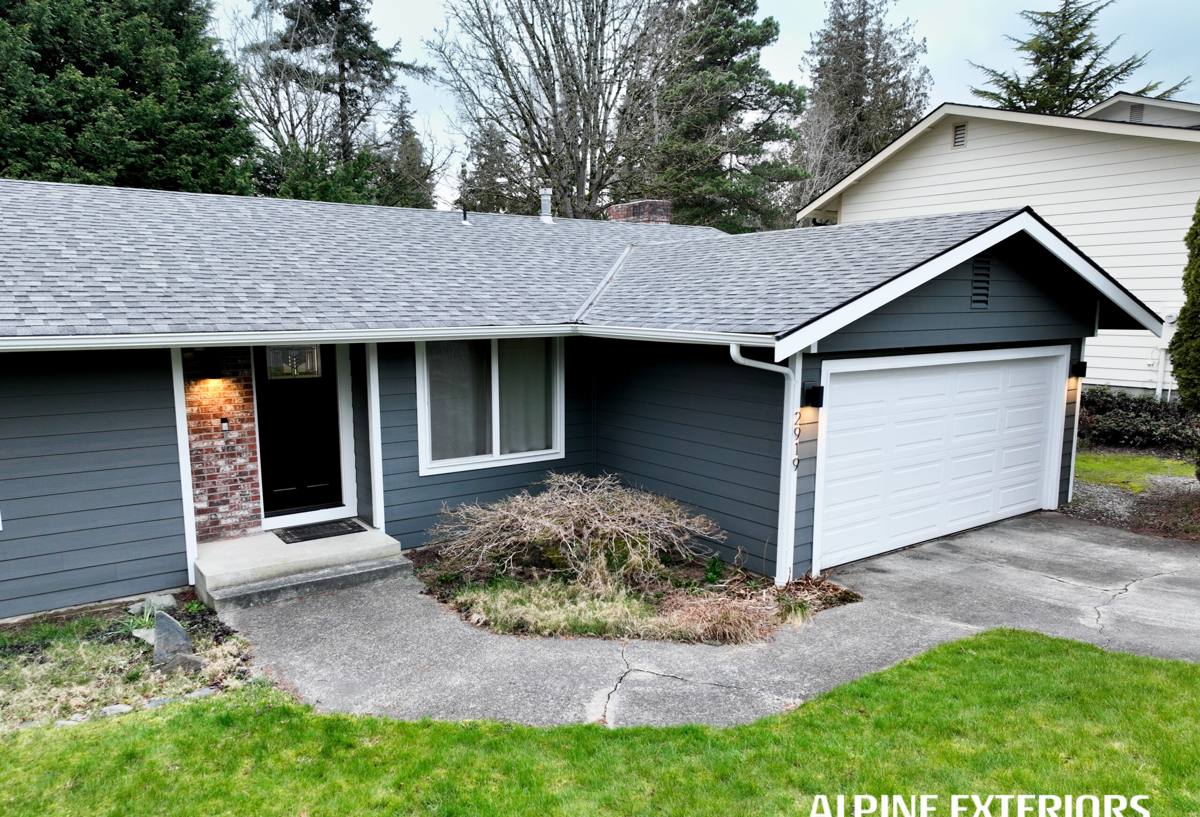
Where Siding Fails First on Waterfront Exposures
Before we talk about products, it helps to know what actually goes wrong on homes near the water. We see the same failure patterns repeat:
- Fastener corrosion where salt air reaches exposed nail heads or lower-grade hardware
- Moisture trapped behind siding with no functioning drainage plane, leading to sheathing rot
- Caulk-dependent joints that were never properly flashed, so they fail once the sealant ages
- Moss and algae holding constant moisture against the siding face on shaded or north walls
- Paint or coating breakdown from repeated wet-dry cycling, especially on south and west faces that also get sun
Most of these aren't material defects — they're installation shortcuts that don't show up as a problem for a few years, then show up all at once as a rot repair.
What a Correct Replacement Involves
Replacing siding on a Flounder Bay home is a full building-envelope job, not a cosmetic swap. Done right, it includes:
Full tear-off and sheathing inspection
We remove the old siding down to the sheathing so we can actually look at the wall — not guess at its condition from the outside. Any rot or soft sheathing gets addressed before anything new goes up. Covering over a compromised wall with new siding just hides the problem for another few years.
A continuous, correctly lapped water-resistive barrier
Every seam, penetration, and window opening gets flashed and lapped so water is directed out and down, not trapped behind the cladding. On a wind-driven-rain exposure like Flounder Bay, this layer does more long-term work than the siding itself.
A drainage gap where the wall assembly calls for it
Allowing any incidental moisture that gets behind the siding to drain and dry, rather than sit against the back of the board, matters more here than it does further inland.
Manufacturer-spec fastening and clearances
Corrosion-resistant fasteners, correct nailing patterns, and proper clearance from grade, decks, and roof lines — all details that either protect a warranty or void it.
Why We Install Only James Hardie Fiber Cement
We get asked why we don't offer vinyl, LP SmartSide, or cedar alongside Hardie. It's a fair question, and the honest answer is about trade-offs, not knocking those products.
Vinyl is inexpensive and low-maintenance in mild conditions, but it's a petroleum-based product that expands and contracts with temperature and can become brittle over time — not the first choice for a wind-exposed waterfront wall where impact resistance and long-term dimensional stability matter. Wood-based products like LP SmartSide use engineered wood with a resin-treated strand core; it performs well when the finish and caulking are maintained on schedule, but any breach in that finish lets moisture into a wood-based substrate, which is exactly the failure mode a salt-air, high-moisture site should be designed to avoid. Cedar is a beautiful, genuinely traditional material, but it's a natural product that needs ongoing staining or sealing, and in a climate this wet it asks for more upkeep than most owners want to sign up for.
James Hardie fiber cement is cement, sand, and cellulose fiber — non-combustible, dimensionally stable, and not a food source for moss or rot organisms the way wood-based siding can be. Its factory-applied ColorPlus finish is baked on under controlled conditions, which gives it more consistent, longer-lasting color performance than field-applied paint. That combination is why we standardized on it rather than carrying multiple product lines.
HardieZone Engineering and Why It Matters Here
James Hardie engineers its products by climate zone (HZ5 and HZ10), adjusting the formulation for moisture exposure and freeze-thaw behavior in the region it's shipped to. Western Washington, including Fidalgo Island and Skagit County, falls into a wet marine climate zone, and the product we install is manufactured for exactly that condition — not a generic national blend.
For Flounder Bay specifically, we typically discuss:
- HardiePlank lap siding — the standard for most single-family homes, available in several exposure widths and a range of ColorPlus finishes
- HardieShingle — for accent areas or a more traditional coastal look, without the maintenance burden of real cedar shingle
- HardieTrim — matched trim boards so corners, fascia, and window surrounds age at the same rate as the field siding
Color choice matters on a waterfront lot too — homes with more direct sun and reflected light off the water show fading and dirt differently than a shaded inland lot, and we factor that into color recommendations, not just aesthetics.
Comparing the Options Homeowners Actually Weigh
| Factor | Vinyl | Wood-Based (LP/Cedar) | James Hardie Fiber Cement |
|---|---|---|---|
| Moisture tolerance | Fair — can warp with heat/cold cycling | Depends heavily on finish maintenance | Strong — cement-based, not wood |
| Salt air / corrosion resistance | Good on the panel, fasteners still a concern | Moderate — finish protects the substrate | Good with correct corrosion-resistant fasteners |
| Moss/algae resistance | Surface growth possible, easy to clean | Can hold moisture if growth isn't cleaned | Resists moisture absorption into the board |
| Maintenance | Low | Higher — periodic refinishing | Low — factory finish, occasional wash |
| Fire performance | Combustible | Combustible | Non-combustible |
| Typical warranty structure | Varies by manufacturer | Varies by manufacturer | Long-term, transferable limited warranty |
Our Process for a Flounder Bay Project
The steps don't change from house to house, but the details we pay attention to shift based on exposure:
- On-site assessment — we look at wind and rain exposure by elevation, existing moisture damage, and shaded/moss-prone areas specific to your lot
- Written estimate — scope, product selection, and a clear breakdown, not a vague allowance
- Tear-off and sheathing check — old siding removed, substrate inspected and repaired as needed
- Water management installed first — barrier, flashing, and drainage details before a single piece of Hardie goes up
- Hardie installation to manufacturer spec — correct fasteners, clearances, and fastening patterns for your HardieZone
- Final walkthrough — we go over what was done and what routine care looks like for your specific exposure
Choosing a Contractor for This Kind of Site
Waterfront and near-waterfront exposures punish shortcuts faster than inland lots do, so vetting matters more here, not less. Before hiring anyone for a Flounder Bay siding job, it's worth asking:
- Do they inspect and repair sheathing, or just re-side over what's there?
- Can they explain their water-resistive barrier and flashing approach in plain language?
- Are they a registered, licensed, insured contractor in Washington?
- Do they install to the manufacturer's published fastening and clearance specs, and will that be in writing?
- Have they worked on other homes in this specific exposure — wind-driven rain off the water, not just general Skagit County jobs?
Living With Moss Season After the Job Is Done
Even correctly installed siding benefits from a little seasonal attention on a site like this. A yearly rinse of shaded and north-facing walls before moss gets established, keeping gutters clear so overflow doesn't run down the wall face, and trimming back vegetation that holds moisture against the siding all go a long way toward protecting the finish. Hardie's factory finish and cement-based composition make this upkeep far lighter than it would be with a wood-based product, but "low-maintenance" isn't "no-maintenance," especially this close to the water.
If you're weighing a siding replacement on a Flounder Bay home, we're happy to walk the exterior with you, talk through what your specific exposure needs, and put together a clear, no-pressure estimate — just fill out the form below to get started.