 Anacortes Siding
 West Anacortes: A Different Set of Exterior Demands
Homes on the west side of Anacortes sit close to the water, and that proximity shapes everything about how a house exterior ages. Fidalgo Island catches wind and moisture off the Salish Sea from multiple directions, and West Anacortes properties often take the brunt of it — salt-laden air, sideways rain during winter storms, and long stretches of shade and dampness that keep moss and algae active for most of the year. A siding product that performs fine forty miles inland in the Skagit Valley can behave very differently a few blocks from saltwater.
We work throughout Anacortes and Skagit County, but West Anacortes gets its own conversation because the failure patterns we see there are consistent: paint that chalks and peels early, caulking that gives out at seams, fastener corrosion, and moss creeping up from the bottom courses of siding that never fully dries out between rain events. None of that is unusual for the area — it's just what marine exposure does to an exterior over time. The question is which materials and installation choices hold up to it, and which ones just delay the problem.
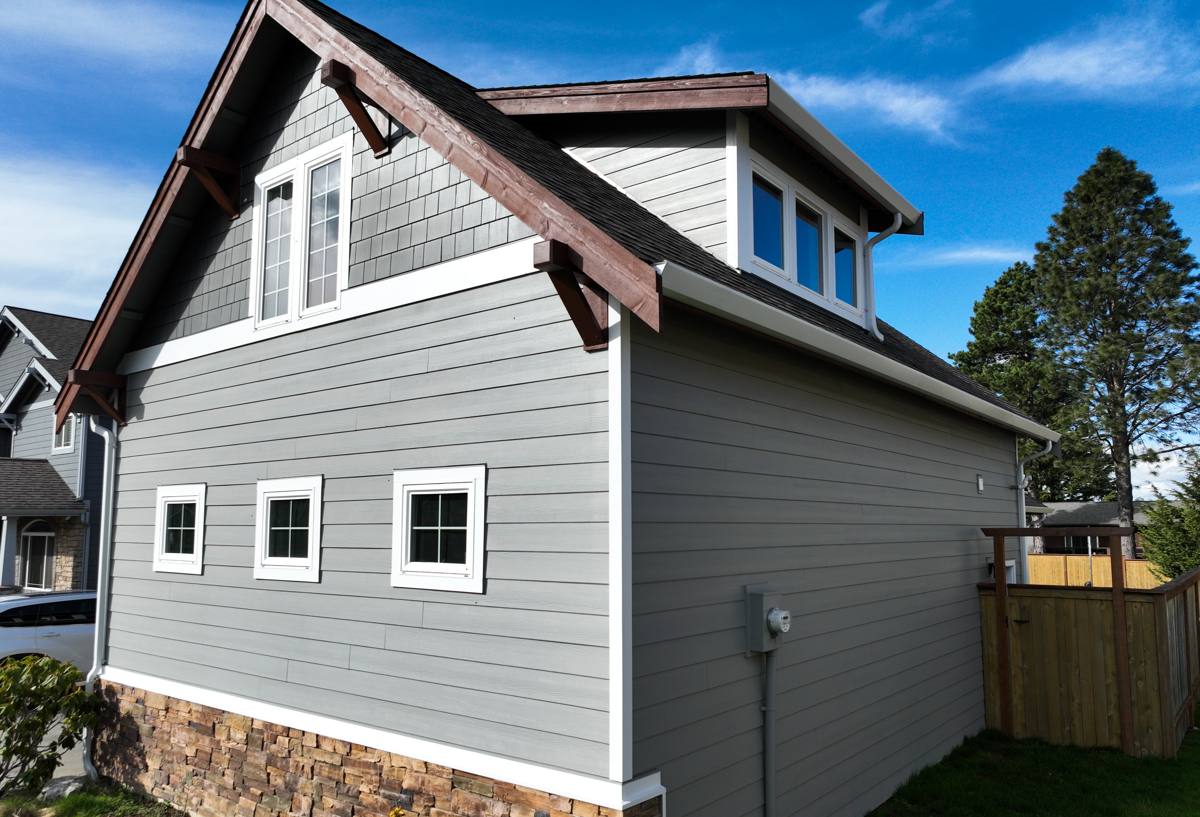
What Marine Exposure Actually Does to a House
Salt Air and Metal Fasteners
Airborne salt accelerates corrosion on anything metal — nail heads, flashing, trim fasteners, even some vinyl siding hardware. Over years, corroding fasteners can streak siding, loosen panels, and create small gaps where water gets behind the cladding. It's a slow process, which is exactly why it's easy to underestimate when a siding job is first bid.
Driving Rain and Wind-Driven Moisture
West-facing and water-facing walls in this part of Anacortes take rain almost horizontally during winter fronts. That kind of exposure tests lap siding at every horizontal seam, every window and door transition, and every inside corner. A house wrapped and flashed correctly sheds that water. A house with shortcuts in the water-resistive barrier or flashing details will show it — usually as staining, soft trim, or interior moisture problems that show up long after the siding was installed.
Moss, Algae, and Shaded Walls
Anacortes' long moss season isn't unique to any one neighborhood, but shaded, north- and west-facing walls in West Anacortes — especially under mature trees or close to neighboring structures — stay damp longer between dry spells. Moss and algae growth on siding is mostly cosmetic, but it holds moisture against the surface and, on wood-based products, can contribute to softening and rot at the areas it colonizes.
How We Approach Exterior Work Here
We handle siding, roofing, windows, and decks as connected systems rather than separate trades, because on a coastal property they behave as one envelope. A roof that sheds water poorly will overload the siding and trim below it. Windows that aren't flashed to the siding correctly create a leak path no matter how good the cladding is. Decks attached to the house need the same water-management thinking as the wall behind them. When we're on a West Anacortes property, we're looking at how all four systems interact, not just quoting the piece that was asked about.
Siding
This is where we've drawn a firm line on materials, explained below. Installation in this climate means correct water-resistive barrier detailing, proper flashing at every penetration and horizontal transition, and fastening patterns that account for wind exposure.
Roofing
Roof-to-wall flashing, valley work, and ventilation matter more here than in drier inland climates, since a roof that traps moisture underneath it accelerates decking and fascia problems.
Windows
Old aluminum or single-pane windows are common in older Anacortes housing stock and are frequently a bigger source of moisture and heat loss than the siding around them. We flash new windows into the wall assembly as part of an integrated approach, not as a bolt-on afterthought.
Decks
Ledger board attachment and flashing where a deck meets the house is one of the most common hidden rot locations we find on coastal homes. We treat that connection with the same care as any other wall penetration.
Why We Only Install James Hardie Fiber Cement
We get asked regularly why we don't offer vinyl, LP SmartSide, primed wood, or cedar siding alongside Hardie. The honest answer is that we made a standard decision for the climate we work in, not a marketing one. Each of those alternatives has legitimate strengths — vinyl is inexpensive, cedar is genuinely beautiful, LP SmartSide is easier to install in some conditions — but each also carries a trade-off that shows up faster on a marine-exposed, moss-prone property than it would somewhere drier and more sheltered.
James Hardie fiber cement is engineered specifically around moisture, fire, and pest resistance. It doesn't feed fungal growth the way wood-based products can, it won't melt or deform against a hot grill or fire pit spark the way vinyl can, and it holds paint and factory finishes far longer in high-humidity, high-UV, salt-exposed conditions than field-applied paint on wood or composite products does.
ColorPlus Technology
Most of the Hardie siding we install uses the factory-applied ColorPlus finish rather than site-painted product. That finish is baked on in a controlled environment, bonds more consistently than field paint, and is backed by its own finish warranty — which matters in an area where repainting a whole house every several years because of coastal weathering gets expensive fast.
HZ5 Climate-Engineered Formulation
Hardie manufactures its siding in different formulations for different climate zones. Western Washington falls into the HZ5 zone, engineered for wetter, more moisture-active conditions than the product sold in dry inland regions. That's a meaningful distinction — it's not the same board being marketed everywhere with a one-size-fits-all pitch.
Non-Combustible Material
Fiber cement is non-combustible, which is a real consideration given regional wildfire smoke and ember exposure during dry summer stretches, even in a generally wet coastal county like Skagit.
What Correct Hardie Installation Requires
Fiber cement is only as good as its installation. Hardie's own installation instructions are specific, and skipping steps is the most common reason a siding job underperforms — not a flaw in the material itself. On a West Anacortes property, we pay particular attention to:
- Proper water-resistive barrier with correctly lapped and taped seams before any siding goes on
- Flashing at every window, door, and roof-to-wall transition, installed to shed water outward and down
- Minimum clearance between the bottom of the siding and grade, decks, patios, or roofing, so splash-back moisture doesn't sit against the board
- Correct fastener type, spacing, and depth — over- or under-driven nails are a common source of early failure
- Caulking only at the specific joints Hardie's instructions call for, not as a substitute for proper flashing
- Field-cut edges primed and sealed, since exposed raw fiber cement edges are a weak point if left untreated
Comparing Common Siding Choices for a Coastal Property
| Material | Moisture Behavior | Finish Durability | Fire Resistance |
|---|---|---|---|
| James Hardie fiber cement | Engineered resistance to moisture-driven damage; won't rot | Factory ColorPlus finish holds up well in marine, high-UV conditions | Non-combustible |
| Vinyl | Doesn't absorb water itself, but can trap moisture behind it if installed poorly | Color is baked in but can fade and become brittle over time; can warp near heat sources | Combustible; can deform near flame or heat |
| LP SmartSide | Wood-strand core; performs well when sealed and maintained, vulnerable if finish is neglected | Field or factory finish requires ongoing maintenance to prevent moisture entry at cuts and edges | Combustible |
| Cedar / primed spruce | Natural wood; attractive but moisture- and pest-susceptible without diligent upkeep | Requires regular refinishing, especially in shaded, damp locations | Combustible |
None of this means the alternatives are poorly made products — it means each has an upkeep profile that either costs more over time in this specific climate or requires more homeowner diligence than we think is realistic to expect. We'd rather install one product correctly and stand behind it than offer four options and let the climate sort out which ones fail first.
What Drives Project Cost
| Factor | Why It Matters Here |
|---|---|
| Existing wall condition | Hidden rot from prior moisture intrusion, common on older coastal homes, adds repair scope before new siding goes on |
| House shape and trim detail | More corners, dormers, and window openings mean more flashing and cutting labor |
| Siding profile and accessories | Lap width, trim boards, and soffit choices affect material cost and labor time |
| Access and site conditions | Waterfront-adjacent lots, steep grades, or tight setbacks can add staging complexity |
| Scope beyond siding | Bundling roofing, window, or deck work with siding can reduce overlap in labor and staging costs |
We give a firm number after seeing the actual property, not a phone estimate — condition varies too much from house to house in this area to quote responsibly without a look at the walls.
Why a Local Crew Matters
A crew that works Anacortes and Skagit County regularly knows what a West Anacortes wall is up against before the first panel goes up. That means recognizing which walls need extra flashing attention because of prevailing wind and rain direction, understanding how moss and shade patterns on a given lot affect long-term maintenance, and building in the clearances and details that a generic installation crew from outside the region might not think twice about. It also means we're reachable if a warranty question comes up years down the road, not a name on an invoice from a company that moved on to the next county.
Maintenance Expectations After Installation
Even a well-installed Hardie exterior isn't maintenance-free — nothing is, in this climate. Homeowners in West Anacortes should expect to periodically rinse off accumulated salt and organic buildup, keep gutters clear so water isn't overflowing onto siding, and trim back vegetation that's shading walls and keeping them damp longer than necessary. Compared to repainting a wood exterior every few years or replacing warped vinyl panels, that's a modest ask — and it's the same baseline maintenance any exterior in this region needs regardless of material.
If you're planning a siding, roofing, window, or deck project in West Anacortes, we're happy to take a look at your property and walk through what we're seeing and what it would take to address it. There's no pressure and no cost to get a straightforward estimate — just fill out the form below to get started.