 Anacortes Siding
 Why West Anacortes Windows Wear Out Faster Than You'd Expect
West Anacortes sits close to open water, and that changes what a window has to deal with compared to a house a few miles inland in Skagit County. Wind coming off the water carries fine salt spray that settles on glass, frames, and hardware. Over months and years, that salt film holds moisture against metal components and can accelerate corrosion on hinges, balances, and screen frames long before the glass itself fails. Add in driving rain that hits west- and southwest-facing walls almost sideways during winter storms, and you've got two separate stresses working on the same window at the same time: chemical wear from salt and physical wear from wind-driven water trying to find a way in.
Then there's the moss and mildew season, which in this part of Skagit County can run from fall through late spring. Shaded elevations, north-facing walls, and windows tucked under eaves or tree cover stay damp for long stretches. That dampness doesn't just grow moss on the roof — it keeps humidity high right at the window perimeter, which is exactly where poor flashing or worn-out sealant shows up as rot in the trim and sheathing behind it. A window replacement done without accounting for this climate is a window replacement you'll be redoing in half the time it should last.
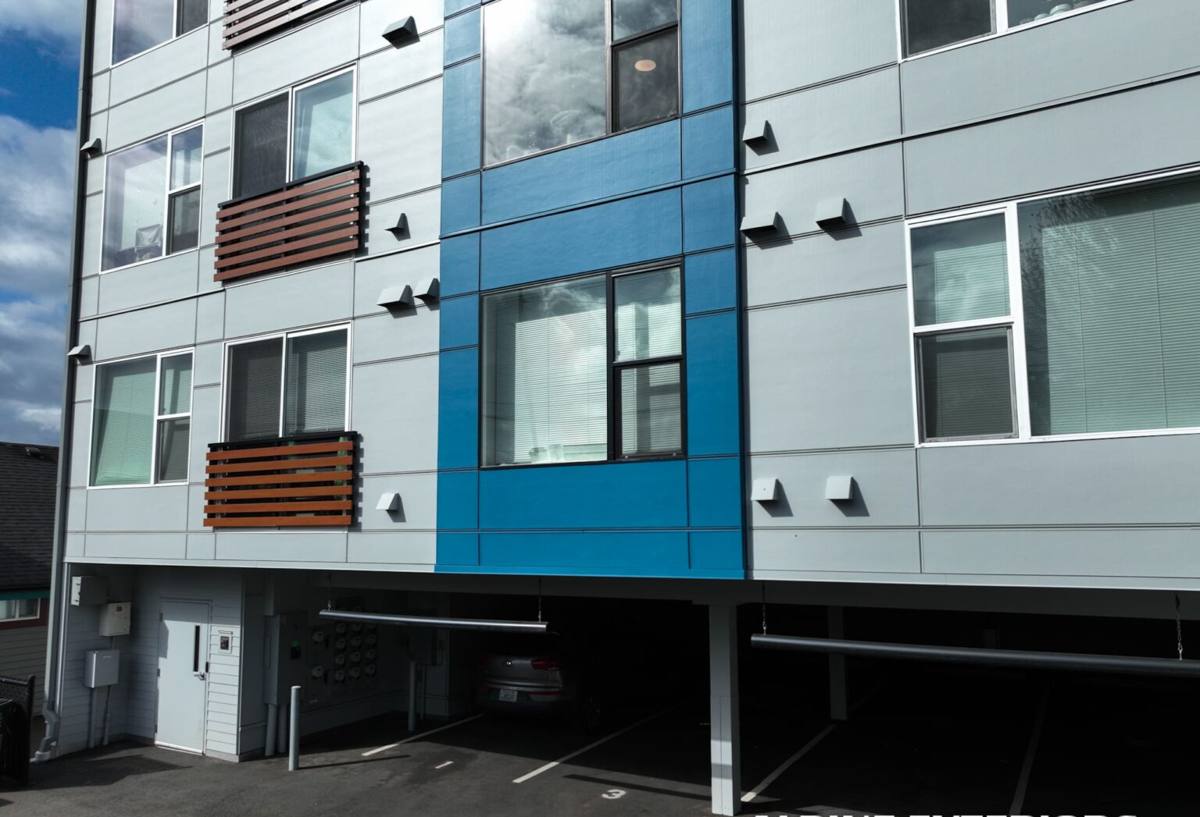
Signs a West Anacortes Home Needs Window Replacement, Not Just Repair
Not every problem window needs full replacement. But in a marine climate, certain symptoms point to failure that's already past the point where caulk and weatherstripping will fix it.
- Fogging or a visible haze between panes — the seal on the insulated glass unit has failed and moist air is trapped inside
- Soft or discolored wood trim at the sill or jamb, especially on west- and south-facing walls
- Windows that are noticeably harder to open, close, or lock than they used to be
- Visible corrosion or chalky white buildup on aluminum frames or hardware
- A cold draft you can feel standing near the window even with it fully closed and locked
- Paint that keeps bubbling or peeling at the window frame no matter how often it's redone
- Persistent moss or black mildew staining on the siding directly below a window, which usually means water is exiting there instead of the weep holes
If you're seeing two or more of these, especially on the water-facing side of the house, it's worth a proper inspection rather than another round of caulking.
What a Correct Window Replacement Actually Involves Here
It's Not Just Swapping the Glass
A window replacement is only as good as the flashing and water management behind the trim — and in West Anacortes, that detail matters more than in a drier inland climate. When we pull an old window, we're not just measuring the rough opening; we're checking the condition of the sheathing, the house wrap, and whatever flashing (or lack of it) was originally installed. If there's hidden moisture damage from years of marginal sealing, that has to be addressed before a new window ever goes in, or the new unit inherits the same failure point.
Flashing and Sealing Done for a Wind-Driven Rain Climate
Correct installation means integrating flashing tape or pan flashing at the sill so any water that does get past the exterior is directed back out, not into the wall cavity. It means proper head flashing above the window, and a sealed but not fully "boxed in" perimeter, since windows still need a path for incidental moisture to drain. In a location that takes rain sideways during winter storms, we treat the sill pan and corner seals as the most important part of the job, not an afterthought after the window is set.
Hardware and Materials That Handle Salt Air
We also pay attention to fastener and hardware material. Standard steel fasteners and lower-grade hardware corrode faster this close to the water. Stainless or coated fasteners and quality hardware cost a little more up front but avoid the streaking, seizing, and premature hardware failure that shows up within a few years on cheaper installs in this exact kind of exposure.
Frame Material Comparison for This Climate
| Frame Material | Salt Air Performance | Maintenance | Typical Trade-Off |
|---|---|---|---|
| Vinyl | Good — won't corrode, minimal reaction to salt exposure | Low — occasional cleaning | Frame color/finish choices are more limited than wood |
| Fiberglass | Very good — dimensionally stable, resists pitting | Low | Higher upfront cost than vinyl |
| Aluminum | Weaker — prone to corrosion and pitting near salt air unless well-coated | Higher — needs monitoring for corrosion | Thin sightlines, but not our first recommendation this close to the water |
| Wood (clad exterior) | Good on the clad side, vulnerable if cladding is compromised | Moderate — depends on cladding integrity | Warm interior look, but any breach in the exterior cladding invites rot |
We'll walk through these trade-offs honestly for your specific exposure — a window on a sheltered east wall doesn't need the same spec as one taking direct weather off the water.
Our Process, Start to Finish
- On-site assessment. We look at each window's exposure, current condition, and any signs of hidden moisture damage before quoting anything.
- Honest scope and estimate. You get a clear breakdown of what's being replaced, what materials we're recommending and why, and what it costs — no pressure to upgrade beyond what your home actually needs.
- Careful removal. Old windows come out without unnecessary damage to surrounding trim or siding, and we inspect the opening for rot or moisture issues once it's exposed.
- Repair before replace. Any compromised sheathing or framing gets addressed first — installing a new window into a damaged opening just locks the problem in.
- Proper flashing and sealing. Sill pan, flashing tape, and sealant are installed to shed water outward, matched to the wall's actual sun and rain exposure.
- Window set and hardware check. The unit is leveled, shimmed, and fastened correctly, then every lock and operating mechanism is tested before we call it done.
- Trim and cleanup. Interior and exterior trim is finished cleanly, and the site is cleaned up — old windows and debris hauled off, not left for you to deal with.
Cost Factors for a West Anacortes Window Job
| Factor | Why It Matters Here |
|---|---|
| Number and size of windows | Straightforward driver of total project cost |
| Frame material chosen | Vinyl and fiberglass cost more than bargain aluminum but hold up far better against salt air |
| Condition of the existing opening | Hidden rot or water damage found during removal adds repair work before the new window can go in |
| Wall exposure | Water-facing walls may warrant upgraded flashing detail versus sheltered walls |
| Glass package | Double vs. triple pane, low-E coatings, and gas fill affect both cost and comfort/energy performance |
| Access and site conditions | Second-story windows, tight lot access, or landscaping obstacles can affect labor time |
We give you real numbers for your actual windows and your actual house — not a generic per-window rate that ignores what your home is facing.
Why Local Experience in West Anacortes Actually Matters
A crew that works this specific area regularly already knows which walls in a given neighborhood tend to take the worst of the wind and rain, which framing eras and original construction details are common on this part of Fidalgo Island, and how fast moss and mildew build up on shaded north sides here versus more open, sun-exposed lots. That's not something you can fully substitute with a one-size-fits-all national install crew that shows up, sets windows to a generic spec, and leaves town. Consistent local work also means we're not guessing about how a particular product or installation detail actually performs after a few Skagit County winters — we've seen it.
It also means accountability. If a question comes up six months or two years after the install, you're calling a crew that's still working in your neighborhood, not chasing down a company that was only in Anacortes for one job.
Timing Your Window Replacement Around the Local Weather
Window replacement can be done here nearly year-round, but scheduling around the weather makes for a cleaner job. Late spring through early fall gives us more dry-weather windows for opening up walls and getting flashing and sealant set without racing incoming rain. That said, if a window has already failed and is letting water in, we're not going to tell you to wait eight months for "ideal" weather — active water intrusion gets prioritized regardless of season, and we work carefully around wet-weather conditions when we have to.
What to Ask Before You Sign a Contract
- Will you inspect and repair the rough opening if there's hidden moisture damage, or just install over it?
- What flashing method are you using at the sill, and is it appropriate for a wind-driven rain exposure?
- What fastener and hardware materials are specified, given the salt air here?
- What's the warranty on both the product and your installation labor, and who do I call if there's an issue later?
- Can you walk me through why you're recommending this frame material for this specific wall of my house?
A contractor who can answer these clearly, without hedging, is one who's actually thought about your house rather than quoting a standard package.
If your windows in West Anacortes are showing wear, letting in drafts, or you're just planning ahead before the next storm season, we're happy to take a look and give you a straightforward, no-pressure estimate. Use the form below to get started.