 Anacortes Siding
 Why Guemes Island Siding Wears Differently Than a Mainland Home
Guemes Island sits right in the path of Rosario Strait weather — open water on multiple sides, salt-laden wind, and a tree canopy that keeps large parts of every lot shaded and damp for much of the year. A home a few miles inland in Anacortes deals with plenty of Pacific Northwest moisture too, but an island home takes it from more directions at once, with less buffering from other structures and less exposure to direct afternoon sun that would otherwise help siding dry out between storms. Over years, that combination shows up as premature paint failure, soft trim, moss colonization, and — on the wrong siding material — actual substrate breakdown.
This page is specifically about siding replacement on Guemes Island: what the climate does to different materials, what a correct tear-off-and-reinstall job actually involves, and why a crew that already understands island conditions and logistics will give you a better outcome than a generalist mainland contractor treating it like any other job.
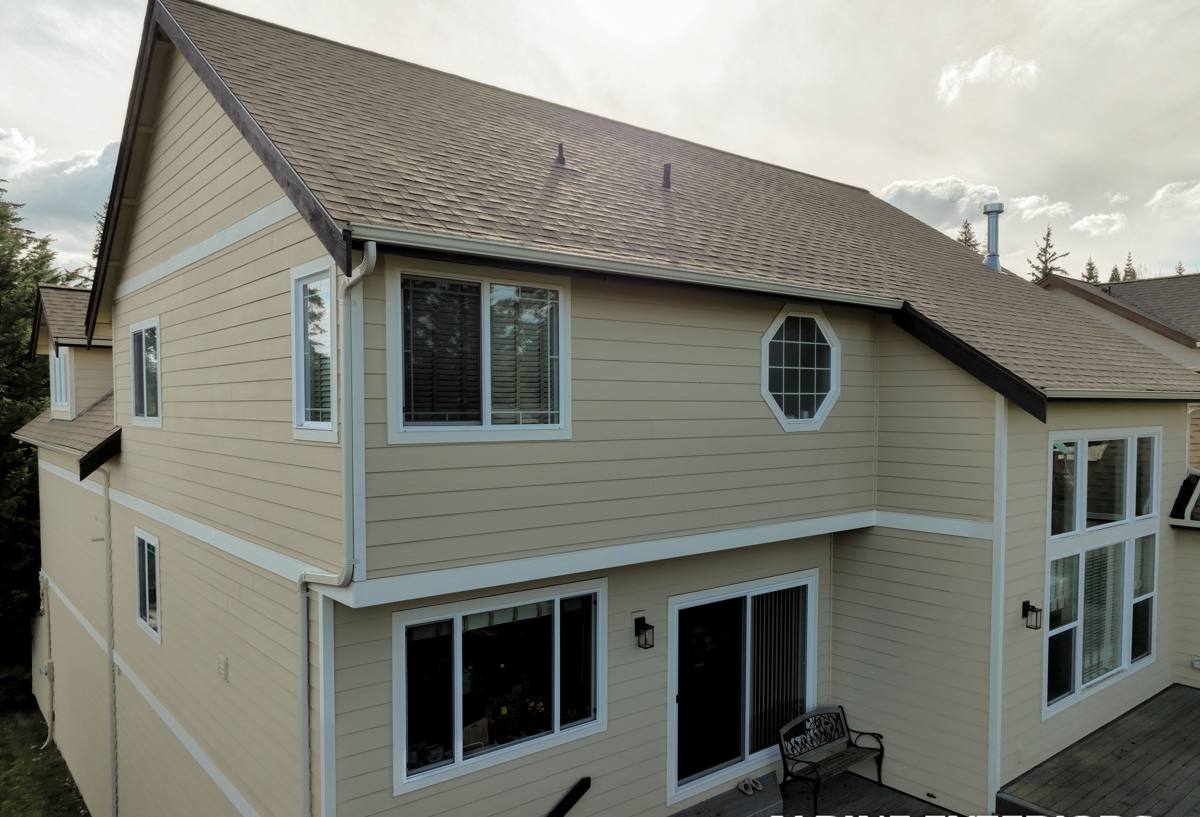
What Salt Air, Rain, and a Long Moss Season Actually Do
Salt air and corrosion
Airborne salt doesn't just sit on the surface — it works into fasteners, flashing, and any exposed metal trim. Over time it accelerates corrosion of lower-grade fasteners and can stain or pit finishes that aren't rated for coastal exposure. This is one reason fastener choice and flashing material matter as much as the siding panel itself in a location like this.
Driving rain and wind-driven moisture
Guemes Island gets rain that doesn't fall straight down — wind pushes it sideways and up under laps, trim, and butt joints. Siding systems and installation details that work fine in a sheltered inland yard can fail here simply because water finds a path that a calmer climate would never test. Correct lap exposure, house wrap integration, and flashing at every penetration are not optional details on island homes — they're the difference between a wall assembly that sheds water and one that slowly absorbs it.
A long moss season
Shade, moisture, and mild temperatures give moss and algae a long growing window on north-facing and tree-shaded walls. Moss holds moisture against the siding surface far longer than the surrounding air would on its own, which is hard on any organic or moisture-sensitive substrate and hard on paint film generally. It's manageable with the right material and finish, but it's a real, ongoing factor in how a wall assembly should be designed and maintained here — not a cosmetic afterthought.
Signs Your Siding Is Telling You It's Time
Most siding failure on Guemes Island doesn't happen all at once — it shows up gradually, and homeowners often don't connect the early signs to the underlying cause. Walk your exterior and look for:
- Soft or spongy spots when you press on siding, especially near the bottom courses and around window and door trim
- Paint that's peeling, bubbling, or chalking heavily rather than fading evenly
- Visible gaps, warping, or buckling in panels or lap boards
- Persistent moss or algae growth that returns within a season of cleaning
- Dark staining or streaking below seams, nail heads, or trim joints — often a sign water is tracking behind the siding, not just on it
- Rising interior humidity, musty smells, or peeling interior paint on exterior walls
- Visible rust bleeding from fastener heads or metal trim
Any one of these can be minor. Several together, especially on the weather-facing sides of the house, usually mean the siding and the water management behind it need a real look, not another round of caulk and paint.
What a Correct Siding Replacement Actually Involves
Tear-off and what's underneath
A proper replacement starts by removing the old siding and inspecting the sheathing, framing, and existing house wrap or building paper underneath. This is the step that gets skipped when a job is priced too low or rushed — and it's the step that determines whether the new siding lasts. Rot, soft sheathing, or failed weather barrier has to be addressed before a single new panel goes up, or you've just covered the same problem with a new face.
Water management details
The siding itself is only part of the system. Correct flashing at windows, doors, and roof-to-wall intersections; proper house wrap laps and taping; rainscreen or drainage gap where appropriate; and correct caulking at penetrations all matter more here than in a drier, calmer climate. This is where driving rain either gets shed or gets in.
Installation to manufacturer spec
Every siding product has an installation manual with specific requirements for fastener type and spacing, minimum clearance from grade, roof lines, and decks, lap exposure, and butt joint treatment. Following that spec isn't a formality — it's what the manufacturer's warranty is actually based on, and it's what determines how the assembly performs in wind-driven rain and salt air over 20-plus years, not just the first five.
How Siding Materials Actually Hold Up on Island Homes
| Material | Behavior in salt air & driving rain | Behavior in shaded, moss-prone areas | Long-term maintenance |
|---|---|---|---|
| Vinyl | Can warp or fade with UV and temperature swings; seams are a water entry point | Moss and algae grow readily on the surface; hard to fully clean without damage | Low routine upkeep, but panels can't be spot-repaired invisibly and don't reduce moisture risk |
| LP SmartSide (engineered wood) | Wood-based substrate is moisture-sensitive; edge and cut-end sealing is critical | Prolonged moss contact against an engineered wood substrate is a real long-term risk | Requires diligent caulk and paint maintenance to keep water out of the substrate |
| Primed spruce / cedar | Natural wood movement and moisture absorption in driving rain conditions | Moss and mildew are a persistent, ongoing battle on shaded elevations | Highest maintenance burden; refinishing cycles are frequent in this climate |
| James Hardie fiber cement | Non-combustible, dimensionally stable material engineered for moisture exposure | Withstands prolonged damp/moss contact far better than wood-based substrates | Factory ColorPlus finish reduces repaint cycles; lower long-term upkeep |
No siding material is completely maintenance-free on an island lot — even Hardie siding benefits from periodic washing to keep moss from establishing. But the underlying substrate matters enormously once water does find its way to the surface, and that's the core reason we don't install wood-based or vinyl systems on homes in this climate.
Why We Install Only James Hardie Fiber Cement
We install James Hardie exclusively — not LP SmartSide, not vinyl, not cedar, not primed spruce, not other fiber cement brands. That's a deliberate standard, not a sales preference. Hardie's fiber cement is non-combustible and dimensionally stable, meaning it doesn't swell, warp, or rot the way wood-based products can when they take on moisture repeatedly over years. The HZ5 product line specifically is engineered for wet, moderate climates like ours, with formulation aimed at moisture and freeze-thaw performance rather than a one-size-fits-all national spec.
The factory-applied ColorPlus finish also matters here more than it would in a drier climate — a factory-baked finish holds up to UV and moisture better than field-applied paint, which means fewer repaint cycles and less opportunity for water to get behind a failing paint film. Add a strong transferable warranty backed by a large, established manufacturer, and the whole picture is why we standardized on one product system rather than offering several. We'd rather install one thing well than several things we can't fully stand behind on this coastline.
Working on an Island Job Site
Guemes Island is accessible by ferry, and that changes how a siding project needs to be planned compared with a job in town. Material deliveries, crew scheduling, dumpster and debris hauling, and even something as simple as a forgotten tool all take longer to solve when you can't just drive back into Anacortes on a whim. A crew that already works this island builds ferry timing into the schedule from day one — staging materials in advance, batching trips, and planning the job in a sequence that doesn't leave a wall open and exposed while waiting on a delayed run. That's not a small convenience; on a job where driving rain is a real risk, how long a wall sits open matters.
Local experience also means knowing which parts of an island lot are hardest hit — the water-facing and northwest-exposed walls versus the more sheltered, tree-covered sides — and sequencing the work accordingly so the most exposed elevations aren't left uncovered longer than necessary.
Timing the Work Around Island Weather
Siding replacement can be done across most of the year here, but scheduling still matters. Drier stretches reduce the number of days a wall assembly is open to the weather during tear-off and reinstall, and they give any new caulk, flashing sealant, or finish work the cure time it needs. We plan Guemes Island projects around realistic weather windows rather than a fixed calendar date, and we're upfront if a stretch of forecast rain means holding a start date a few days rather than rushing a tear-off that shouldn't sit exposed overnight.
What to Expect From Our Process
- On-site inspection of existing siding, trim, and visible water damage or moss patterns
- Honest assessment of sheathing and framing condition once tear-off begins
- A written scope covering flashing, house wrap, and water management details — not just the visible siding
- Installation to James Hardie's published specifications for fastener type, spacing, and clearance
- A schedule that accounts for ferry logistics and realistic weather windows
If you're weighing a siding replacement on Guemes Island, we're happy to take a look, talk through what your home's specific exposure and shade pattern mean for the job, and give you a straight answer — no pressure, no upsell. Use the form below to request a free estimate.