 Anacortes Siding
 Why Siding Ages Faster Here Than the Manufacturer's Brochure Suggests
Every siding product on the market carries a warranty number and a lifespan estimate, and almost none of those numbers were calculated with Skagit County in mind. Anacortes sits where salt air off Rosario Strait and Guemes Channel meets driving winter rain and a moss season that can stretch from October into May. That combination is harder on a house than the dry-summer, mild-winter conditions most siding is tested under.
Salt-laden air accelerates corrosion on fasteners and metal flashing. Wind-driven rain pushes water sideways into laps and seams that were only ever designed to shed water falling straight down. And moss doesn't just sit there looking green — it holds moisture against the wall assembly for weeks at a time, which is exactly the environment that rot, mold, and paint failure need to get established. None of this means your siding is doomed. It means the warning signs below tend to show up earlier, and matter more, on an Anacortes house than they would somewhere drier.
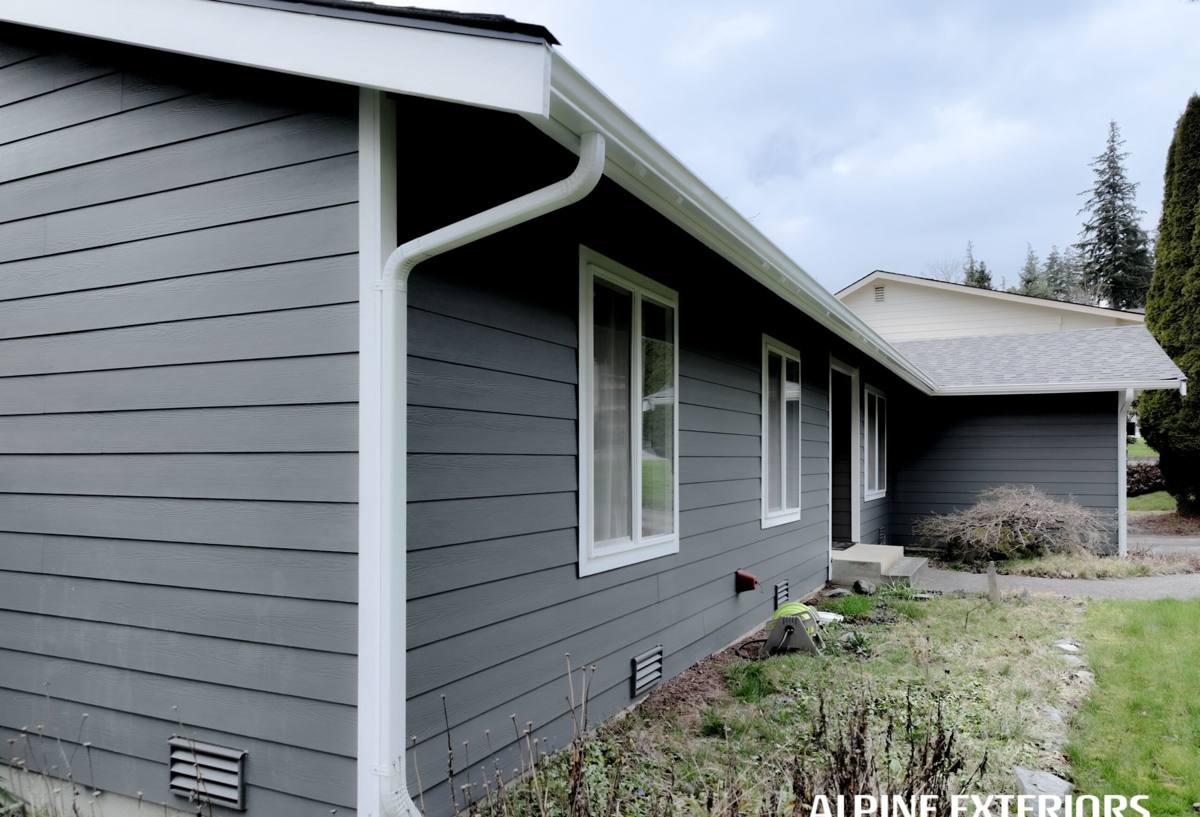
The Signs You Can See From the Ground
Paint and Finish Problems
Paint failure is usually the first visible symptom, and it's worth reading carefully because different failure patterns point to different root causes.
- Peeling in sheets or curls — usually moisture pushing out from behind the siding, not just old paint.
- Chalky white residue on your hand after touching the wall — normal UV breakdown on aging paint, less urgent on its own.
- Bubbling or blistering — trapped moisture under the film, a sign water is getting in somewhere.
- Color fading unevenly, especially on the south and west walls — sun exposure wearing through a factory or field finish faster than expected.
Visible Damage to the Siding Itself
Look for warping, buckling, or waviness in the wall plane — panels that no longer lie flat usually mean moisture swelling behind them. Cracking along panel edges or at corners is common on older wood and some fiber cement products, especially where caulking has failed and let water into the cut ends. Gaps opening up between panels, or panels that have visibly shifted, point to fastener failure or a substrate that's no longer holding a nail.
Signs You Notice by Touch, Sound, or Smell
Some of the most important warning signs never show up as a photo-worthy defect — they show up when you actually put a hand on the wall.
- Soft or spongy spots when you press on the siding — almost always rot underneath, regardless of what the surface paint looks like.
- A hollow or crumbly sound when you tap near the base of the wall or under windows.
- A musty smell in an adjacent interior room, especially after a stretch of rain — a strong sign moisture has worked past the siding and into the wall cavity.
- Visible mold or persistent black streaking that pressure washing doesn't remove for long — surface cleaning treats a symptom, not the moisture source feeding it.
The Trouble Spots: Windows, Doors, and Trim
Failure rarely starts in the middle of a flat wall. It starts at penetrations and transitions — the places where siding meets something else and the water management depends on flashing and sealant rather than the panel itself.
Check the corners of window and door trim for gaps, cracked caulk, or soft wood. Look at where siding meets the foundation for staining, efflorescence, or darkened panels — a sign of splash-back moisture that never fully dries. Inspect where siding meets roof lines, chimneys, and dryer vents; these transitions depend on flashing installed correctly the first time, and a lot of long-term siding failure traces back to a flashing detail that was never right rather than the siding product itself.
What's Actually Happening Behind the Wall
By the time siding shows visible damage, there's a good chance moisture has already reached the water-resistive barrier, the sheathing, or the framing behind it. This is the part homeowners can't inspect without opening up the wall, which is why visible signs matter — they're often the only clue you get before a small moisture problem becomes a structural repair.
Rot in sheathing or framing doesn't just cost more to fix than the siding itself; it can also affect insulation performance and, in bad cases, indoor air quality from trapped mold. Catching failure signs early, while the fix is still "replace some siding," is almost always cheaper and less disruptive than catching it late, when the fix becomes "replace siding, sheathing, and possibly framing."
How Failure Patterns Differ by Material
Not every siding material fails the same way, and knowing which pattern you're looking at helps you understand what you're actually dealing with.
| Material | Typical Failure Pattern | Why It Happens in This Climate |
|---|---|---|
| Untreated or primed wood/spruce | Swelling, cupping, rot at butt joints and cut ends | End grain absorbs moisture fast; repeated wet-dry cycling in our rainy season breaks down the wood fiber |
| Cedar | Splitting, graying, moss and mildew growth | Natural material with no factory-sealed finish; needs ongoing maintenance to resist our long wet season |
| Vinyl | Cracking in cold snaps, warping/melting near heat sources, fading | Petroleum-based product moves with temperature; UV and salt air accelerate brittleness over time |
| LP SmartSide (engineered wood) | Edge swelling, delamination if caulking/paint maintenance lapses | Wood-fiber core is moisture-sensitive; performance depends heavily on installation and upkeep discipline |
| Fiber cement (James Hardie) | Failure mostly limited to installation errors — bad caulking, missing flashing, wrong fastening | Non-combustible, dimensionally stable core resists moisture swelling; factory ColorPlus finish resists the fade and chalk cycle |
That last row is why we build this company around one product line. It's not that other materials are inherently defective — cedar can look beautiful, vinyl is inexpensive, engineered wood has real fans. It's that in a climate like ours, the failure modes of those materials show up faster and more often, and we'd rather stand behind a product whose problems, when they do occur, trace back to installation rather than the material itself.
Repair or Replace? What Actually Drives That Decision
Not every warning sign means a full re-side. The honest answer depends on how far the damage has spread and what's underneath it.
| Factor | Leans Toward Repair | Leans Toward Replacement |
|---|---|---|
| Extent of damage | Isolated to a few panels or one wall section | Spread across multiple walls or elevations |
| Underlying sheathing | Dry, solid when probed | Soft, discolored, or smells musty |
| Age of existing siding | Under 10-15 years, otherwise sound | Original siding is 20-plus years old |
| Root cause | A single fixable issue (one bad flashing detail) | Systemic — same failure repeating at multiple points |
| Product type | Fiber cement with isolated caulk/fastener issues | Wood, vinyl, or engineered wood showing widespread material breakdown |
A Practical Self-Inspection Checklist
Walk the exterior of the house on a dry day, ideally after a stretch of wet weather has had time to show its effects. Bring a flashlight and don't skip the spots that are hard to reach.
- Press firmly on siding near the ground, under windows, and around any deck or porch attachment points
- Check all four corners of every window and door for cracked caulk or soft trim
- Look underneath eaves and around any roof-to-wall transitions for staining
- Note any panels that look wavy, bowed, or out of plane compared to their neighbors
- Smell interior walls that back onto exterior siding after a rainy week
- Check the base of the wall near grade for moss buildup or standing moisture
- Look for gaps that have opened between siding and trim boards, especially on the weather-exposed west and south sides
If two or more of these turn up positive, it's worth having a contractor look closer before the next wet season sets in.
Why We Rebuild These Walls in James Hardie
When we're called out to a house showing these signs, the conversation isn't just about matching what's already there — it's about what goes back up in its place. We install James Hardie fiber cement exclusively, in the HardieZone lines engineered for our Pacific Northwest moisture exposure, finished with the factory-applied ColorPlus system rather than field paint. That combination means the color coat isn't the first thing to fail, the panel itself doesn't swell or rot the way wood-based products can, and the whole assembly comes with a manufacturer warranty built around long-term performance rather than a best-case scenario.
We won't tell you every failing wall needs a full tear-off — plenty of the signs above are fixable with targeted repair. But when a house is due for new siding, we've made the call to install one product system because we're the ones who get the callback if it fails, and we'd rather that callback never happen.
If you're seeing any of these signs on your home, we're happy to take a look and give you a straight answer — repair, monitor, or replace — with a free, no-pressure estimate.