 Anacortes Siding
 Why West Anacortes Roofs Wear Differently Than Roofs Inland
West Anacortes sits close enough to the water that homes here take a different kind of beating than a roof twenty miles inland in Skagit County. The salt-laden air off Rosario Strait and the surrounding waterways accelerates corrosion on anything metal that isn't rated for it — nails, flashing, vents, even cheap fastener coatings. Add the driving, wind-pushed rain that comes through in fall and winter storms, and you've got water hitting roof edges and penetrations sideways, not just falling straight down. Then there's the shade and moisture that a lot of West Anacortes lots carry from mature conifers, which keeps roof surfaces damp long after a storm passes and feeds a moss and algae season that can run most of the year.
None of this makes a roof impossible to keep watertight — it just means the materials and details have to be chosen for this specific environment, not for a generic Pacific Northwest spec sheet. A metal roof done right for West Anacortes looks different, underneath the surface, than the same product installed on a dry inland roof.
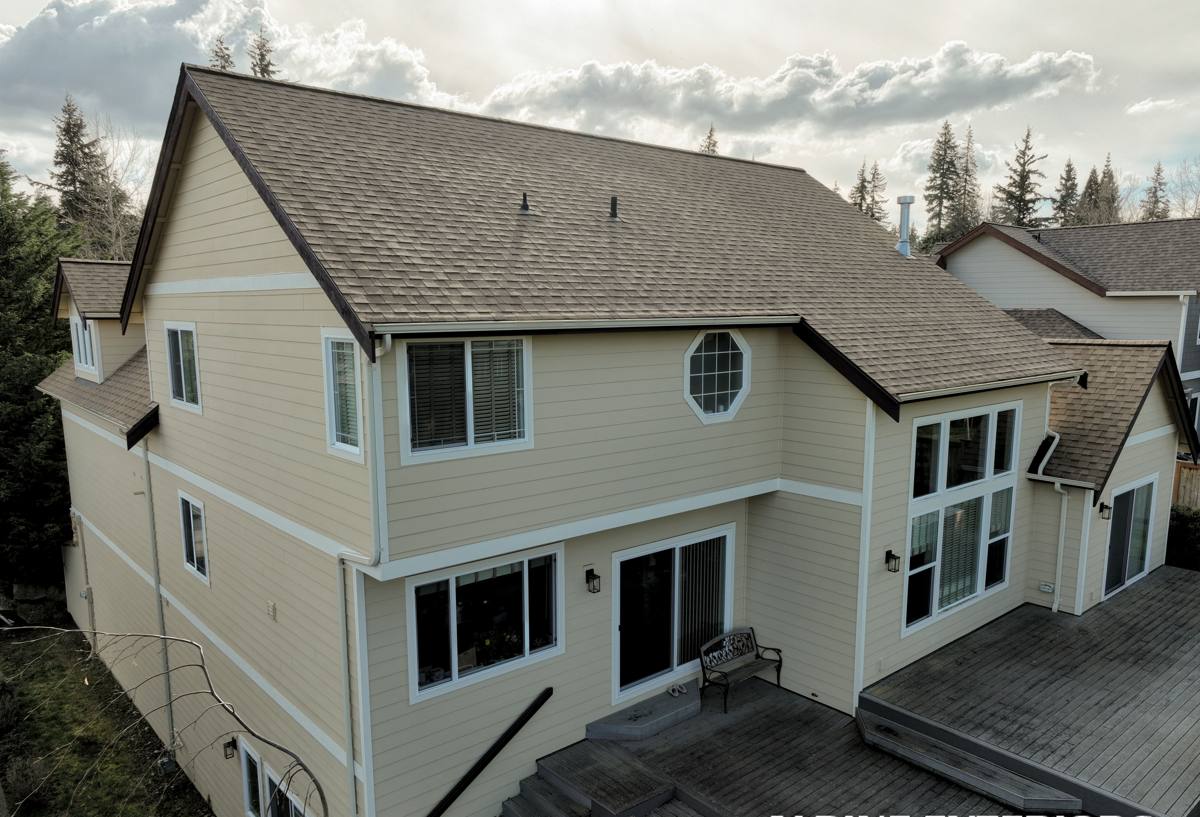
What Metal Roofing Actually Solves Here
Metal isn't a fashion choice on this side of Anacortes — it's a practical answer to three specific local problems.
- Wind-driven rain: A properly seamed or interlocked metal panel sheds water fast and doesn't rely on shingle overlap alone to stay dry when rain is coming in at an angle.
- Moss and organic growth: Metal gives moss and moisture-loving algae far less to grip onto than the granular surface of a shingle, and it dries out faster after the roof shades over.
- Salt-air corrosion: A correctly specified metal system uses coatings and fasteners built to resist that corrosion, instead of fighting it with maintenance every year.
It's also a long-service investment. A shingle roof in this climate often needs earlier attention because of moss lift and granule loss; a coastal-rated metal roof, installed correctly, is built to go decades between major work.
Choosing the Right Metal System for This Climate
Not all metal roofing is built the same, and the differences matter more here than they would somewhere dry and inland. We walk homeowners through the tradeoffs honestly rather than pushing one system for every house.
| System | How It's Fastened | Best For | Coastal Notes |
|---|---|---|---|
| Standing seam | Hidden clips, no exposed fasteners on the field | Homes where long-term, low-maintenance performance is the priority | Best resistance to salt-air corrosion since there are no exposed screw heads to fail |
| Exposed-fastener panel | Screws through the panel face into decking or purlins | Outbuildings, budget-conscious re-roofs, simpler rooflines | Works fine here only with marine-grade stainless or coated fasteners, and needs gasket inspection over time |
| Stone-coated steel | Interlocking panels resembling shake or tile | Homeowners who want a metal roof's performance with a more traditional look | Good moss resistance; check that flashing details match the profile depth |
For most West Anacortes homes near the water, we lean toward standing seam or a quality stone-coated system, because both minimize the exposed fasteners that are the first thing salt air attacks. Exposed-fastener panels aren't wrong — they're a legitimate, more affordable option — but they ask more of the maintenance schedule in this specific setting.
Steel, Aluminum, or Galvalume Steel
The base metal matters as much as the panel style. Galvalume-coated steel is the common workhorse and performs well when paired with a good paint finish. Aluminum costs more but naturally resists corrosion even if a coating is scratched, which makes it worth discussing on homes with a more direct salt-air exposure. We'll talk through what your specific lot and exposure call for rather than defaulting to one metal for every job.
Coatings and Fasteners: Where Salt Air Actually Wins or Loses
Most metal roof failures near the water aren't the panel itself — they're the coating breaking down or a fastener corroding years before it should. This is the part of the job that's easy to shortcut and hard to see once the roof is finished, which is exactly why it deserves attention up front.
- Paint system: A PVDF (fluoropolymer) finish holds color and resists chalking far longer near salt air than a basic polyester coating. It costs more up front and pays for itself in fewer repaints and less fading.
- Fasteners: Marine-grade stainless steel screws and matched, weathertight rubber washers are non-negotiable this close to the water. A cheap fastener is often the first thing to rust through, and once it fails, water finds a path into the deck below.
- Flashing metal: Flashing should match or exceed the panel's corrosion resistance — mixing incompatible metals (like uncoated steel flashing against aluminum panels) can set up galvanic corrosion that eats through both over time.
Moss, Shade, and Roof Design in a Tree-Heavy Neighborhood
A lot of West Anacortes properties sit under or near mature evergreens, which is great for privacy and terrible for keeping a roof dry and debris-free. Needles and cones collect in valleys, gutters, and around penetrations, holding moisture against the roof surface long after the rain stops. That's the exact condition moss needs to establish.
What We Design Around
- Panel profiles and seam spacing that don't create ledges where needles and debris can pile up
- Proper ridge and soffit ventilation so the roof deck itself dries out, not just the surface
- Larger or guarded gutters where tree cover is heavy, since clogged gutters back water up under roof edges
- Flashing and closures at valleys and penetrations sized to shed debris instead of trapping it
Metal alone doesn't eliminate moss risk if the roof design still gives debris somewhere to sit — the panel choice and the detailing around it both matter.
How We Approach a West Anacortes Metal Roofing Job
The process is the same whether it's a full re-roof or a repair, and we don't skip steps to make a bid look cheaper.
- On-site assessment: We look at your existing roof structure, exposure to wind and salt air, tree cover, and any current signs of moss, leaks, or deck damage before recommending a system.
- Deck inspection and prep: Metal only performs as well as what it's fastened to. Any soft, rotted, or moisture-damaged decking gets addressed before a single panel goes down — covering over a bad deck just hides a bigger problem.
- Underlayment: We use a high-temperature, self-adhering underlayment at eaves, valleys, and penetrations, which matters more here because of how often wind-driven rain tests those transition points.
- Panel and fastener installation: Panels go down per the manufacturer's coastal or high-exposure fastening spec, not a generic inland pattern, with corrosion-resistant fasteners throughout.
- Flashing and detail work: Valleys, chimneys, vents, and wall transitions get properly lapped and sealed flashing — this is where the majority of real-world leaks originate, on metal or any other roof type.
- Final walkthrough: We review the finished roof with you, including what routine maintenance looks like for your specific setting.
Water Management: The Part That Actually Stops Leaks
Panels get most of the attention, but flashing and water management do most of the work in a storm. In driving rain, water is pushed uphill and sideways under laps and around penetrations that would stay dry in a straight downpour. That means:
- Eave and rake edges detailed to kick water away from fascia and siding, not just off the roof edge
- Valley flashing sized and lapped for volume, since valleys concentrate water from two roof planes into one channel
- Pipe boots and vent flashing rated for UV and coastal exposure, since these small penetrations are a common leak point on any roof type
- Proper kickout flashing anywhere a roof edge meets a wall, so water is directed into the gutter instead of behind the siding
This is also where corners get cut on lower-cost jobs, because it's labor-intensive and doesn't show up in a quick estimate. It's the difference between a roof that looks fine for a year and one that stays dry for decades.
Maintenance: What a Metal Roof Actually Needs Near the Water
Metal roofing is low-maintenance compared to shingles, but "low" isn't "none," especially with West Anacortes' tree cover and salt exposure.
| Task | Why It Matters Here | Rough Frequency |
|---|---|---|
| Clear needles/debris from valleys and gutters | Prevents moss establishment and water backup at edges | 1-2x per year, more under heavy tree cover |
| Visual check of fasteners and flashing | Catches early corrosion or seal failure before it leaks | Annually |
| Gutter and downspout flow check | Confirms wind-driven rain and roof runoff are actually draining | After major storms |
| Soft-wash of moss-prone areas | Removes early growth before it holds moisture against panels | As needed, typically every 1-2 years |
None of this is heavy work, but skipping it is how a well-installed roof develops avoidable problems years earlier than it should.
Why It Matters That We Already Work West Anacortes
A roofing crew that mostly works drier, inland jobs will often spec and install a roof the same way regardless of where it sits. A crew that regularly works this side of Anacortes already knows how exposure off the water changes fastener choice, how much tree cover changes gutter sizing, and where wind-driven rain tends to find weak flashing. That local pattern recognition doesn't show up on a spec sheet — it shows up in fewer callbacks and a roof that's still doing its job in twenty years. It also means when you have a question about moss on a north-facing slope or a leak after a windstorm, you're talking to someone who has already seen that exact situation on a similar Skagit County roof, not troubleshooting from a manual.
Get a Straight Answer for Your Roof
If you're weighing a metal roof for a West Anacortes home, we're glad to take a look, walk you through what your specific exposure and tree cover call for, and give you a straightforward, no-pressure estimate — no upsell, just an honest read on what your roof needs. Use the form below to get started.