 Anacortes Siding
 Why Burlington Homes Wear Out Their Siding Faster Than You'd Expect
Burlington sits down in the Skagit Valley, close enough to Puget Sound and the tidal flats to catch the same moisture-loaded marine air that soaks the rest of Skagit County. That air doesn't just bring rain — it carries salt and humidity that settle into siding day after day, year after year. Add in the valley's shade pockets, morning fog, and the long stretch of gray months where surfaces barely get a chance to fully dry out, and you have a recipe for siding that ages faster than it would in a drier climate.
Moss is the most visible sign of this. It doesn't need much — a shaded north wall, a gutter that overflows during a heavy rain, a spot where two roof planes dump water onto the same section of wall — and once it takes hold, it holds moisture directly against the siding surface. On wood-based products, that's a slow, steady path to rot. On poorly maintained vinyl, it's mostly cosmetic but still ugly. On correctly installed fiber cement, it's a surface issue that pressure washing handles — which is exactly why product choice matters as much as workmanship.
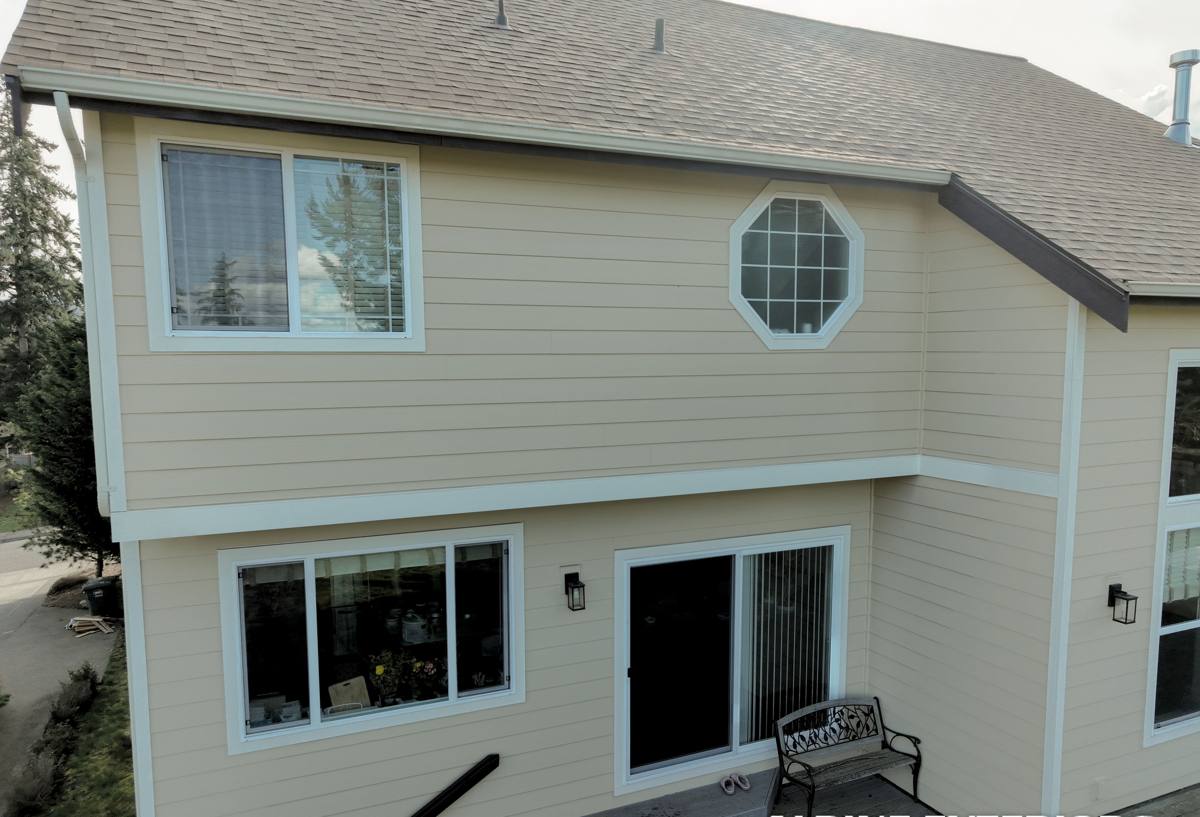
Signs Your Burlington Home Is Due for Siding Replacement
Most siding failure doesn't announce itself with a hole in the wall. It shows up as small, easy-to-dismiss details that add up over a few rainy seasons. Homeowners in Burlington should walk their exterior once or twice a year and check for the following:
- Soft or spongy spots when you press on the siding, especially near the bottom courses and around window trim
- Paint that's peeling, bubbling, or needing repainting more often than every 7-10 years
- Persistent moss or algae streaking that comes right back after cleaning
- Visible gaps, warping, or boards that have pulled away from the wall
- Musty smells or discoloration on interior walls that share an exterior wall
- Cracked or crumbling caulk lines at seams, corners, and trim
- Siding that's original to a home built more than 20-25 years ago, particularly if it's wood, hardboard, or an older vinyl product
Any one of these on its own might just need a repair. Several at once, especially combined with an aging original installation, usually means it's time to talk about full replacement rather than patching the same problem every year.
What a Correct Siding Replacement Actually Involves
Siding replacement is easy to oversimplify as "tear off the old, nail up the new." In a climate like Skagit County's, the parts you don't see are what determine whether the job lasts 10 years or 40. A proper replacement includes:
Full tear-off and wall inspection
We remove the old siding completely rather than installing over it. That's the only way to actually see the sheathing underneath — soft spots, old water staining, or rot that's been hiding behind the old material for years. Any damaged sheathing gets addressed before anything new goes up.
A weather-resistive barrier that's actually sealed
The house wrap or building paper behind the siding is your home's real line of defense against wind-driven rain. It needs to be installed with proper overlaps, and every penetration — outlets, hose bibs, light fixtures — needs to be flashed and sealed correctly, not just caulked over.
Flashing at every vulnerable point
Windows, doors, deck ledgers, and roof-to-wall transitions are where the majority of siding-related water damage actually starts. Flashing has to shed water down and out, not funnel it behind the cladding.
Correct fastening and clearances
Fiber cement siding has manufacturer-specified nailing patterns, minimum clearances from grade, roof lines, and decks, and specific gapping at butt joints. Skipping these details is the single biggest reason a siding job that looks fine on installation day fails within a few years.
Why We Install Only James Hardie Fiber Cement
We made a deliberate decision to stop installing vinyl, LP SmartSide, primed wood, cedar, and other fiber cement brands, and to only offer James Hardie products. That's not a marketing gimmick — it's a standard we hold because of what we've seen play out on homes in this climate over time.
Vinyl is inexpensive and low-maintenance in the sense that it doesn't need painting, but it's a thin plastic product that can warp in direct sun, crack in a hard freeze, and gives you very little to work with on color or profile. Wood-based products, including engineered wood like LP SmartSide, perform well when everything goes right, but they depend heavily on paint maintenance and perfect detailing to keep moisture out — and in a region with this much sustained dampness, that margin for error is thin. Other fiber cement brands may be reasonable products, but we standardized on one manufacturer so our crews master one installation system rather than splitting attention across several, and so our clients get one consistent warranty structure.
James Hardie's fiber cement is non-combustible, doesn't rot, holds paint and factory-applied ColorPlus finishes far longer than most alternatives, and is engineered in specific product lines (HZ5 and HZ10) matched to different climate zones. For a Skagit County home dealing with salt-tinged air, driving rain, and a moss season that runs most of the year, that combination of moisture resistance and finish durability is what actually holds up.
Comparing Siding Materials for a Burlington Home
| Material | Moisture Resistance | Maintenance | Typical Lifespan |
|---|---|---|---|
| Vinyl | Sheds surface water; can trap moisture behind poorly installed panels | Low, but limited repair options when damaged | 15-25 years |
| Primed wood / cedar | Vulnerable without diligent paint upkeep | High — regular repainting and caulk inspection | 10-20 years, highly dependent on maintenance |
| LP SmartSide (engineered wood) | Good when detailed correctly; sensitive to installation quality | Moderate — periodic repainting | 20-30 years |
| James Hardie fiber cement | Non-combustible, does not rot, engineered moisture management | Low — occasional washing, repaint on a much longer cycle | 30-50 years with correct installation |
Choosing the Right James Hardie Product Line
Not every Hardie product is built the same way, and picking the right one matters for a Burlington home:
HardiePlank lap siding
The most common choice for traditional home styles — available in smooth and woodgrain textures, with a wide range of ColorPlus factory finishes that hold color far longer than field-applied paint.
HardiePanel vertical siding
Common for modern designs, accent walls, or gable ends, often paired with HardiePlank for a mixed look.
HardieShingle
A shingle-style profile for homes wanting a cottage or Craftsman look without the maintenance burden of real wood shingles.
HZ5 vs. HZ10 engineered climate zones
Hardie engineers its products for specific climate conditions. Western Washington falls into a zone where moisture resistance is the priority over extreme freeze-thaw cycling, and we spec the product line and installation details accordingly rather than using a one-size-fits-all approach.
What Drives the Cost of a Burlington Siding Replacement
| Factor | Why It Matters |
|---|---|
| Home size and number of stories | More square footage and higher walls mean more material and labor, plus added scaffolding for multi-story sections |
| Extent of sheathing repair needed | Homes with hidden moisture damage from old siding need repair work before new siding goes up |
| Trim and detail complexity | Homes with lots of window trim, corners, and roof intersections take more time to flash and finish correctly |
| Product line and profile chosen | HardiePlank, HardiePanel, and HardieShingle carry different material costs and install times |
| Access and site conditions | Tight lot lines, landscaping, or difficult grading can add setup time |
We don't quote a price without seeing the home. Anyone who does is either guessing or leaving out details that show up as change orders later.
Our Process, Start to Finish
We walk the exterior with you first, looking at the same wear signs listed above and checking for hidden moisture issues before any tear-off begins. From there:
- We provide a written estimate that spells out product line, color, and scope — no vague allowances
- We schedule the tear-off and inspect sheathing before covering anything back up, flagging any repairs with you directly
- We install house wrap, flashing, and James Hardie siding to manufacturer specification, including proper clearances and fastening
- We do a final walkthrough with you so you can see the finished detailing before we consider the job done
Why Hire a Crew That Already Works in Burlington and Skagit County
Siding that's engineered for the Pacific Northwest still has to be installed by people who understand this specific valley — where moss builds up fastest, which wall orientations take the worst of the driving rain, and how the local building department expects flashing and weather barriers to be detailed. A crew that already works around Burlington and the greater Skagit County area isn't learning these patterns on your house. That familiarity shows up in fewer callbacks and a job that's built to handle another 30 winters here, not just installed to look good on day one.
If your siding is showing moss that won't quit, soft spots, or it's simply original to a home that's due, we're happy to take a look. Reach out for a free, no-pressure estimate — we'll walk the exterior with you, tell you honestly what we see, and lay out what a correct James Hardie installation would involve for your home.