 Anacortes Siding
 Deck Replacement Built for Burlington's Weather, Not Against It
Burlington sits inland from Anacortes but still gets the full weather package that defines Skagit County: long wet winters, a marine-influenced climate that keeps humidity high nearly year-round, and enough overcast days that a deck rarely gets a real chance to dry out between rainfalls. Add in salt-tinged air drifting in off Fidalgo Bay and the Salish Sea on windy days, and you have a set of conditions that ages an old deck faster than most homeowners expect. If your deck is cupping, spongy underfoot, or growing moss faster than you can pressure wash it, that's not bad luck — it's the climate doing exactly what it does to a structure that was either under-built for the region or has simply reached the end of its service life.
A deck replacement here isn't just swapping old boards for new ones. It's a chance to correct the drainage, spacing, and material choices that should have accounted for this climate from the start.
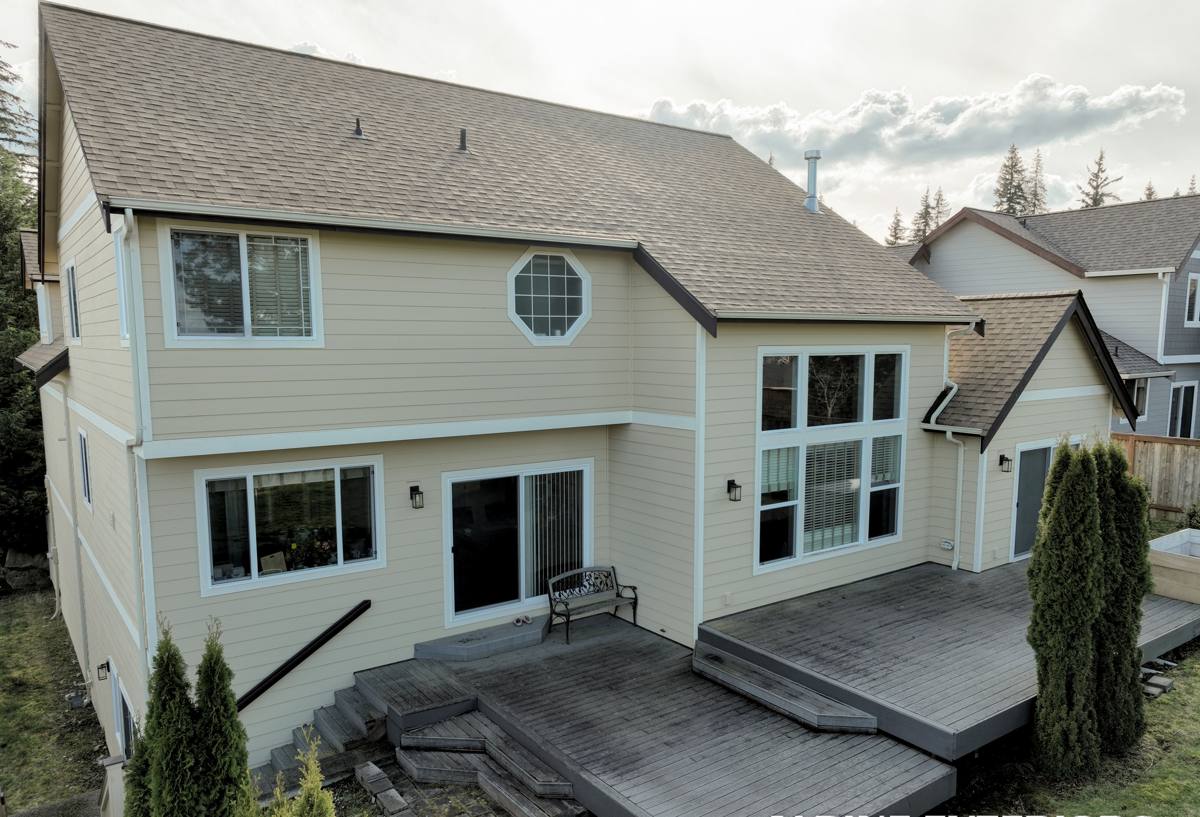
Why Decks Fail in This Part of Skagit County
Most deck failures we see in the Burlington and Anacortes area trace back to a handful of repeat offenders:
- Trapped moisture at ledger boards and joists — the point where a deck attaches to the house is the single most common source of hidden rot, especially without proper flashing.
- Moss and algae growth — the region's long, mild, wet season gives moss months to establish itself on horizontal wood surfaces, and once it takes hold it holds moisture against the board around the clock.
- Undersized or poorly spaced framing — older decks were often built to whatever code existed decades ago, with joist spacing and beam sizing that doesn't match today's standards or today's decking materials.
- Fasteners that corrode — salt-influenced air accelerates corrosion in lower-grade screws and nails, which loosens boards and creates squeaks, movement, and eventually failure points.
- No real drainage plan underneath — decks built directly over bare soil or gravel with no grading trap water underneath, which keeps the framing damp for days after every storm.
None of these are exotic problems. They're what happens when a deck is built for a dry-climate assumption in a place that almost never gets one.
What a Correct Deck Replacement Involves
Tear-Off and Structural Assessment
We start by removing the old decking and inspecting everything underneath — ledger board, joists, beams, posts, and footings. This is where a lot of the real story gets told. Framing that looks fine from the top can be soft, cracked, or water-stained underneath, and there's no honest way to quote a replacement without seeing it directly.
Ledger Flashing Done Right
The ledger board — where the deck attaches to your house — needs proper flashing that directs water away from the wall framing, not into it. This is one of the most commonly skipped or half-done steps on older decks, and it's one of the most important for a structure that has to survive Anacortes-area rain year after year.
Framing Sized for the Region
We size joists, beams, and post spacing to current code and to the actual decking material you choose, not to whatever the old deck happened to use. Composite and heavier board profiles often call for tighter joist spacing than traditional wood decking — getting this wrong is a common cause of bounce and premature sagging.
Drainage and Ventilation Underneath
Airflow under the deck matters as much as what's on top of it. We grade and clear the space beneath the frame so water has somewhere to go instead of sitting under the joists, and we keep skirting (if you want it) vented rather than sealed tight.
Fasteners and Hardware
We use corrosion-resistant, code-rated hardware and fasteners throughout — hangers, hurricane ties where called for, and structural screws rated for exterior and coastal-influenced use. This is not a place to save a few dollars, since fastener failure is one of the more dangerous ways a deck can go wrong.
Decking Material Options for Burlington Homes
There's no single "best" decking material — the right choice depends on your budget, how much upkeep you're willing to do, and how much moss and moisture exposure your specific lot gets.
| Material | Maintenance | Moisture & Moss Behavior | Typical Lifespan |
|---|---|---|---|
| Pressure-treated wood | Annual cleaning, periodic staining/sealing | Absorbs moisture; needs sealing to resist moss and rot | 10-15 years with upkeep |
| Cedar | Regular oiling or staining to maintain appearance | Naturally rot-resistant but still needs sealing in this climate | 15-20 years with upkeep |
| Composite decking | Occasional washing, no staining/sealing | Doesn't absorb water like wood; some capped composites resist moss buildup well | 25-30+ years |
| PVC decking | Low — occasional washing | Fully moisture-resistant surface; least hospitable to moss | 25-30+ years |
We'll walk through these trade-offs honestly during your estimate. Composite and PVC cost more up front but cut down dramatically on the yearly maintenance that wood decking demands in a climate like this. Wood costs less initially but only holds up if someone actually keeps up with the sealing schedule — and in our experience, that's the step that gets skipped a few years in.
Designing Around Moss From the Start
You can't eliminate moss risk entirely in Skagit County, but you can design a deck that fights it instead of inviting it in. A few things we build into every replacement:
- Board spacing that allows water to drain through rather than pool on the surface
- Decking profiles with grooved or textured surfaces where appropriate, which shed water faster than flat, smooth boards
- Avoiding low spots and reverse slopes in the framing that create standing-water zones
- Keeping vegetation and overhanging branches trimmed back from the deck edge where possible, since shade and leaf litter both extend how long a surface stays wet
None of this makes seasonal cleaning optional — it just means the cleaning you do actually keeps up, instead of fighting a losing battle against a deck that was never designed to shed water in the first place.
Our Process for a Burlington Deck Replacement
- On-site assessment — we look at the existing deck, the framing underneath, drainage around the foundation, and sun/shade exposure to understand what's actually driving the wear you're seeing.
- Honest scope and estimate — you get a clear breakdown of what needs full replacement versus what can be reused safely, with material options and straightforward pricing.
- Permitting — deck replacements of most sizes require a permit through the appropriate local jurisdiction; we handle that process so you don't have to chase it down yourself.
- Tear-off and structural rebuild — old decking and any compromised framing comes out, and the structure is rebuilt to current code with proper flashing and drainage.
- Decking installation — your chosen material goes down with attention to spacing, fastening pattern, and edge details that hold up over time.
- Final walkthrough — we go over the finished deck with you, including what maintenance (if any) your material choice needs going forward.
Signs Your Burlington Deck Needs Replacing, Not Just Repairing
Not every worn deck needs a full replacement. Here's a rough guide to when repair still makes sense versus when it's time to start over:
- Soft, spongy, or spring-loaded feeling boards in multiple areas — usually points to framing damage, not just surface wear
- Visible gaps opening up between the ledger board and the house
- Persistent moss or algae staining that returns within weeks of cleaning
- Posts or footings that show movement, cracking, or visible rot at the base
- A deck older than 20 years that has never had the framing inspected
- Multiple boards cupping, splitting, or pulling away from fasteners
If it's one or two isolated boards on an otherwise sound structure, a repair might genuinely be the right call — we'll tell you that directly rather than pushing a full replacement you don't need.
Why Hire a Crew That Already Works This Area
Deck framing and drainage decisions that work fine in a drier climate can fail within a few years here. A crew that regularly builds and replaces decks around Anacortes and Skagit County already knows how the local rain pattern, moss pressure, and salt-air exposure behave on a real structure over time — not just in a manual. That translates into decisions made on-site: how the ledger gets flashed, how much drainage slope the framing needs, which fastener grade actually holds up, and which decking profiles genuinely resist the moss cycle in this specific part of Washington. It also means we're a known, reachable local business if a question comes up five years down the road — not a crew that worked one job in the area and moved on.
Get a Free Estimate for Your Burlington Deck Replacement
If your deck is showing its age — soft spots, persistent moss, gaps at the house, or just years of wear from Skagit County's wet climate — we're happy to take a look and give you a straightforward assessment of what it needs. Use the form below to request a free, no-pressure estimate for your deck replacement in Burlington or the surrounding Anacortes area.