 Anacortes Siding
 Why Oak Harbor's Climate Is Hard on Exterior Siding
Homes in and around Oak Harbor sit close enough to Puget Sound and the waters near Deception Pass that salt air is a daily fact of life, not an occasional weather event. Salt-laden moisture works into seams, fasteners, and any exposed wood or composite edge, accelerating corrosion and rot in ways that inland siding never has to deal with. Add in wind-driven rain that comes sideways off the water during winter storms, and siding here needs to shed water at the face of the board, not just at the surface.
Then there's the moss and algae problem. Skagit County's marine climate keeps humidity high for months at a time, especially on north-facing walls and anything shaded by trees or a neighboring structure. Organic growth isn't just cosmetic — it holds moisture against the siding surface, which is exactly the condition that causes paint failure, substrate softening, and eventually rot on anything that isn't built to resist it. Any product installed on a home near Oak Harbor has to hold up to all three of these stresses at once: salt, wind-driven rain, and sustained damp.
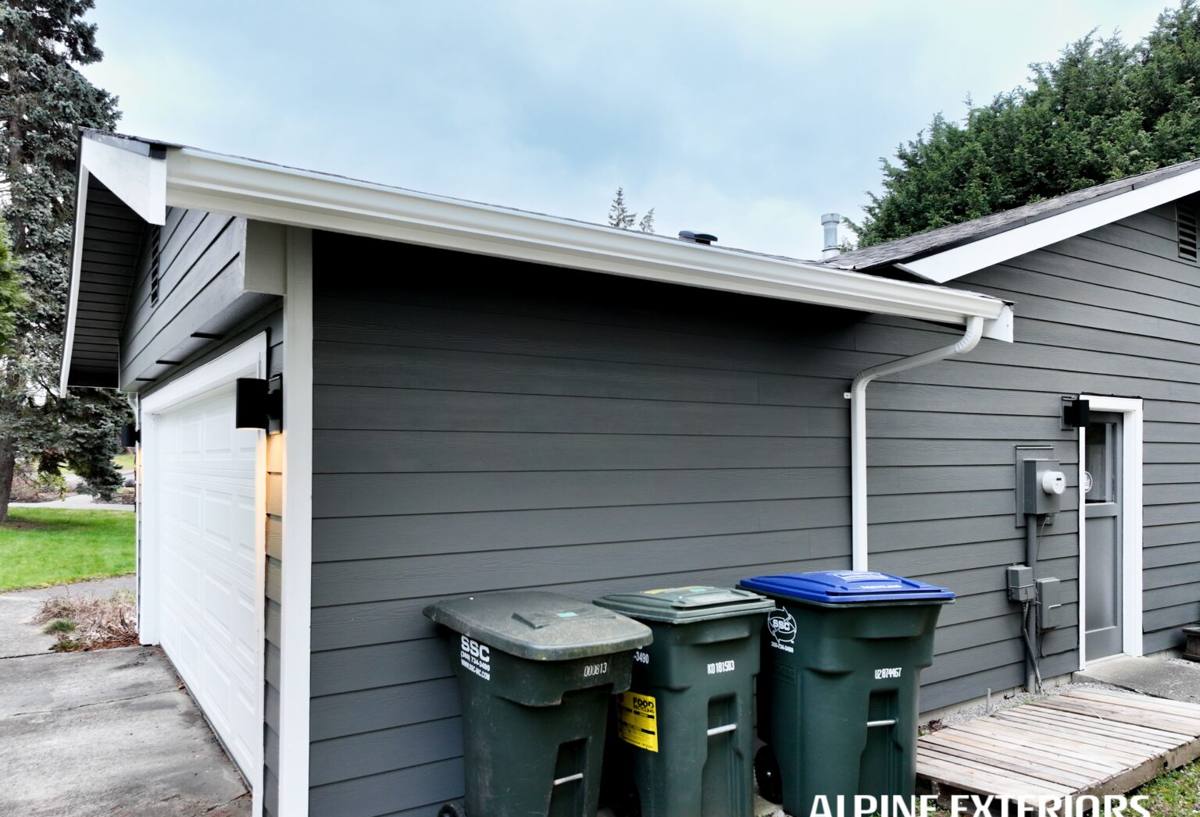
Why We Standardized on James Hardie for Homes in This Area
We made a deliberate decision to install only James Hardie fiber cement siding, and we don't install vinyl, LP SmartSide, cedar, primed spruce, Cemplank, or Allura. That's not a marketing position — it's what years of working on homes exposed to this exact coastal climate led us to.
Vinyl siding expands and contracts with temperature swings and can warp or crack under sustained wind pressure; it also traps moisture behind it if the drainage plane isn't perfect, which is a real risk in a climate this wet. Cedar and primed wood look great on day one, but they demand a recoating and caulking schedule that most homeowners underestimate, and any lapse in that maintenance shows up fast in a damp climate. Engineered wood products like LP SmartSide use a wood-strand core with a resin coating — durable in many climates, but wood-based cores are inherently more sensitive to sustained moisture exposure than a cement-based product, and sustained moisture is exactly what this region delivers for months at a time.
James Hardie's fiber cement is cellulose fiber, sand, and cement — it doesn't have an organic core to feed rot, it doesn't burn, and it holds its factory-applied ColorPlus finish for years longer than field-applied paint typically lasts in this climate. That's the trade-off we settled on: a heavier, harder-to-cut product that costs more up front, in exchange for not having to re-caulk, re-paint, or replace boards on a five-to-seven-year cycle.
What We're Not Saying
Vinyl and wood siding aren't defective products — they work fine in plenty of climates and budgets. Our position is narrower: given the salt air, rain exposure, and moss season specific to this stretch of coastline, we don't think they hold up as well as fiber cement, and we'd rather turn down work than install something we don't think will perform here.
The Hardie Product Lines That Fit This Climate
James Hardie engineers its siding in different formulations for different climate zones, and homes in the milder, wetter marine climate here fall into a different category than homes in colder, drier inland regions. That distinction matters more than most homeowners realize — a product engineered for freeze-heavy climates isn't optimized for the same failure modes as one engineered for sustained moisture and humidity.
- HardiePlank lap siding — the most common choice for full siding replacements; available in several plank widths and textures (smooth or cedar-textured)
- HardieShingle — staggered or straight-edge panels for homes that want a shingle-style look without the maintenance of real cedar shingles
- HardiePanel vertical siding — often used for accent sections, gable ends, or a modern board-and-batten look
- HardieTrim — matching trim boards so window and corner details age at the same rate as the field siding
All of these come with James Hardie's ColorPlus factory finish as an option — a baked-on finish applied under controlled conditions, which resists fading and chipping far better than paint applied on site, especially in a climate where the paint has to cure between rain systems.
What Correct Installation Involves Here
Fiber cement siding performs the way it's supposed to only if it's installed to spec — and in a high-moisture, salt-air environment, the margin for error is smaller than it would be somewhere drier.
Clearances and Drainage
Hardie's own installation instructions call for minimum clearances between the bottom of the siding and grade, roof lines, decks, and walkways. Those clearances exist specifically to keep splash-back moisture off the siding face — and splash-back is worse here because of how much sideways rain this area gets. We also confirm there's a proper drainage plane (house wrap plus, where appropriate, a rainscreen gap) behind the siding so any moisture that does get past the face can drain and dry out instead of sitting against the sheathing.
Fastening and Flashing
Fasteners have to be corrosion-resistant and driven at the correct depth — over-driven nails crack the board's factory seal and create a moisture entry point that's invisible until it fails years later. Flashing at every window, door, and penetration has to be lapped correctly so water sheds outward rather than behind the siding. In a salt-air environment, we also pay closer attention to fastener and flashing material compatibility, since dissimilar metals can corrode faster when exposed to salt-laden moisture.
Joints and Caulking
Butt joints, corners, and trim intersections are where most siding failures start. We follow Hardie's specified joint treatment (flashed joints or approved sealant, not just caulk over a butted seam) because a joint that looks fine for the first year can open up and let water in once the caulk starts to give — and in this climate, caulk gives faster than it would somewhere drier.
Our Process for Oak Harbor-Area Projects
Every project starts with an assessment of what's actually happening behind the existing siding, not just what it looks like from the street.
- Site and moisture assessment — we check the sheathing, look for signs of past moisture intrusion, and confirm what's actually behind the current siding before quoting the job.
- Scope decision — full tear-off versus repair depends on the condition of the sheathing and framing, not just the visible siding. We won't cover up rot that needs to be addressed first.
- Weather-window scheduling — we plan installation around drier stretches where possible, since fiber cement, house wrap, and caulking all perform better installed on a dry substrate.
- Installation to spec — correct clearances, fastening, flashing, and joint treatment as described above.
- Final walkthrough — we go over the finished work with the homeowner before calling the job done.
Cost Factors to Expect
Every home is different, but a few factors consistently move the price on a Hardie siding project in this area:
| Factor | Why It Matters | Typical Impact |
|---|---|---|
| Tear-off vs. new construction | Removing and disposing of old siding, plus repairing any hidden sheathing damage | Adds labor and possible repair costs |
| Siding profile and texture | Lap widths, shingle-style panels, and vertical panel work require different labor and material | Moderate to significant |
| Trim and detail complexity | Multiple gables, dormers, and window trim add cutting and fitting time | Moderate |
| Home access and height | Two-story sections, steep lots, or limited equipment access change labor time | Moderate |
| ColorPlus vs. field-painted finish | Factory finish costs more up front but eliminates a painting phase | Small to moderate, offset by lower long-term maintenance |
Maintenance Through Salt Air and Moss Season
James Hardie siding needs far less upkeep than wood or vinyl, but "low-maintenance" isn't "no-maintenance," especially in a climate that stays damp for months. A short annual routine keeps it performing the way it's designed to:
- Rinse siding annually to remove salt residue and airborne grime, especially on walls facing open water or prevailing wind
- Check north-facing and shaded walls for moss or algae buildup and address it early, before it holds moisture against the surface
- Inspect caulking at joints, corners, and trim intersections once a year and re-caulk any spots that have started to crack or pull away
- Keep gutters clean and downspouts directed away from the foundation so splash-back doesn't hit the bottom courses of siding
- Trim back vegetation and tree limbs that shade siding and keep it damp longer than it needs to be
- Watch for any soft spots, staining, or discoloration near ground level, which can indicate a drainage or clearance issue rather than a siding defect
Why Hiring a Crew That Already Works This Coastline Matters
A siding crew that mostly works inland, drier climates isn't necessarily prepared for what salt air and driving rain do to fastening, flashing, and joint details over time. Working regularly in Skagit County and the surrounding coastal communities means we've seen how these homes actually fail when siding is installed without accounting for the exposure — and we build every installation around avoiding those specific failure points, not a generic install spec.
It also means practical scheduling awareness: knowing which weeks tend to bring drier working stretches, planning around wind exposure on more open lots, and understanding which sides of a home take the worst of the weather so extra care goes where it's actually needed.
Get a Straight Answer About Your Home
If you're planning a siding project on a home near Oak Harbor and want to know what it actually needs — not a generic quote — we're happy to take a look and walk you through it. Request a free, no-pressure estimate using the form below and we'll give you a straightforward assessment of your siding and what correct installation would involve for your specific home.