 Anacortes Siding
 Why Oak Harbor Roofs Wear Out Faster Than the Brochure Says
Oak Harbor sits on Whidbey Island, just over the Deception Pass Bridge from our home base in Anacortes, and the roofs out there take a different kind of beating than roofs fifty miles inland. Open water exposure across the Strait and Saratoga Passage means salt-laden air moving across shingles, flashing, and fasteners nearly year-round. Add the long stretch of wet, mild winters typical of the North Puget Sound region, and you get the two things that shorten a roof's life faster than almost anything else: constant low-grade moisture and metal corrosion.
None of that means a roof is doomed. It means the materials, fastener choices, and ventilation details matter more here than they would in a drier, inland climate. A roof that's "fine" on paper in a manufacturer's spec sheet can still underperform badly on a shaded, north-facing slope two blocks from the water. We size up each Oak Harbor roof for its specific exposure — wind direction, tree cover, slope orientation — before recommending anything.
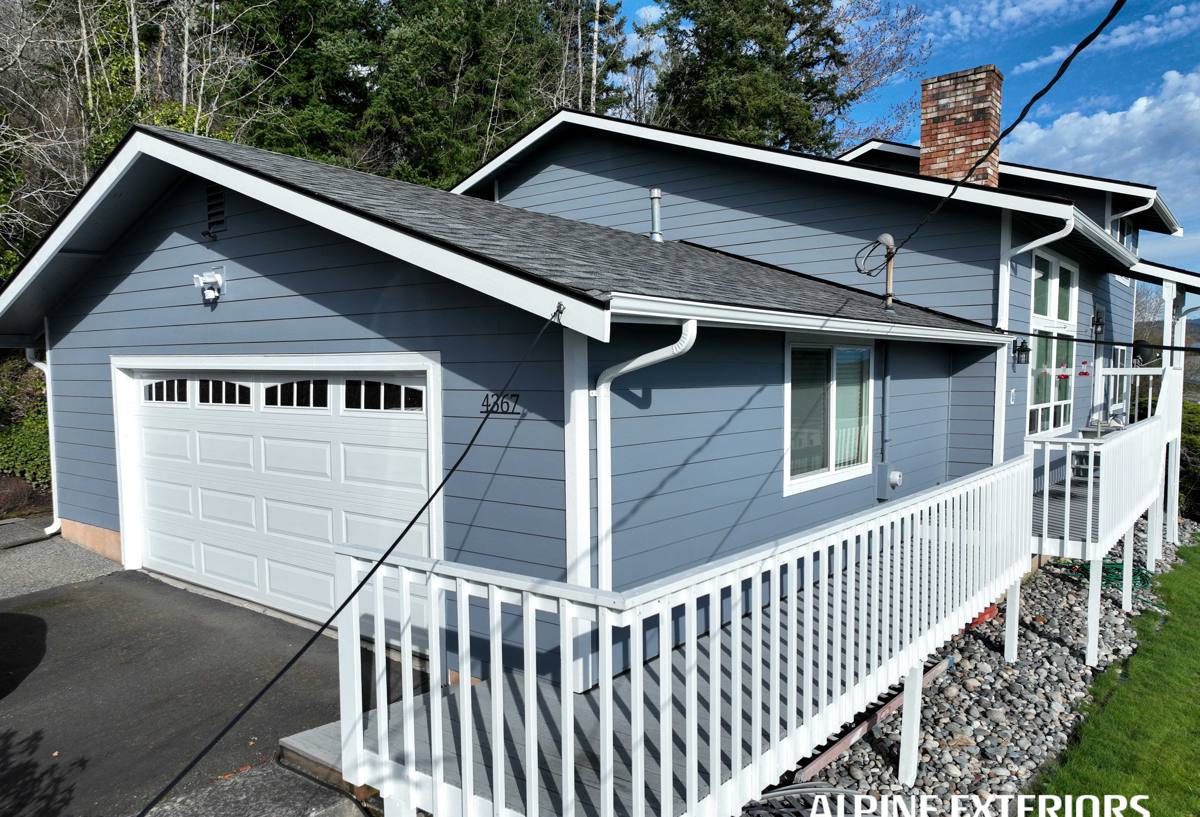
Moss Season Is Longer Here Than Most Homeowners Realize
Moss isn't just a cosmetic nuisance. On shaded or north-facing roof planes, especially under conifers, moss holds moisture against the shingle surface for months at a stretch. Over a few seasons that trapped moisture works granules loose, lifts shingle edges, and eventually finds its way under laps and around fasteners. By the time moss is visible from the ground, it's usually already doing damage you can't see from the street.
A roof replacement is the right time to break that cycle — not just by installing a new roof, but by addressing the conditions that let moss take hold in the first place: airflow, shade, and debris buildup.
What we look at during a moss-prone roof assessment
- Which slopes get the least sun and longest moisture retention
- Overhanging branches and needle/debris accumulation in valleys
- Whether the current ventilation is pulling enough air through the attic to dry the underside of the deck
- Condition of the decking itself where moss has been established longest
Signs an Oak Harbor Roof Needs Replacement, Not Another Repair
Repairs make sense when the problem is localized — a cracked pipe boot, a section of lifted shingles after a windstorm, a flashing leak at a chimney. Replacement becomes the honest recommendation when the damage is spread across the roof or the underlying materials have reached the end of their service life. Here's what tends to separate the two:
- Granule loss visible in gutters across multiple slopes, not just one spot
- Shingles that are curling, cupping, or brittle when walked
- Soft or spongy decking found during inspection, usually from long-term moisture intrusion
- Moss or algae staining that returns within a season or two of cleaning
- Daylight visible through the roof deck from inside the attic
- A roof already past or near the end of its rated lifespan, especially with no upgraded ventilation
- Multiple past repairs in different areas within a short span of years
If a roof is only showing one or two of these on a small section, repair is usually the right call and we'll say so. We don't push replacement on a roof that has years left in it.
What a Correct Roof Replacement Actually Involves
A roof replacement is more than swapping old shingles for new ones. In a climate that drives moisture and salt air into every gap, the parts you don't see after the job is done matter as much as the shingles themselves.
Tear-off and deck inspection
We remove the existing roofing down to the deck rather than layering over it. This is the only point in the project where the sheathing is fully exposed, so it's the one chance to find and replace any wood that's gone soft or delaminated from years of trapped moisture — often worse under moss-covered areas than a homeowner expects.
Underlayment and moisture barrier
Given how much driving rain this region sees, we pay close attention to underlayment coverage and ice-and-water shield placement at eaves, valleys, and any low-slope transitions — the spots most likely to see wind-driven rain pushed backward under the shingle edge.
Flashing at every penetration
Chimneys, vents, skylights, and sidewall intersections are where the large majority of roof leaks actually start, not in the open field of shingles. Corrosion-resistant flashing, correctly stepped and sealed, is non-negotiable this close to salt air.
Ventilation correction
Many older roofs in this area were installed with minimal or unbalanced ventilation. Part of a proper replacement is checking that intake (soffit) and exhaust (ridge or box vents) are balanced, so the attic can actually dry out between wet stretches instead of staying damp against the deck.
Fastener and hardware choice
Standard fasteners corrode faster in salt-air exposure. We use corrosion-resistant nails and hardware rated for coastal conditions rather than whatever is cheapest at the yard.
Material Options for Oak Harbor's Climate
There's no single "best" roofing material — there's the right material for a given home's exposure, budget, and roofline. Here's how the common options stack up for this specific climate:
| Material | Moss & Moisture Resistance | Salt Air Durability | Typical Lifespan | Maintenance Needs |
|---|---|---|---|---|
| Architectural asphalt shingle | Good with proper ventilation; algae-resistant granule options available | Good with corrosion-resistant fasteners and flashing | 25–30 years | Periodic moss/debris removal on shaded slopes |
| Standing seam metal | Excellent — sheds moisture, hard for moss to establish on | Good to excellent with the right coating and fastener spec | 40–50+ years | Low; occasional inspection of seams and fasteners |
| Cedar shake | Poor without diligent upkeep — moisture-retentive by nature | Fair; requires ongoing treatment | 20–30 years with maintenance | High — regular treatment and moss control required |
| Synthetic composite shingle | Good; engineered to resist moisture absorption | Good | 30–50 years depending on product | Low to moderate |
For most Oak Harbor homes we end up recommending either a quality architectural asphalt shingle with algae-resistant granules or standing seam metal, depending on the roofline and the homeowner's long-term maintenance appetite. Cedar shake can look great, but we're honest with clients about the upkeep it demands in a climate this wet — it's a legitimate choice, just not a low-maintenance one.
What Drives the Cost of a Roof Replacement Here
We won't quote a number without seeing the roof — pitch, access, size, and condition of the deck all move the price meaningfully. But the main cost factors on a typical Oak Harbor project are:
- Roof size and complexity — more valleys, dormers, and penetrations mean more labor and flashing work
- Pitch and access — steep roofs or homes with limited staging area take longer and require more safety equipment
- Deck condition — how much sheathing needs replacing once tear-off exposes it
- Material choice — asphalt, metal, and synthetic products carry different material and labor costs
- Ventilation upgrades — bringing an older roof's intake/exhaust balance up to current standards
- Layers of existing roofing — removing multiple old layers adds disposal and labor time
Most full replacements land in a broad mid-range for the roof size and material chosen — we'll walk through exactly where a given home falls once we've been on the roof and in the attic.
How the Project Runs, Start to Finish
- On-site inspection — we get on the roof and into the attic, not just a look from the driveway
- Written estimate — material options, scope, and a clear price, no vague allowances
- Scheduling — timed around weather windows, since a proper tear-off needs a dry stretch
- Protection setup — landscaping, siding, and gutters protected before tear-off begins
- Tear-off and deck repair — old roofing removed, any compromised sheathing replaced
- Underlayment, flashing, and ventilation installed — the parts that determine how the roof performs in year ten, not just year one
- New roofing installed to manufacturer spec, with fastener and flashing detailing suited to coastal exposure
- Full site cleanup, including a magnetic sweep for stray nails
- Final walkthrough — we go over the finished roof and warranty paperwork with you directly
Why It Matters That We Already Work This Area
A crew that only occasionally crosses the bridge onto Whidbey Island doesn't have the same feel for how a given block sits relative to wind exposure, tree cover, or which slopes hold moss longest. Working Oak Harbor regularly means we've already seen how roofs in this specific stretch of the Salish Sea coastline age — which details fail first, which ventilation setups actually keep up with the moisture, and which fastener and flashing choices hold up rather than corrode out early.
It also means practical logistics are already worked out: permitting familiarity with the local jurisdiction, realistic scheduling around this region's weather patterns, and a crew that isn't guessing at material choices for the first time on your roof.
Ready for a Straight Answer on Your Roof?
If your roof is showing moss buildup that keeps coming back, granule loss in the gutters, or it's simply getting close to the end of its expected life, we're glad to take a look. We'll give you an honest read on whether it's a repair or a full replacement — no pressure, no inflated scare tactics. Request a free estimate using the form below and we'll get you scheduled for an on-site look.