 Anacortes Siding
 Old Town Anacortes Roofs Work Harder Than Most
Old Town Anacortes sits close enough to the water that salt air is part of daily life, and that changes what a roof has to survive. Fasteners, flashing, and exposed metal corrode faster here than they would twenty miles inland. Add in Skagit County's long stretch of wet months, driving rain that comes in sideways off Fidalgo Bay and Guemes Channel, and a moss season that can run from fall through spring, and you've got a roof environment that punishes shortcuts. A roof that's installed correctly for this specific setting will outlast one that was built to a generic spec sheet by years.
Many homes in Old Town Anacortes are older, with rooflines and framing that don't always match what you'd see in a newer subdivision. That matters when it comes to ventilation, deck condition, and how new materials tie into existing structures. A new roof installation here isn't just "tear off and replace" — it's a job that needs to account for the house's age, its exposure to weather off the water, and the slow, steady damage that moss and moisture do when they're left unaddressed.
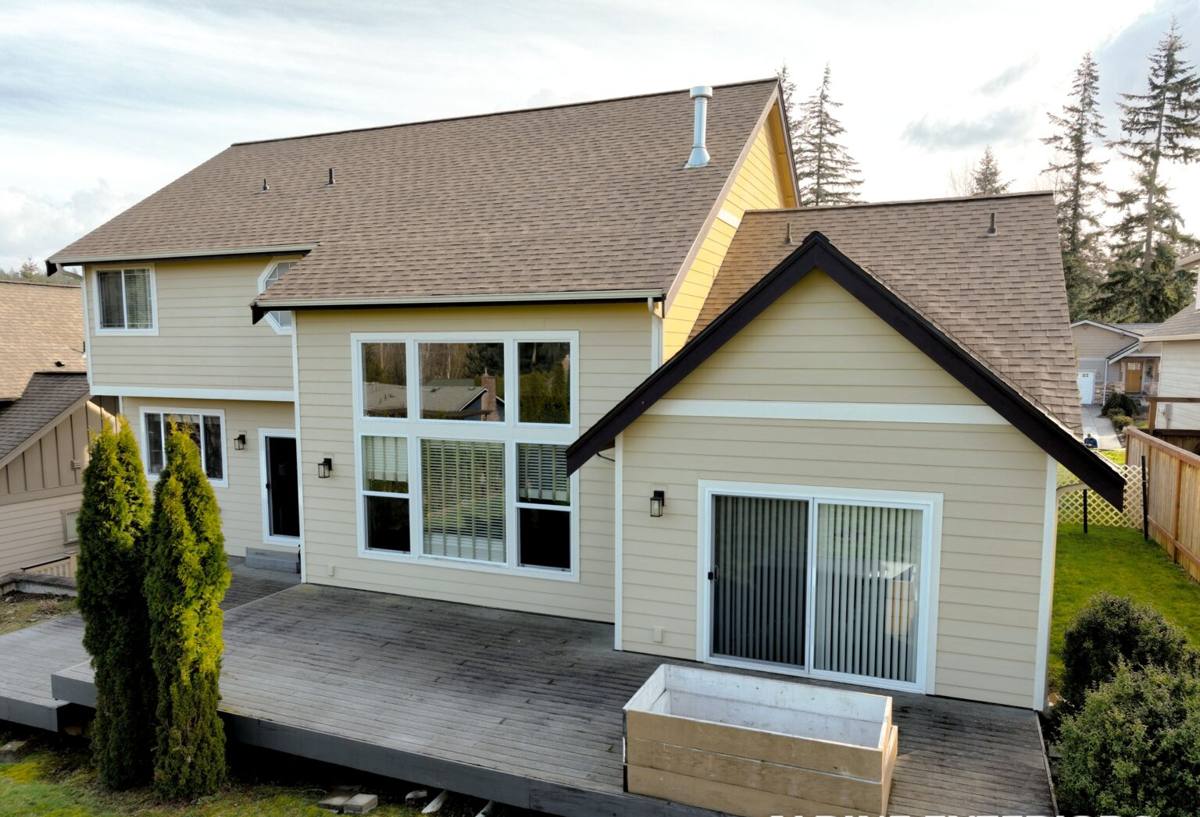
What Correct New Roof Installation Actually Involves
A roof is a system, not a single product. The shingles or panels are the part everyone sees, but most roof failures start underneath, where nobody's looking. For a proper install in this climate, that system includes:
- Deck inspection and repair — any soft, delaminated, or water-stained sheathing gets replaced before anything new goes down. Covering a bad deck with new roofing just hides the problem.
- Ice-and-water shield at vulnerable points — valleys, eaves, and roof-to-wall transitions get a self-adhering membrane, not just felt, because that's where wind-driven rain finds a way in.
- Synthetic underlayment across the field — a durable, water-resistant layer that holds up during the stretch of time between tear-off and final cover, which matters when weather doesn't cooperate.
- Proper flashing at every penetration — chimneys, vents, skylights, and wall intersections are where the vast majority of leaks actually originate, not the open field of the roof.
- Balanced ventilation — intake at the eaves and exhaust at the ridge, sized to the attic volume, so moisture and heat don't get trapped and rot the deck from the inside out.
- Corrosion-resistant fasteners and metal — near the water, standard galvanized components can rust prematurely. Stainless or high-grade coated fasteners and flashing cost more up front and save money over the life of the roof.
Skip any one of these and the roof may look fine for a few years before problems show up — usually as a leak that's already caused hidden damage by the time it's visible inside the house.
Roofing Material Options for Old Town Homes
There's no single "best" roofing material — the right choice depends on the home's roof pitch, its architectural style, and how much long-term maintenance the homeowner wants to take on. Here's how the common options compare for this specific setting:
| Material | Typical Lifespan | Moss & Moisture Resistance | Salt Air Considerations |
|---|---|---|---|
| Architectural asphalt shingle | 25–30 years | Good with algae-resistant granules; needs periodic cleaning | Standard fasteners should be corrosion-resistant grade |
| Standing seam metal | 40–50+ years | Excellent — sheds moss growth, minimal debris retention | Requires coated or coastal-rated panels and fasteners |
| Synthetic composite (shake/slate look) | 30–50 years | Very good, low water absorption | Generally stable; check manufacturer coastal warranty terms |
| Cedar shake | 20–30 years | Higher maintenance — moss and moisture are the main threat | Salt spray accelerates weathering; needs regular treatment |
For a lot of Old Town Anacortes properties, architectural asphalt with algae-resistant granules hits the right balance of cost and performance. Homes with simpler, steeper rooflines are also good candidates for standing seam metal, which sheds moss and needle debris far more effectively than a shingle surface — a real advantage under tree cover, which is common in this neighborhood.
A Note on Cedar Shake
Cedar shake has real visual appeal on older, character-style homes, and we're happy to install it when that's the homeowner's priority. But it's worth being upfront: in a marine climate with a long wet season, cedar demands more upkeep than other options — periodic treatment, moss removal, and closer attention to ventilation underneath it. That's not a knock on the material, it's just the honest maintenance trade-off, and we'll walk through it before you commit either way.
Working With Older Homes and Existing Structures
A meaningful share of homes in Old Town Anacortes were built well before current ventilation and underlayment standards existed. That's not a problem, but it does mean a new roof install often turns up things a newer home wouldn't have: undersized or blocked attic ventilation, older flashing details that were never quite right, or roof decking that's a different thickness or spacing than modern sheathing.
Our approach on these homes is to inspect before we quote, not after we've already started tearing off. If we find deck damage, inadequate ventilation, or flashing that needs to be redone rather than reused, we'll tell you before the work begins and price it as a clear option — not as a surprise add-on once the roof is already open.
Our Installation Process
- On-site inspection — we walk the roof, check the attic, and assess deck condition, ventilation, and flashing points specific to your home.
- Written estimate — material options, scope, and pricing laid out clearly, including what happens if we find deck damage once tear-off starts.
- Tear-off and deck prep — old roofing removed, deck inspected and repaired as needed, debris hauled off the same day where possible.
- Underlayment and flashing — ice-and-water membrane at vulnerable areas, synthetic underlayment across the field, new flashing at every penetration.
- Material installation — shingles, panels, or shakes installed to manufacturer spec, with corrosion-resistant fasteners throughout.
- Ventilation check and final walkthrough — intake and exhaust confirmed balanced, site cleaned, and the finished roof reviewed with you directly.
Moss, Algae, and Long-Term Maintenance
Even a well-installed roof needs some ongoing attention in this climate. Moss doesn't just sit on the surface — its root structure holds moisture against the roofing material and, over years, works its way under shingle edges. Regular gutter cleaning matters more here than in drier parts of the state, since clogged gutters during heavy rain send water back up under the roof edge instead of off the roof.
A few habits go a long way:
- Clear moss and debris from the roof surface at least once a year, ideally before the wet season builds up.
- Keep overhanging branches trimmed back so the roof gets more sun exposure and less constant shade and moisture.
- Check and clean gutters in fall and again after major windstorms.
- Have flashing and roof penetrations visually checked every couple of years, since these are where small problems start.
Cost Factors to Understand Before You Get Quotes
| Factor | Why It Affects Price |
|---|---|
| Roof size and pitch | Steeper roofs take longer to work safely and use more material per square |
| Deck condition | Rotted or delaminated sheathing found during tear-off requires replacement |
| Material choice | Metal and composite systems cost more upfront than asphalt but last longer |
| Number of penetrations | More chimneys, skylights, and vents mean more flashing work |
| Ventilation upgrades | Older homes may need added intake or exhaust vents to meet code |
| Access and site conditions | Tight lots, tree cover, or difficult staging can add labor time |
Broad ranges are all any honest contractor can give before seeing the roof in person — anyone quoting a firm number over the phone hasn't actually inspected your deck or ventilation. A written, itemized estimate after a real inspection is the only number worth comparing.
What to Ask Before Hiring a Roofing Contractor
- Are you licensed and insured to work in Washington State, and can you provide proof?
- Will you inspect the deck and attic before quoting, not just measure the roof from the ground?
- What underlayment and flashing materials are included, and are they upgraded for coastal exposure?
- Do you use corrosion-resistant fasteners appropriate for a marine environment?
- What's the plan if you find deck damage or ventilation issues once the roof is opened up?
- What warranty covers workmanship separately from the manufacturer's material warranty?
Why Local Experience in Old Town Anacortes Matters
A roofing crew that works regularly in this specific area already knows what to expect — the moss patterns under mature tree cover, how far wind-driven rain travels up under eaves during a winter storm off the water, and which flashing details tend to fail first on older Skagit County homes. That's not something you get from a crew that mostly works inland and treats every job the same way. We price coastal-grade materials and fasteners into our estimates because we've seen what standard-grade hardware does after a few winters this close to the water — not because we're upselling.
If your roof is showing granule loss, moss buildup, curling edges, or you've just had enough of patching leaks year after year, it's worth getting a straight answer on whether repair still makes sense or a new roof is the better long-term move. We're happy to walk your roof, give you an honest read on its condition, and put together a free, no-pressure estimate — just fill out the form below to get started.