 Anacortes Siding
 Fiber Cement Siding for Old Town Anacortes Homes
Old Town is one of the older residential pockets of Anacortes, sitting close to the waterfront where the town first took shape. Homes here tend to be a generation or two older than what you'll find in newer parts of Skagit County, and that history shows up on the exterior first — original siding that's been painted over more times than anyone can count, trim that's been patched instead of replaced, and wall assemblies that were built to a very different standard than what's expected today. Combine that older housing stock with a location this close to the water, and Old Town ends up being one of the more demanding places in Anacortes to get siding right.
This page is about one thing specifically: James Hardie fiber cement siding, installed on Old Town homes, by a crew that already works this neighborhood. Not a general overview of every exterior product we've ever heard of — what this particular siding needs to do here, what a correct installation actually involves, and how we approach a project on a street where the average house has already seen sixty, eighty, or a hundred years of Pacific Northwest weather.
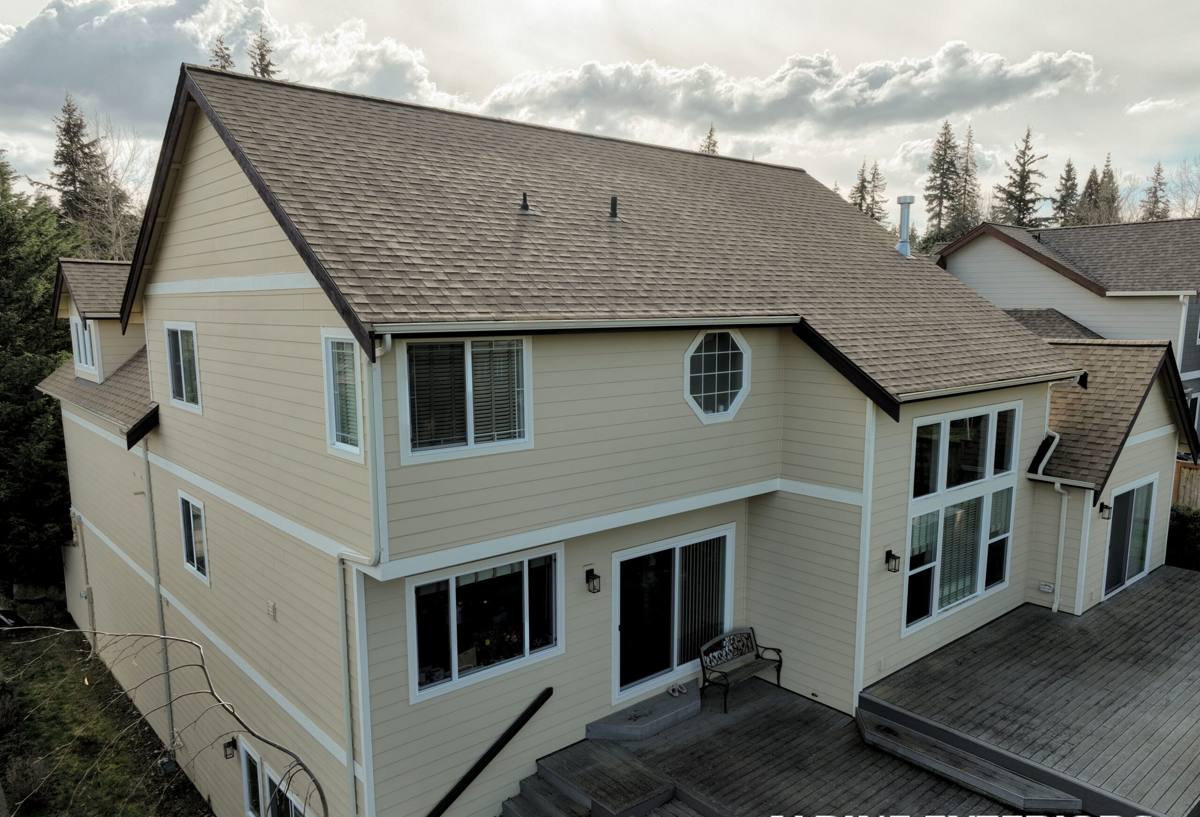
What Old Town's Waterfront Location Asks of Siding
Anacortes sits surrounded by water, and Old Town's position near the original waterfront puts it about as close to that exposure as a residential neighborhood in this city gets. That proximity changes what siding has to withstand compared to a home set back further inland.
Salt Air and Fastener Corrosion
Air moving off the water carries salt, and salt is hard on anything metal over time — fasteners, flashing, hardware. It's a slow process, not a dramatic one, which is exactly why it catches people off guard. A fastener that starts corroding loses holding strength gradually, and by the time it's visible as rust bleed on the siding face, the corrosion has usually been working for years. Older Old Town homes, many of which have gone through at least one prior siding or re-roof job with whatever fasteners were standard at the time, are where we see this show up most.
Driving Rain Off the Water
Rain in this part of Skagit County doesn't reliably fall straight down. Wind off the water pushes it sideways into walls, which stresses seams, laps, and trim joints that a siding system built for calmer weather was never really tested against. On older homes, this matters even more, because the flashing and water-resistive barrier behind decades-old siding often weren't detailed to a modern standard in the first place.
A Moss Season That Doesn't Really End
Mild, damp conditions keep moss and mildew active across most of the year on shaded and north-facing walls, and a lot of Old Town's older lots have mature trees and close-set homes that keep certain wall sections in shade for long stretches. Moss doesn't just look bad — it holds moisture against the siding surface longer than it would otherwise sit, and that extended dampness is what accelerates rot underneath a wall that already has some age on it.
Why Old Town's Older Housing Stock Changes the Job
A fiber cement siding job on a newer Skagit County home and one on an older Old Town home are not the same scope of work, even when the finished wall looks similar. Older homes in this neighborhood were often built and re-sided before modern house wrap, rainscreen gaps, and integrated window flashing were standard practice. That doesn't mean every old wall is failing, but it does mean we go in expecting to find out what's actually behind the existing siding rather than assuming a clean substrate.
Some of what shows up on tear-off in this neighborhood is straightforward — sound framing and sheathing under siding that's simply reached the end of its service life. Some of it isn't — soft sheathing near a window that was never properly flashed, or a section of wall that's been quietly wicking moisture for years behind a layer of old paint. Either way, it's better to find it before new siding goes up than to cover it and let it keep going.
Why We Install Only James Hardie Fiber Cement
We install one siding product on Old Town homes: James Hardie fiber cement. We don't offer LP SmartSide, vinyl, Cemplank, Allura, primed spruce, or cedar. Those are legitimate products and other contractors install them competently — we made a professional decision that, for a climate and a housing stock like this one, standing behind a single system we understand completely serves homeowners better than offering a cheaper alternative that quietly shifts maintenance risk onto them down the road.
- Non-combustible core: fiber cement doesn't feed a fire the way wood-based siding products can.
- Factory-applied ColorPlus finish: the color coat cures under controlled factory conditions rather than being brushed on at the job site, which holds up far better against fading and chalking in salt air and UV.
- Climate-engineered HZ product line: Hardie builds region-specific formulations for areas with heavy sustained moisture, which fits this stretch of the Salish Sea better than a generic national spec.
- Dimensional stability: fiber cement doesn't swell, cup, or warp the way wood-based products can after repeated wet-season moisture cycles — a real advantage on an old wall that's already seen decades of that cycling.
- Strong transferable warranty: backed by one of the more substantial warranty structures in the industry when installed to spec, which matters on a resale-heavy older neighborhood like this one.
How the Alternatives Trade Off on an Old Town Home
| Material | Behavior in This Climate | Consideration on an Older Home |
|---|---|---|
| James Hardie fiber cement | Dimensionally stable; factory finish resists salt air and moss | Standard product we install; matches decades-long service life other original siding on the block has already shown |
| Vinyl siding | Can go brittle with age and UV; not a water barrier on its own | Loose-hung system depends entirely on the barrier behind it — a liability if that layer is original and undocumented |
| LP SmartSide / engineered wood | Wood-fiber core absorbs moisture readily at cut edges | More sensitive to the kind of hidden moisture older walls sometimes already have |
| Cedar / primed spruce | Absorbs and releases moisture continuously; needs a repaint or reseal cycle | Attractive on a historic-style home, but the upkeep schedule is demanding this close to the water |
None of this is a claim that vinyl, engineered wood, or cedar can't be installed competently by someone else. It's an honest statement of why, on homes with this much age and this much water exposure, we've chosen to put our name behind one product rather than several.
What a Correct Fiber Cement Installation Involves
Fiber cement performs the way it's engineered to when it's installed to spec — and falls short of that when it isn't, no differently than any other siding material. On an older Old Town home, getting these details right matters even more, because they're compensating for a wall assembly that's already had decades of exposure:
- A continuous, properly lapped water-resistive barrier behind the siding, with no gaps left over from the old wall
- A drainage gap or rainscreen detail so incidental moisture can dry out instead of sitting against old sheathing
- Correct fastener type, spacing, and depth for fiber cement, using corrosion-resistant fasteners given the salt air exposure
- Properly flashed and sequenced transitions at windows, doors, and any wall penetration — often the weakest point on an older home
- Primed, sealed cut edges wherever a factory-finished board is field-cut
- Correct clearance between the bottom of the siding and grade, porches, or roof lines, which older homes with settled grading sometimes no longer have
Skip any of these and a wall can still look right for a season or two. On an older home, the consequences of skipping them tend to show up faster, because there's less margin left in a wall assembly that's already been through decades of wet Pacific Northwest winters.
Our Process for an Old Town Fiber Cement Siding Project
Walkthrough and Assessment
We start by looking at the actual condition of the home — which walls face the water and take the brunt of wind-driven rain, which are shaded and slow to dry, and what the existing siding and trim are telling us about what's likely happening underneath. On an older home, this step also means an honest conversation about what we expect to find once tear-off starts.
Tear-Off and Substrate Check
Once the old siding comes off, we look at the sheathing and framing before anything new goes up. Sound substrate gets new house wrap and moves straight to installation. Soft or damaged substrate gets repaired first — covering a moisture problem with new siding just delays a bigger repair down the road.
Installation to Manufacturer Spec
Every fastener, lap, and flashing detail follows James Hardie's published requirements for this climate zone. That's what keeps the manufacturer's warranty intact, and it's the same reason the wall performs for decades rather than years.
Final Walkthrough
We walk the finished job with you, explain what little maintenance fiber cement actually needs, and make sure you know what a healthy wall looks like going forward if you ever want to check it yourself.
Cost Factors for Fiber Cement Siding in Old Town
| Factor | What It Affects | Why It Matters in Old Town |
|---|---|---|
| Home age and wall assembly | Prep work before new siding goes on | Older homes more often need substrate repair discovered during tear-off |
| Tear-off vs. overlay | Labor scope and hidden-damage exposure | Tear-off is usually the right call on decades-old original siding this close to the water |
| Trim and window count | Flashing and finish labor | Older homes often have more window and trim detail than newer construction |
| Site access and lot layout | Labor time and staging | Close-set lots and mature landscaping common in Old Town can add setup time |
| Color and profile selection | Material cost | ColorPlus factory finishes hold up against salt air and UV far better than field-applied paint |
Real numbers depend on the specific house — two homes on the same block can price out very differently depending on what's actually behind the existing siding. We walk the property in person before quoting rather than pricing off square footage alone.
Signs an Old Town Home's Siding Needs Attention
- Moss or dark staining that comes back quickly after cleaning, especially on shaded walls
- Soft or spongy siding near the base of the wall or around window and door trim
- Peeling, bubbling, or chalking paint on original siding boards
- Visible gaps at seams, corners, or trim joints where water can track in
- Rust staining around fasteners or flashing, a common sign of sustained salt air exposure
- Cracked, warped, or missing siding sections after a windstorm
- A musty smell or rising heating bills that may point to a wall that's no longer sealing properly
Why Hire a Crew That Already Works Old Town Anacortes
A crew that's worked this neighborhood repeatedly knows what a typical Old Town wall assembly looks like once the old siding comes off, roughly how old the average home's last re-side was, and which orientations take the worst of the wind and salt off the water. That's the kind of knowledge that shapes real decisions on install day — where extra flashing attention is worth the time, which walls need a closer look at the substrate before anyone commits to a schedule, and which details actually matter on a home with this much history versus which are just code minimums. It's the difference between a job that still looks and performs the same in twenty years and one that's showing problems again in five.
If you own a home in Old Town Anacortes and you're weighing new siding, dealing with an aging original wall, or just want a straight answer about what's actually going on behind it, we're happy to take a look. Reach out using the form below to schedule a free, no-pressure estimate.