 Anacortes Siding
 Siding Built for Bow's Particular Climate
Bow sits in that stretch of Skagit County where the landscape can't decide if it wants to be farmland, forest, or shoreline — and often it's all three within a mile of any given house. That mix creates a siding environment that's tougher than it looks from the road. Homes here deal with salt-laden air drifting in off the bay, long stretches of driving rain carried on southwest winds, and shaded, moisture-holding lots where moss and algae get a real foothold on anything that stays damp for more than a day or two.
None of that is exotic or unusual for this part of Washington. But it does mean siding installed here has to do more work than siding on a dry-side or urban-interior home. A product and installation method that's fine in a low-moisture climate can fail early in Bow — not dramatically, just quietly, through swelling, staining, soft spots, and paint that won't hold. We install James Hardie fiber cement siding exclusively, and a lot of that decision comes down to how this specific climate treats a home over ten, twenty, thirty years.
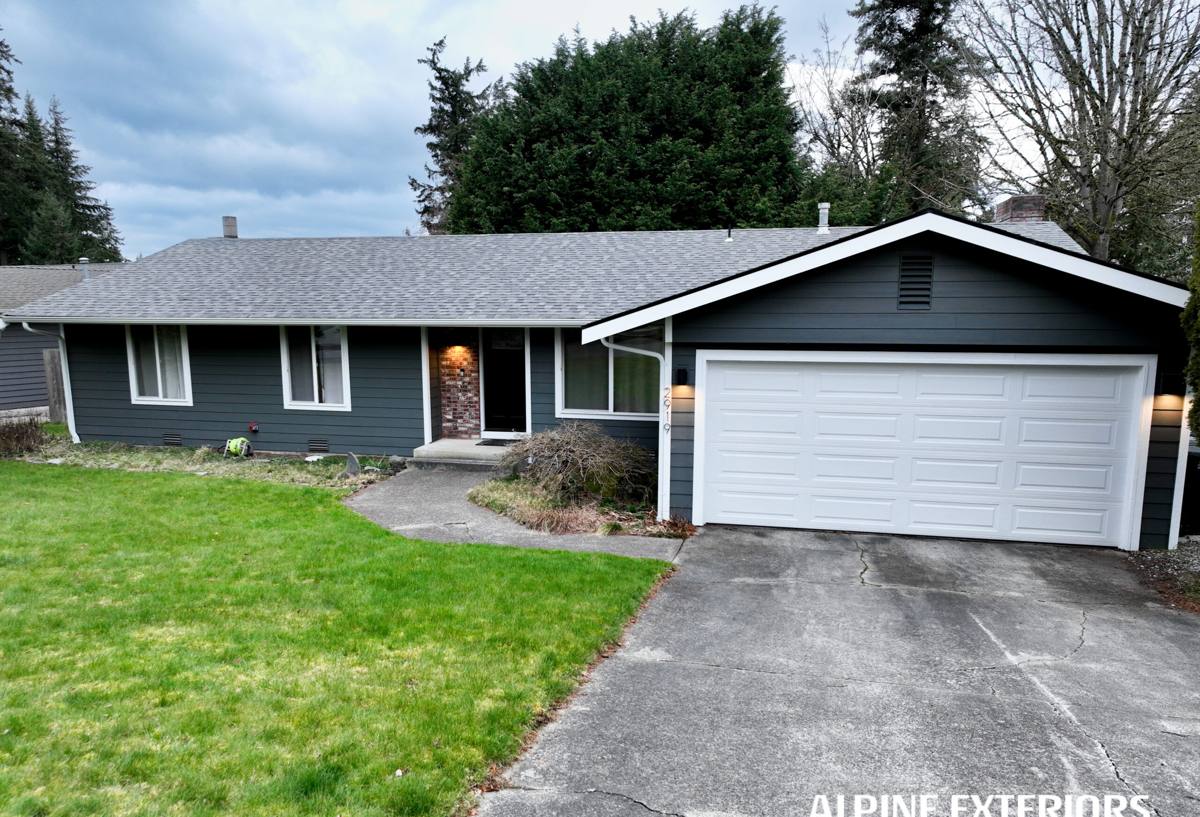
What Salt Air, Rain, and Moss Actually Do to Siding
Salt Air and Corrosion
Proximity to Samish Bay and the surrounding tidal flats means airborne salt is a real factor for homes in and around Bow, even those set back from the water. Salt accelerates corrosion of fasteners, flashing, and any metal trim components, and it can degrade lower-quality paint finishes faster than inland weathering would. Siding materials and finishes that aren't formulated to resist this need more frequent recoating and touch-up than homeowners are usually told to expect going in.
Driving Rain and Wind-Driven Moisture
Rain in this part of Skagit County doesn't always fall straight down. Wind off the water pushes it sideways into wall assemblies, which puts real stress on laps, seams, and butt joints — the places where water intrusion actually starts. A siding system is only as good as its weakest joint, and in a driving-rain climate, sloppy joint work shows up as a problem within a few wet seasons, not decades.
Moss, Algae, and Shade
Tree cover and morning fog keep north-facing walls and shaded eaves damp longer than homeowners often realize. That's exactly the condition moss and algae need to establish themselves on a wall surface. Siding that absorbs moisture, or that traps it against an organic substrate, gives moss something to hold onto. Siding that sheds water and resists moisture absorption at the surface makes it much harder for growth to take hold in the first place.
Why James Hardie Fiber Cement Fits This Environment
James Hardie's fiber cement siding is engineered specifically around moisture performance, and the company builds region-specific product lines — HZ5 for the Pacific Northwest's wet, moderate climate — that are formulated for exactly the conditions Bow deals with. Fiber cement doesn't absorb and swell the way some wood-based and engineered-wood products can when a joint or seam lets water in over time. It also doesn't provide the same organic material for moss and mildew to feed on that untreated or lower-grade wood products do.
The factory-applied ColorPlus finish matters here too. It's baked on under controlled conditions and backed by its own finish warranty, which means the color and protective layer holds up more consistently against sun, salt, and rain than field-applied paint typically does — especially on siding that's going to spend years next to salt air. For homes in Bow, that translates into fewer repaint cycles and a finish that ages evenly instead of chalking or fading unevenly on the weather-facing walls.
Fiber cement is also non-combustible, which is a meaningful consideration in Skagit County given the region's dry-season wildfire risk in surrounding wooded areas — a benefit that has nothing to do with rain or moss, but is part of why we standardized on this product rather than treating fire resistance as optional.
What a Correct Installation Actually Involves
Fiber cement siding's reputation is only as good as the installation behind it. Most of the failures we get called out to inspect on other contractors' work aren't material failures — they're installation shortcuts that let moisture do damage the siding itself was designed to prevent. A correct job in a climate like Bow's includes:
- Proper clearance between the siding's bottom edge and grade, decks, patios, and roofing — tight clearances trap moisture against the bottom course, which is the first place we see rot on poorly installed jobs.
- Correct fastener placement and type — corrosion-resistant fasteners, driven flush (not overdriven), in the pattern the manufacturer specifies, not just "close enough."
- Flashing at every penetration — windows, doors, hose bibs, vents, and any other wall penetration need proper head flashing and kick-out flashing where rooflines meet walls, since these are the leading points of water entry.
- A functioning water-resistive barrier and rainscreen gap where called for, so any moisture that does get past the siding has somewhere to drain and dry rather than sitting against the sheathing.
- Correctly lapped and caulked joints at every butt seam and corner, using sealants rated for exterior, UV, and moisture exposure — not general-purpose caulk.
- Painted or factory-finished cut edges on every field cut, since an unsealed cut edge is a direct path for moisture into the fiber cement itself.
Skipping any one of these doesn't usually cause an immediate, visible problem. It shows up two, five, or ten winters later as a soft spot, a stain, or a section of siding that's failed while the rest of the wall is fine — which is exactly the kind of localized, hard-to-diagnose damage a wet, salt-exposed climate produces.
Our Process for a Bow Siding Installation
1. On-Site Assessment
We walk the home in person, looking at exposure direction, existing moisture damage, roofline intersections, grade clearance, and anything specific to the lot — tree cover, drainage patterns, distance from water — that affects how the new siding needs to be detailed.
2. Tear-Off and Substrate Check
Old siding comes off and we inspect the sheathing underneath before anything new goes up. This is where hidden moisture damage from a prior installation's shortcuts usually turns up, and it needs to be addressed before new siding covers it back up.
3. Weather Barrier and Flashing Detail
We install or verify the water-resistive barrier and get flashing correct at every window, door, and penetration first — this step determines how the whole system performs over the next several decades, and it's not one we compress to save time.
4. James Hardie Installation to Spec
Siding goes up following James Hardie's installation guidelines for our climate zone — correct fastening, clearances, lap dimensions, and sealed cut edges throughout, using the HZ5 product line suited to Pacific Northwest moisture and temperature conditions.
5. Final Walkthrough
We walk the finished job with the homeowner, confirm details against the plan, and make sure warranty paperwork is registered correctly with James Hardie so the coverage is actually in place if it's ever needed.
Cost Factors for a Bow Siding Project
Every home is different, but the factors that actually move a siding project's scope and cost in this area tend to fall into a consistent set of categories:
| Factor | Why It Matters in Bow | Effect on the Job |
|---|---|---|
| Existing moisture damage | Coastal and shaded lots often hide sheathing damage under old siding | May require substrate repair before new siding goes on |
| Home size and wall complexity | More corners, gables, and penetrations mean more flashing detail work | Increases labor time and materials |
| Tear-off vs. re-side | Full removal lets us inspect and correct the substrate | Adds a labor step but reduces long-term risk |
| Trim and accessory scope | Corner boards, fascia, and soffit details affect water shedding | Can be bundled with siding for a consistent, sealed system |
| Site access and lot conditions | Wooded or sloped lots common around Bow can limit staging areas | May affect scheduling and equipment needs |
| Color and finish selection | ColorPlus factory finishes vary by product line and color | Minor cost variation, no difference in installation quality |
Questions to Ask Any Contractor Before You Sign
- Will you show me the actual clearance you're planning between the siding and grade, decks, and roofing?
- What's your flashing detail at windows, doors, and roof-to-wall intersections?
- Are you installing to the manufacturer's published specifications for this climate zone, and can I see them?
- Will you inspect and repair the sheathing before new siding goes up, or is this a cover-over job?
- Is the manufacturer's warranty registered in my name once the job is complete?
- Have you worked on homes in Bow or similar coastal-exposure areas before?
Why It Matters That We Already Work in Bow
A siding crew that's worked this area knows which walls take the worst weather without needing to guess, understands how close a given lot sits to salt exposure, and has already seen what happens when moisture gets past a poorly detailed joint in this specific climate. That local pattern recognition shows up in small decisions — where we add extra flashing attention, how we sequence work around Skagit County's wet-season scheduling realities, and which details we simply don't skip because we've seen what skipping them costs a homeowner down the line.
It also means straightforward logistics: no learning curve on permitting requirements, no guesswork about typical lot conditions in the area, and a crew that shows up already familiar with the kind of house they're working on.
Get a Straight Answer for Your Home
If you're weighing a siding project on your Bow home, we're glad to come take a look, walk the exterior with you, and give you a straightforward read on what your home actually needs — no pressure, no inflated scope. Reach out for a free estimate and we'll go from there.