 Anacortes Siding
 Building New on Fidalgo Island? The Windows Have to Work Before the Siding Ever Goes On
If you're framing a new home, an addition, or a shop conversion anywhere on Fidalgo Island, the windows are not a finishing touch you deal with at the end. New-construction windows get installed with a nailing flange directly into the rough opening, before the weather-resistive barrier is lapped and before siding closes everything up. Get that sequence wrong and you don't find out for a year or two — by then the sheathing behind the window is already wet. Get it right, and the window becomes part of the wall's drainage plane instead of a weak point in it.
We install new-construction windows on framing crews and remodel projects around Anacortes and the rest of Fidalgo Island regularly enough that this isn't a one-off for us. That matters more here than in a lot of places, because Fidalgo Island's exposure to Rosario Strait and the surrounding saltwater channels puts a specific set of demands on a window install that a generic crew from outside Skagit County may not think to plan for.
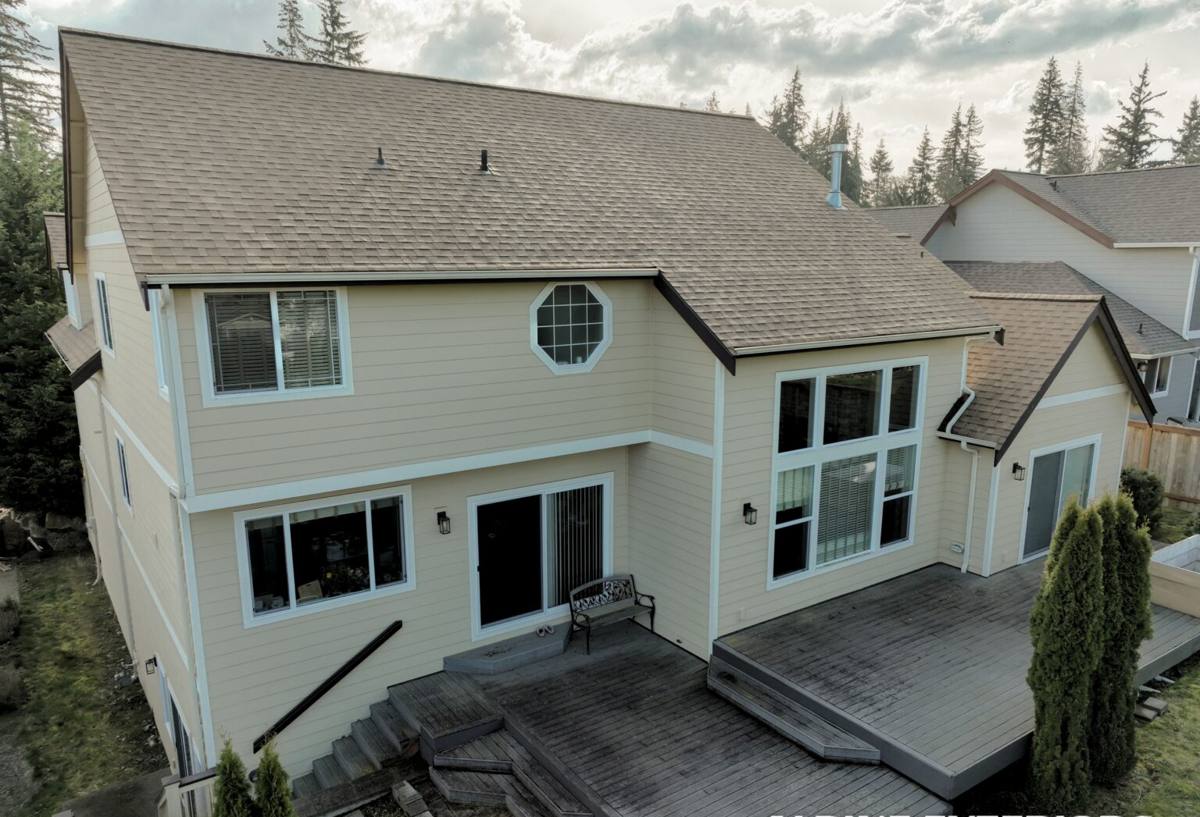
What Fidalgo Island's Climate Actually Asks of a Window Installation
Salt Air and Corrosion
Homes on or near Fidalgo Island sit close enough to saltwater that airborne salt settles on exterior surfaces year-round, and it settles harder on west- and south-facing walls that catch the prevailing wind off the water. Salt film accelerates corrosion on unprotected fasteners, weep-hole screens, and hardware. It's part of why we pay attention to what a window's flashing components and screws are made of, not just the frame material — a window can have a great frame and still develop streaking or corrosion at the hardware if the flashing tape, fasteners, or sill pan components weren't chosen with salt exposure in mind.
Driving Rain and Wind Exposure
Storms coming off the Strait don't just drop rain straight down — wind pushes it sideways, and sideways rain finds any gap in a window's flashing that vertical rain would never reach. A new-construction opening that's flashed correctly sheds that water down and out, in front of the WRB, before it ever touches framing. A window that's only caulked around the flange, with no proper flashing sequence underneath, will eventually leak in exactly this kind of weather — usually quietly, behind the wall, long before anyone sees a stain inside.
The Long Moss Season
Anacortes gets a long stretch of the year where surfaces stay damp enough for moss and algae to take hold — sills, trim, and the tops of window openings included. That's mostly a maintenance issue rather than a structural one, but it does mean sill design and drainage details matter: a sill that holds standing water gives moss and mildew a head start, and a sill that sheds water cleanly doesn't.
New-Construction Windows vs. Replacement Windows: Not the Same Job
We get asked fairly often why a "new-construction" window costs a certain amount versus a replacement window, and the honest answer is that they're solving different problems. On new construction, we have full access to the rough opening, the sheathing, and the WRB — so the window gets integrated into the wall's water-management system from scratch. Replacement windows go into an opening that's already finished, so the work is different in scope and in what it can achieve.
| Factor | New-Construction Window | Replacement / Insert Window |
|---|---|---|
| Installed during | Framing, before siding and finish work | Existing home, opening stays as-is |
| Flashing access | Full access to sheathing, WRB, and rough opening | Limited — works within the existing frame |
| Best suited for | New builds, additions, full remodels | Swapping out old windows without touching siding |
| Water management | Built into the wall assembly from scratch | Depends heavily on the condition of the original install |
| Typical trim/siding impact | Trim and siding installed around the new window | Existing trim usually reused or matched |
Fidalgo Island's new-construction and addition work is mostly the first column — which is good news, because it means we get to do the flashing job right the first time instead of working around decisions someone else made years ago.
The Water-Management Sequence That Actually Prevents Rot
This is the part of the job that doesn't show once the siding's on, which is exactly why it has to be done correctly the first time. The order matters as much as the materials:
- The rough opening gets a sill pan installed first, sloped slightly to the exterior so any water that gets past the window has somewhere to go besides the framing.
- Self-adhering flashing tape goes at the jambs, lapped over the sill pan.
- The window itself is set, leveled, shimmed, and fastened through the nailing flange per the manufacturer's schedule — not just a handful of screws where it's convenient.
- Flashing tape goes over the side flanges, then over the head flange last, so every layer sheds water onto the layer below it — the same shingle-lap principle as a roof.
- The weather-resistive barrier is lapped over the head flashing, never tucked behind it, so the drainage plane stays continuous down the wall.
- Sealant is used at specific points the manufacturer calls out — not smeared everywhere as a substitute for correct flashing, which just traps moisture instead of shedding it.
Skipping or reversing any one of these steps is the single most common cause of window-related water damage we see opened up during remodels — and it's invisible from inside or outside until the damage is already done. On a site exposed to wind-driven rain off the water, there's less margin for a shortcut here than there would be on a sheltered inland lot.
Choosing a Frame Material for a Marine Climate
Frame material is a real decision on Fidalgo Island, not just a budget line. Each option handles the combination of salt air, moisture, and temperature swings a little differently.
| Material | Behavior in Salt Air / Moisture | Maintenance | General Cost Position |
|---|---|---|---|
| Vinyl | Won't rust or corrode; can discolor over many years of UV and salt exposure on unshaded elevations | Low — occasional rinse to clear salt film | Lower |
| Fiberglass | Very stable dimensionally; holds up well to moisture and temperature swings without warping | Low | Mid to higher |
| Wood-clad | Interior wood look with an exterior cladding that protects against weather, but any breach in the cladding exposes wood to moisture | Higher — cladding seams and any exposed end grain need attention | Higher |
None of these is the "wrong" choice — it's a trade-off between upfront cost, maintenance appetite, and how much you value a wood interior. Our professional standard is to be straightforward with clients about what each option actually requires over time in this climate, rather than upselling a material that doesn't fit the maintenance routine they're planning on.
Glass and Performance: What Actually Matters Here
Western Washington's marine climate isn't a high-solar-gain environment, so the glass package decision here leans differently than it would in a sunnier climate. A couple of things worth knowing before you spec glass:
- U-factor (how well the window resists heat loss) generally matters more here than solar heat gain coefficient, since Fidalgo Island doesn't get the kind of intense summer sun that makes SHGC the priority.
- Low-E coatings help retain interior heat during our long, mild-but-damp winters without cutting daylight the way tinted glass does.
- Argon or krypton gas fills between panes improve insulation value, which pays off over a heating season that runs longer here than in drier climates.
- Condensation resistance is worth asking about specifically — high ambient humidity plus temperature swings between indoor and outdoor air is exactly the condition that shows condensation issues on lower-quality glass packages first.
Our Installation Process
Here's what a typical new-construction window job looks like on our end, from first walkthrough to final seal:
- Review the plans or framed openings on site and confirm rough opening sizes against the window schedule before ordering
- Verify flashing materials and sill pan components are appropriate for a marine, high-moisture site
- Install sill pans, jamb flashing, windows, and head flashing in the correct shingle-lap sequence
- Integrate the flashing with the wall's weather-resistive barrier so the drainage plane stays unbroken
- Check every unit for level, plumb, square, and smooth operation before final fastening
- Apply sealant only where the manufacturer specifies it — not as a substitute for proper flashing
- Walk the finished openings with the builder or homeowner and note anything for the siding crew to be aware of at the window returns
Why a Crew That Already Works Fidalgo Island Matters
Fidalgo Island isn't uniform — a lot with direct exposure to the water faces a very different wind load and rain-driving angle than a lot tucked into a more sheltered part of Anacortes. A crew that's done installs across the island has a working sense of which elevations on which types of lots need extra attention to flashing and sealant detail, and which permitting expectations the City of Anacortes and Skagit County apply to new openings. That local familiarity doesn't replace following code and manufacturer instructions — it just means fewer surprises and fewer return trips once the siding and trim are already closed up around the window.
It also means we're not guessing at manufacturer warranty requirements or installation instructions on the fly. Most window manufacturers require their documented installation method to be followed for the warranty to hold, and that documentation is written with normal exposure in mind — a crew used to marine, high-wind sites already builds in the extra care that a coastal opening needs.
What to Expect After Installation
Once your windows are in and the siding's closed up around them, there's very little ongoing work required — but a few things are worth knowing given where you are. Salt film will build up gradually on glass and frames facing the water side of the house, and an occasional rinse keeps it from becoming a permanent haze. Sills and the tops of trim boards can pick up moss or light algae during the wetter months, the same as any exterior surface on Fidalgo Island; a soft brush and an exterior wash a couple of times a year keeps it from taking hold. If you ever notice a window sticking, a draft that wasn't there before, or staining on interior trim below a window, those are worth a look sooner rather than later — they're usually easy fixes early and more involved later.
If you're planning new construction, an addition, or a full remodel on Fidalgo Island and want windows installed the way this climate actually requires, we're happy to walk the site, look at your plans or framed openings, and put together a straightforward, no-pressure estimate — just fill out the form below to get started.