 Anacortes Siding
 Why Guemes Island Decks Wear Out Faster Than You'd Expect
A deck on Guemes Island lives a harder life than the same deck built forty miles inland. The island sits fully exposed to Rosario Strait and the Salish Sea, which means salt-laden air is a constant companion — not just an occasional weather event. That salt air works its way into fastener heads, ledger connections, and any exposed end grain, accelerating corrosion and wood breakdown in ways that are hard to see until a board or bracket fails.
Add in the driving rain that comes sideways off the water during fall and winter storms, and you get moisture intrusion at every horizontal surface and joint. Then there's the moss season — long, damp, and shaded stretches of the year where organic growth gets a foothold on any surface that doesn't dry out quickly. Moss holds moisture against wood and composite alike, and on a north-facing or tree-covered deck, that season can stretch across most of the year.
None of this means a Guemes Island deck is doomed. It means the deck has to be built and maintained differently than a deck in a drier, more sheltered part of Skagit County. Materials, fasteners, flashing details, and drainage all need to account for the environment the deck is actually going to sit in, not a generic Pacific Northwest average.
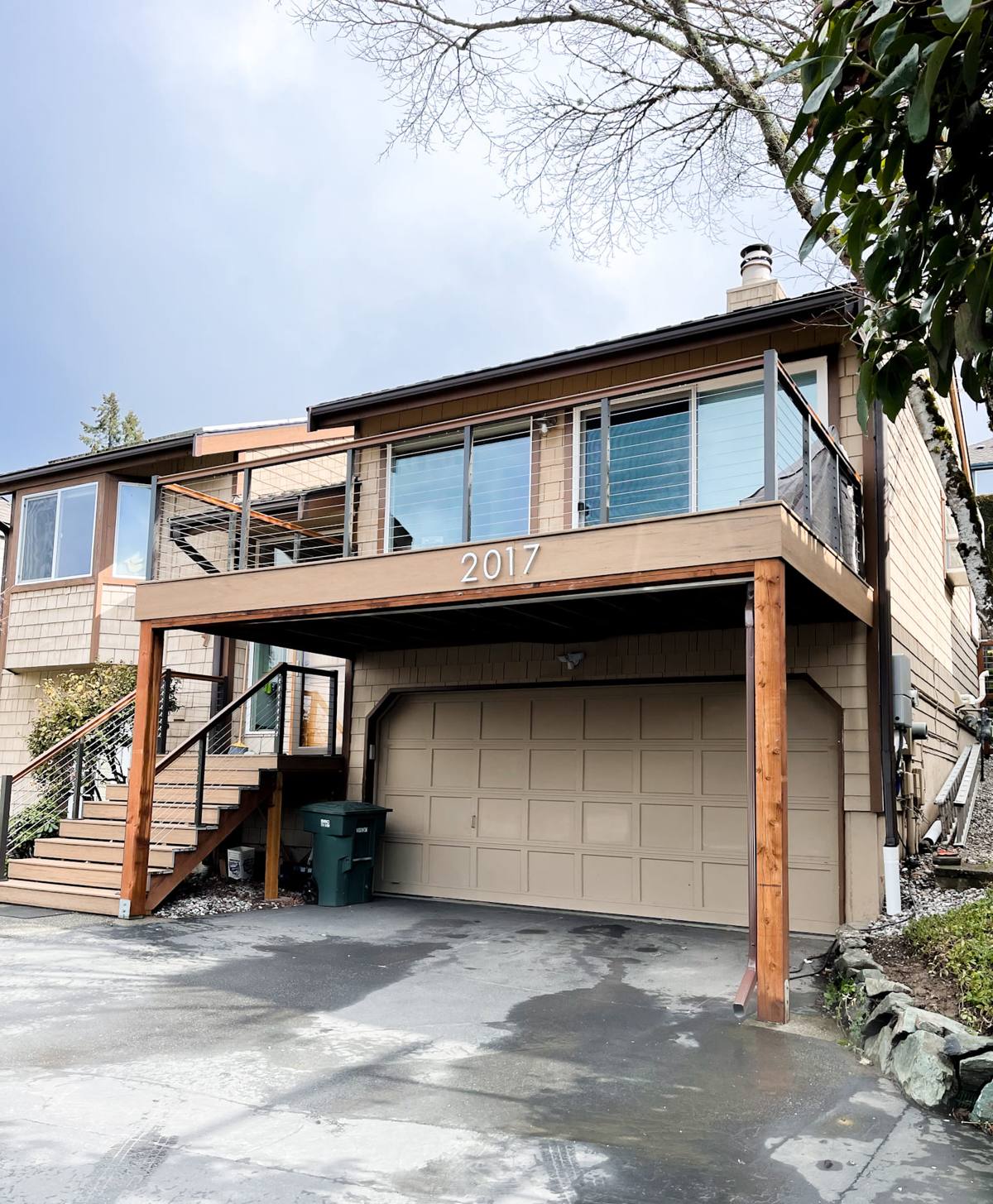
Signs Your Deck Needs Replacement, Not Repair
Homeowners often call us wanting a repair quote and end up learning the deck has passed the point where patching makes sense. Here's what we look for when deciding whether a deck can be saved or should be replaced outright:
- Soft, spongy, or spring-back decking boards, especially near the house or along the outer rim joist
- Rust streaking below joist hangers, ledger bolts, or railing posts
- Visible gaps or separation where the ledger board meets the house siding
- Wood that's gone gray and fibrous (not just weathered on the surface, but soft underneath)
- Persistent moss or algae that returns within weeks of cleaning
- Railings or stairs that flex, wobble, or feel less solid than they used to
- Support posts showing rot at the base, where they meet grade or a footing
Any one of these can sometimes be repaired in isolation. Two or three together, especially on a deck that's already 15-20 years old, usually mean the structure has been absorbing water for a long time and a full replacement will cost less over time than chasing repairs.
What a Correct Deck Replacement Actually Involves
Ledger Board and Flashing
The single most common failure point on any deck — island or mainland — is the ledger board, the piece that attaches the deck to the house. Done wrong, it lets water track behind the siding and into the wall framing, which is a much bigger problem than a bad deck. A correct install uses proper flashing (typically a metal drip flashing paired with a self-adhering membrane) that directs water out and away from the house, not just a bead of caulk and a hope.
Joist Protection
Every cut end and top surface of a joist should be sealed, usually with a self-adhering flashing tape, before decking goes down. This is the detail that gets skipped on cheap jobs because it doesn't show once the boards are on — but it's what keeps water from wicking into the framing lumber year after year, which matters even more in a climate with as much sustained moisture as Guemes Island sees.
Fasteners and Hardware
In a salt-air environment, standard galvanized hardware corrodes faster than it should. We spec stainless steel or heavy-duty coated fasteners and connectors rated for coastal exposure, along with hidden fastener systems where the decking material supports them. This adds a modest amount to material cost and pays for itself many times over by not having rust-streaked, failing hardware in five years.
Footings and Post Bases
Footings need to be sized and set to current code depth, with post bases that hold the post up off the concrete rather than letting it sit in standing water. On sites with poor drainage — common in shaded or lower-lying spots on the island — we'll also look at grading and drainage around the footings themselves.
Material Choices for Guemes Island Conditions
There's no single "best" decking material — the right choice depends on budget, how much upkeep you want to do, and how exposed the deck is. Here's how the common options actually perform in this climate:
| Material | How It Handles Salt Air & Rain | Moss/Algae Resistance | Maintenance |
|---|---|---|---|
| Pressure-treated wood | Good if sealed regularly; end grain and fastener points are vulnerable | Needs periodic cleaning and treatment | Annual cleaning, re-sealing every 1-2 years |
| Cedar | Naturally rot-resistant but still needs sealing near the coast | Moderate; still collects moss in shaded areas | Cleaning and oil/sealer every 1-2 years |
| Composite decking | Excellent — doesn't absorb moisture into the board core | Can still grow surface moss/algae but doesn't rot underneath it | Periodic washing, no sealing needed |
| PVC/capped polymer | Excellent — fully sealed surface resists salt and water absorption | Best surface resistance to organic growth | Lowest — occasional washing |
We install all of these depending on what the homeowner wants, but we'll tell you honestly where each one has trade-offs. Wood costs less up front but demands consistent upkeep to hold up in this climate — skip a couple of sealing cycles and the salt air and rain will find the gaps. Composite and PVC cost more initially but largely remove the maintenance burden, which matters a lot on a property you're not visiting every weekend.
Framing and Structure: What's Underneath Matters Most
The decking surface is what you see, but the framing underneath is what determines how long the deck actually lasts. For replacements, we generally recommend either pressure-treated framing lumber sealed at every cut, or in higher-exposure spots, considering a structural composite or aluminum joist system. The extra cost only applies to framing that's genuinely hard to reach or replace later — for most projects, correctly sealed and flashed treated lumber framing is a sound, cost-effective choice.
Railings deserve the same scrutiny as decking. Cable rail and aluminum systems shed water and don't hold moss the way wood balusters do, but wood and composite rail systems are perfectly fine as long as post connections are flashed and fasteners are corrosion-rated.
The Ferry Factor: Why Logistics Matter for Island Projects
Guemes Island is ferry-access only, and that changes how a deck project has to be planned compared to a job in town. Materials, tools, and crew all have to move on the ferry schedule, which means poor planning turns into wasted trips and delayed timelines. We plan material deliveries and crew days around the ferry rather than discovering the problem mid-project, and we try to batch trips so the work stays efficient instead of stretching out over extra weeks waiting on a forgotten part.
This is also where hiring a crew that already works the island pays off. A contractor who's never worked Guemes Island will often underestimate how much the ferry adds to a schedule, or show up short a tool or material because they didn't plan the trip correctly. We've built our process around it, so island jobs run on a realistic timeline from the first estimate.
Our Deck Replacement Process
- On-site assessment — we inspect the existing deck, ledger connection, framing condition, and drainage, and identify why the current deck failed
- Written estimate — material options, scope, and a realistic timeline that accounts for ferry logistics
- Permit coordination — we handle the permit application and inspection scheduling where required
- Demo and haul-off — full removal of the old structure, including proper disposal (nothing gets left on the island)
- Framing and flashing — new footings/posts as needed, ledger flashing done correctly, joist tape on every cut and top surface
- Decking, railing, and stairs installed to spec, with fasteners and hardware rated for the coastal environment
- Final walkthrough — we go over the finished deck with you, including basic care so it holds up long-term
Permits and Local Considerations
Deck replacement work on Guemes Island falls under Skagit County's permitting jurisdiction, and most structural deck work — especially anything involving new footings or a deck more than 30 inches off grade — requires a building permit and inspection. We handle that process as part of the job rather than leaving it for the homeowner to figure out. Because inspections also depend on scheduling around the ferry, we build that timing into the project plan up front instead of treating it as an afterthought that causes delays later.
Keeping a New Deck Ahead of the Moss Season
A correctly built deck doesn't eliminate moss and algae growth — nothing fully does in this climate — but it does keep growth from turning into structural damage. A few habits go a long way:
- Sweep debris (needles, leaves, seed pods) off the deck regularly, especially in fall
- Rinse or wash the surface a couple of times a year, more often in heavily shaded spots
- Keep gutters and downspouts clear so runoff isn't dumping extra water onto the deck
- Trim back overhanging branches to let more light and air reach the surface
- Check railing posts and stair stringers annually for early rust staining or soft spots
These are simple tasks, but they're what separates a deck that looks and performs well at year fifteen from one that's already showing structural problems by year eight.
Why Hiring a Crew That Already Works Guemes Island Matters
Beyond the ferry logistics, there's real value in working with a contractor who has already seen how decks perform on this specific island over time — which orientations take the worst weather, which older construction habits tend to fail first, and which material choices actually hold up rather than just sound good on paper. That local track record shows up in the details: where we add extra flashing, which fastener spec we won't compromise on, and how we sequence a project around Anacortes and Skagit County's marine climate instead of building to a generic mainland standard.
If your deck is showing its age, or you're just not sure whether it needs a full replacement or can be repaired, we're happy to take a look. Reach out for a free, no-pressure estimate — we'll give you a straight assessment of what your deck actually needs.