 Anacortes Siding
 Why Mount Vernon Decks Take a Beating
Mount Vernon sits in the Skagit Valley, close enough to Puget Sound and the tidal reach of the Skagit River that homes here deal with a version of the same marine climate that shapes exterior work all over this county — humid air, long stretches of driving rain, and shaded, slow-drying corners where moss and algae get a foothold and never really let go. Add in the valley's fog and morning dew, and a deck here spends a lot more of the year damp than a deck in a drier inland climate ever would.
That combination is hard on wood decking specifically. Standing moisture works into end grain and fastener holes, freeze-thaw cycles in winter open up small cracks into bigger ones, and anything shaded by trees or the house itself grows moss and mildew faster than an owner can scrub it off. We see it constantly: boards that cupped or split within a few seasons, ledger connections that trapped water against the house, and railings that started graying and splintering well before the rest of the structure showed its age.
Why Composite Decking Fits This Climate
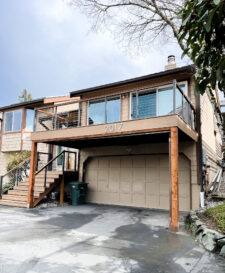
Composite decking — a blend of wood fiber and plastic, usually with a protective cap layer — doesn't solve every problem a Skagit Valley deck faces, but it removes the biggest one: it doesn't absorb water the way solid wood does, so it isn't prone to rot, splintering, or the kind of moisture-driven warping that shows up on wood decks here within a few years. That matters most on north-facing decks, decks under tree cover, and decks close to grade where drainage is already working against you.
What Composite Doesn't Fix on Its Own
Composite still needs a correctly built substructure underneath it. It still gets slippery when moss or algae film builds up on the surface, especially in shaded spots that stay damp for days after a storm. And low-quality or poorly capped boards can fade, stain, or show fastener marks over time. The board itself is only part of a good deck — the framing, drainage, and fastening underneath it do just as much work.
What a Correct Installation Actually Involves
A composite deck that's going to hold up through Skagit County winters isn't just boards screwed to joists. The parts that matter most are usually the ones nobody sees once the job is done:
- Joist framing spaced and sized correctly for the specific composite product being installed — composite spans differently than dimensional lumber, and manufacturer spacing tables exist for a reason
- Proper flashing at the ledger board where the deck meets the house, so water is directed away from the wall rather than trapped behind it
- Joist tape or another moisture barrier on top of the framing, since the joists themselves are still usually wood and benefit from a layer of protection
- Consistent, code-correct gapping between boards for drainage and seasonal expansion
- Hidden fastener systems where the product supports them, for a cleaner surface and fewer entry points for water
- Railing posts and stair stringers anchored to structural framing, not just decking or blocking
Skip any of these and the composite boards on top can look fine for a year or two while the structure underneath quietly develops problems — soft framing, trapped moisture, a ledger connection that's slowly rotting the rim joist it's attached to.
Composite Decking Options: A Cost and Performance Comparison
Not all composite is the same, and the differences show up most in how the deck ages, not how it looks on day one. Here's a general breakdown of what homeowners are usually choosing between:
| Type | Relative Cost | Moisture Resistance | Maintenance | Typical Lifespan |
|---|---|---|---|---|
| Uncapped composite | Lowest | Moderate — can still absorb some moisture at cut edges | Occasional cleaning, more prone to fading/staining | 15–25 years |
| Capped composite | Mid-range | High — protective shell resists staining and moisture | Periodic washing, low overall upkeep | 25–30+ years |
| PVC / cellular decking | Highest | Very high — no wood fiber content to absorb moisture | Low, but can show scratches more visibly | 25–30+ years |
| Pressure-treated wood | Lowest upfront | Low without diligent sealing | Annual sealing/staining recommended | 10–15 years realistically |
These are broad ranges, not quotes — actual pricing depends on deck size, framing condition, railing style, and site access. We'll walk through real numbers for your specific project during an estimate rather than guessing at it here.
Our Process on Mount Vernon Jobs
We're based in Anacortes and already work throughout Skagit County, so a Mount Vernon deck isn't a special trip for us — it's a normal part of the week. That familiarity matters because a lot of decking problems in this area come down to the same handful of climate issues repeating from job to job: bad drainage, shaded areas that never fully dry, and ledger flashing that was installed as an afterthought.
- On-site assessment — we look at existing framing (if there is any), grading and drainage around the deck footprint, sun/shade exposure, and how the deck ties into the house
- Product selection — we walk through composite options honestly, including where a lower-tier product is a reasonable choice and where it isn't worth the money saved
- Framing and structural work — repair or build out joists, posts, and footings to current code and to the spacing the specific decking product requires
- Moisture protection — ledger flashing, joist tape, and drainage detailing before a single board goes down
- Installation — board layout, fastening, and railing installed to manufacturer specs, not just "close enough"
- Final walkthrough — we go over basic care with the homeowner so the deck actually gets the low maintenance composite is supposed to deliver
What We Commonly Find on Existing Mount Vernon Decks
When we're called out to repair or replace a deck rather than build one from scratch, the same few issues show up again and again:
- Ledger boards attached with no flashing, letting years of rain wick into the house rim joist
- Joists spaced for standard lumber but decked with composite that needed tighter spacing, leading to bounce and long-term sagging
- No drainage path underneath low decks, so the crawlspace or ground beneath stays saturated most of the year
- Railings anchored only into the decking surface instead of framing, which becomes a safety issue once the boards start to give
- Moss and algae buildup on shaded sections that were never designed with airflow or drainage in mind
None of these are visible from a quick look at the deck surface — they're the reason a proper inspection matters more than a quote based on square footage alone.
Maintaining a Composite Deck in a Moss-Prone Climate
Composite cuts maintenance dramatically compared to wood, but "low maintenance" isn't "no maintenance," especially with the amount of moisture Skagit Valley sees through fall and winter. A short seasonal routine keeps a composite deck looking and performing the way it should:
- Sweep off leaves, needles, and debris regularly — trapped organic matter is what feeds moss and algae growth
- Wash the surface a couple times a year with a soft-bristle brush and mild soap, more often on shaded sections
- Keep gutters and downspouts clear so runoff isn't dumping directly onto the deck surface
- Check railing posts and stair connections annually for movement, especially after a hard winter
- Clear debris from between boards so drainage gaps stay open
- Trim back overhanging branches to cut down on shade and falling debris where practical
Why Hiring a Crew That Already Works This Area Matters
A lot of decking problems in Skagit County aren't installation mistakes in the sense of sloppy work — they're the result of building a deck the same way it would get built somewhere drier, without accounting for how much water this region actually deals with. A crew that already works Mount Vernon and the surrounding Anacortes area has seen which framing details hold up here and which ones fail early, which shaded spots are going to be a moss problem no matter what, and how to flash a ledger board so it isn't feeding water into the house for the next decade.
That's a different starting point than a contractor who mostly works drier inland climates and treats coastal Skagit County as just another job site. It shows up in the small decisions — where the drainage gap goes, how the joist tape gets lapped, whether the ledger flashing actually sheds water instead of just sitting there — that don't cost more to do right, but take local experience to know matter in the first place.
If you're planning a new composite deck or replacing one that hasn't held up to Skagit Valley weather, we're happy to take a look and give you a straightforward, no-pressure estimate — just fill out the form below.