 Anacortes Siding
 Windows in Mount Vernon Work Harder Than People Think
Mount Vernon sits in the Skagit Valley, close enough to the Salish Sea that the same weather systems driving salt-tinged air and heavy rain into Anacortes and the rest of Skagit County reach inland too. Add the valley's humidity, the long gray stretch of fall through spring, and the moss season that never seems to fully end, and you've got a climate that is genuinely hard on window assemblies. It's not dramatic weather - no hurricanes, no hail the size of golf balls - it's persistent, low-grade moisture pressure, week after week, year after year. That's the kind of exposure that eventually finds every weak point in a window unit or its installation.
Most window failures we see in this area aren't sudden. They're slow. A little bit of moisture gets behind a poorly sealed flange, wood trim stays damp a few extra days each week because it never fully dries between rain events, and a seal that would last twenty years somewhere drier starts failing in twelve. If you own a home in Mount Vernon, understanding that slow-failure pattern is the first step to making a smart decision about replacement.
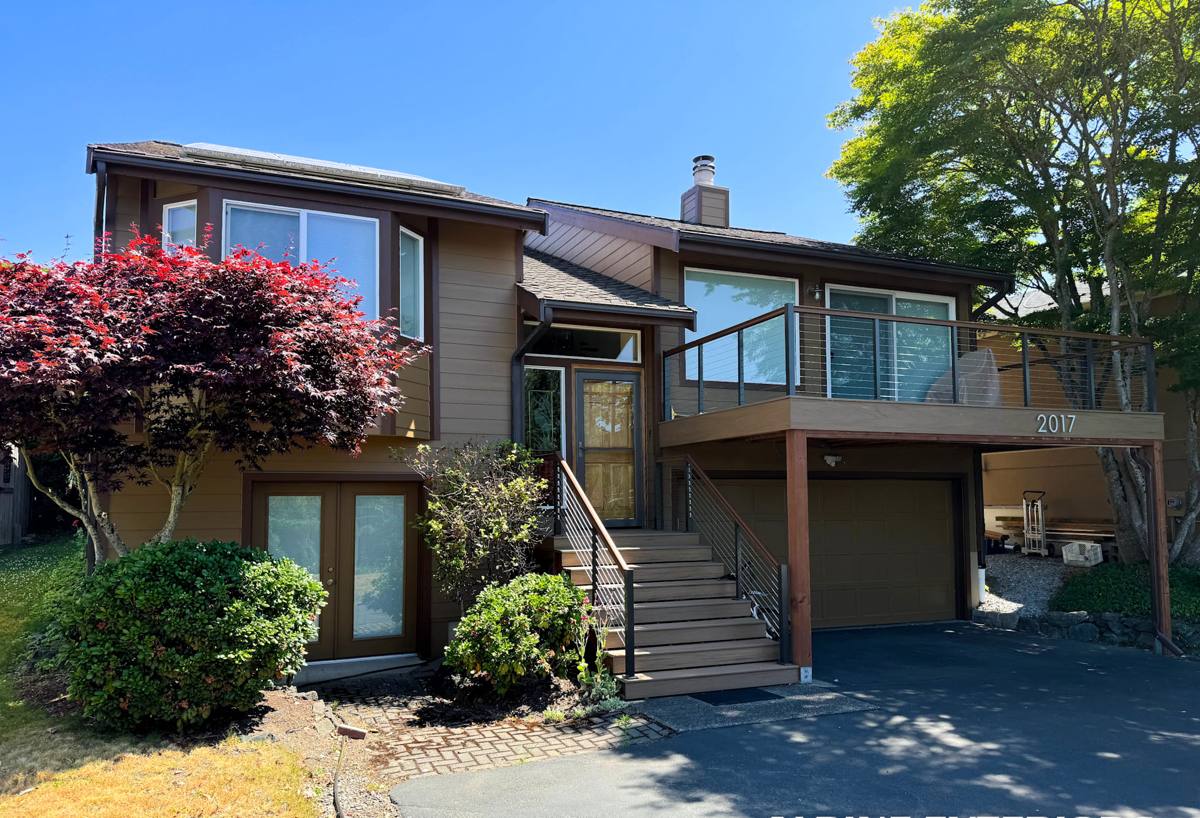
Signs a Mount Vernon Home Needs Window Replacement
Some problems are obvious. Others show up as small annoyances that homeowners live with for years before realizing they add up to a real problem. Here's what we typically look for during an inspection:
- Fogging or a permanent haze between panes - the seal has failed and the insulating gas has escaped
- Soft or spongy trim, sills, or the wall area just below the window
- Windows that are difficult to open, close, or lock, or that no longer sit flush in the frame
- Visible gaps around the frame, or daylight showing through the trim on a bright day
- A cold draft near the window even when it's fully closed and locked
- Condensation forming on the inside of the glass regularly, not just on the coldest mornings
- Moss or black staining developing on exterior trim or the wall just above or below the window
- A noticeable rise in heating costs without any other explanation
Any one of these on its own might not mean much. Two or three together, especially on a home more than 15-20 years old, usually means the window system - not just the glass - is past its useful life.
What a Correct Window Replacement Job Actually Involves
It's Not Just Swapping Glass
A window is only as good as what's behind it. The frame, the flashing, the sealant, and the way the unit is tied into the surrounding wall assembly matter more than the brand name on the sticker. In a climate like ours, where wind-driven rain is common, the flashing detail - how water is directed away from the opening and down the wall rather than into it - is the single most important part of the job. Skip that step, or do it halfway, and even a premium window will eventually leak.
What We Check On Every Installation
Every replacement we do includes checking and correcting the condition of the rough opening, not just installing over whatever is already there. If we find rot, soft sheathing, or a prior installation that was sealed incorrectly, we address it before the new window goes in. Sealing it up and moving on when there's hidden damage underneath just means the same failure happens again in a few years, usually hidden behind a wall until it's expensive to fix.
Choosing the Right Window for Skagit County Weather
There's no single "best" window material - there are trade-offs depending on budget, maintenance tolerance, and how exposed a particular wall is to wind and rain. Here's how the common options compare for a home in this area:
| Material | Moisture Behavior | Maintenance | Typical Lifespan |
|---|---|---|---|
| Vinyl | Won't rot; seams and seals still need to be done correctly | Low - occasional cleaning | 20-30 years |
| Fiberglass | Very stable in moisture and temperature swings | Low | 30-40 years |
| Wood-clad | Attractive but exterior cladding must stay sealed to protect the wood core | Higher - periodic sealant and paint checks | 20-30 years with upkeep |
| Aluminum | Durable frame but conducts cold and can condense in our humidity | Low | 20-30 years |
We don't push one material over another as a blanket rule. We do have a professional standard, though: whatever material a homeowner chooses, the installation detailing has to match our climate. That means paying particular attention to sill pans, sealant compatibility, and drainage paths regardless of what's on the label.
Glass Package Matters Too
Double-pane, low-E glass is the baseline we recommend for this area - it cuts down on the condensation that shows up on cold, humid mornings and helps with the heating bill through our long wet season. Triple-pane is available and does add performance, but for most Mount Vernon homes the added cost doesn't pencil out compared to a well-installed double-pane unit with a good low-E coating.
Our Process From Estimate to Final Walkthrough
- Inspection: we look at every window being considered, plus the trim and wall condition around each one, not just the glass
- Honest recommendation: we tell you which windows genuinely need replacing and which can wait, rather than upselling a full-house job when it isn't needed
- Written estimate: materials, labor, and any repair work to the opening are itemized so there are no surprises
- Removal and opening prep: old units come out carefully, and we check the rough opening for hidden moisture damage before anything new goes in
- Installation and flashing: proper sill pans, flashing tape, and sealant sequencing so water sheds outward, not inward
- Interior and exterior finish work: trim, caulking, and paint-ready or paint-matched finishing
- Final walkthrough: every window is opened, closed, and checked with you before we consider the job done
Mistakes We Commonly Find From Past Installations
A fair amount of our work in this area is correcting problems left behind by rushed or out-of-town crews. The most common issues we run into: sealant used in place of proper flashing, gaps foamed shut instead of flashed and drained, and openings left oversized and packed with insulation as if that alone would keep water out. None of those shortcuts are visible from the street, which is exactly why they go unnoticed until there's a stain on the ceiling or soft trim years later. We frame this as our own installation standard rather than a knock on any particular product - most window units on the market are solid; the failures we see almost always trace back to how the opening was prepared and sealed, not the window itself.
Cost Factors for Mount Vernon Window Replacement
Pricing depends on several variables, and we'd rather explain what drives cost than throw out a number that doesn't reflect your actual home. Broadly, expect a range from a few hundred dollars for a straightforward single-window swap in an already-sound opening, up into the low thousands per window for larger units, custom sizes, or openings that need repair work first.
| Factor | Why It Affects Cost |
|---|---|
| Window size and quantity | Larger openings and whole-house jobs cost more in materials and labor, but often see a lower per-window rate |
| Condition of the existing opening | Hidden rot or water damage adds repair time before the new window can go in |
| Material choice | Vinyl, fiberglass, and wood-clad all carry different material costs |
| Access and home layout | Second-story or hard-to-reach windows take more time and equipment |
| Custom sizing or shapes | Non-standard openings require special-order units, which cost more than stock sizes |
Why Local Experience in Mount Vernon Matters
A crew that only occasionally works in Skagit County can install a window that looks fine on installation day and still fails within a few wet seasons, simply because they're used to detailing for a drier climate. Working regularly in Mount Vernon and the surrounding area means knowing which wall orientations take the worst of the wind-driven rain, how much drainage margin to build in given how long moss and moisture linger here, and which shortcuts simply don't hold up under this weather pattern. That local pattern-recognition is hard to replicate from a general contractor's handbook - it comes from having repaired the failures those shortcuts caused.
Let's Take a Look at Your Windows
If you're dealing with drafts, fogged glass, or windows that just don't feel right anymore, it's worth having someone look at the whole picture - not just the glass, but the frame, the trim, and what's happening behind the wall. We offer free, no-pressure estimates for Mount Vernon homeowners, and we'll always tell you honestly whether you need a full replacement, a partial one, or just a repair. Use the form below to get started.