 Anacortes Siding
 Siding in Old Town Anacortes Has a Harder Job Than It Looks
Old Town Anacortes is one of the older residential pockets in the city, sitting close to the water on Fidalgo Island with a housing stock that spans early-1900s originals, mid-century additions, and newer infill built to match the neighborhood's character. Whatever the vintage, every one of those homes is fighting the same three things year-round: salt-laden air off the surrounding marine waters, driving rain that comes in sideways off Rosario Strait and the Guemes Channel, and a moss season that can run most of the year in Skagit County's damp, shaded microclimates.
Siding here isn't just a cosmetic layer. It's the first line of defense against moisture intrusion, and in a neighborhood with a lot of older framing and original sheathing, the siding system matters more than it would in a drier inland town. This page focuses specifically on James Hardie fiber cement siding as it applies to Old Town Anacortes homes — what the climate demands, what correct installation looks like, and why local experience with this exact neighborhood makes a real difference in the outcome.
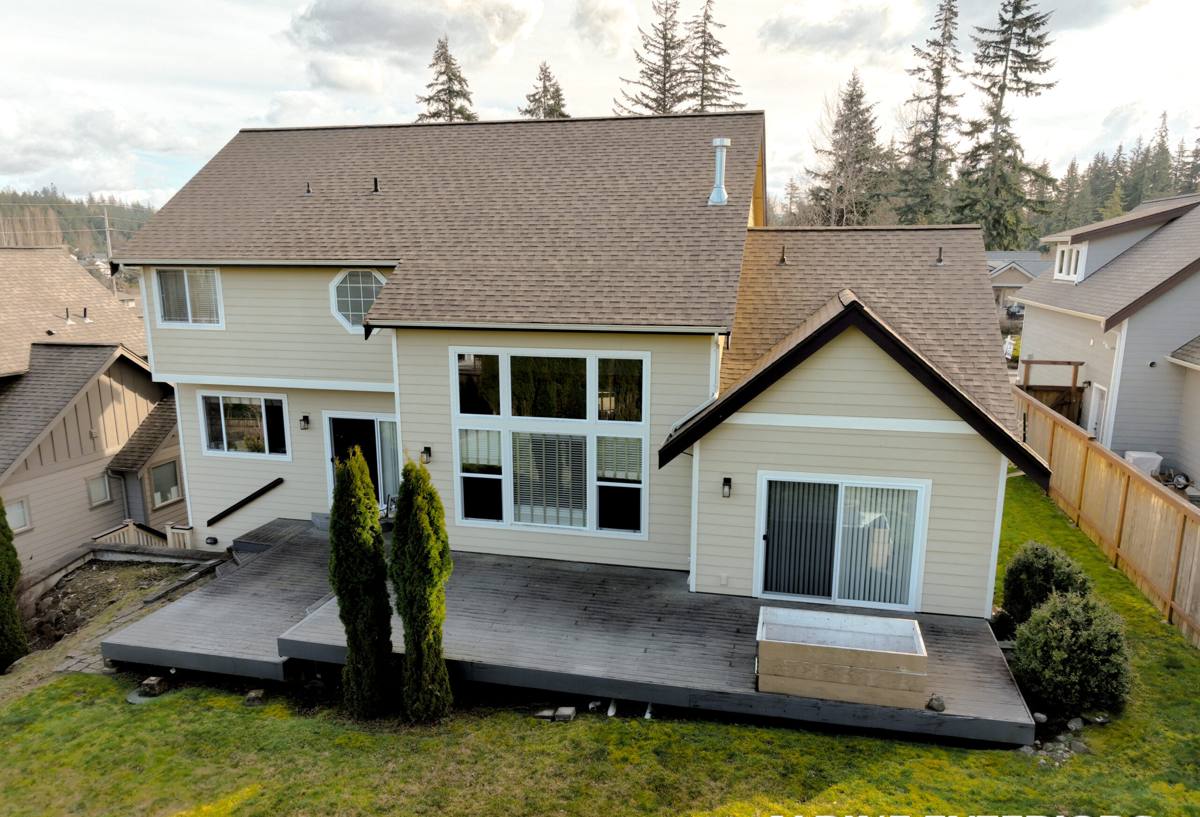
What Salt Air, Driving Rain, and Moss Season Actually Do to a House
Salt Air
Homes close to the water pick up airborne salt that settles on every exterior surface. On untreated wood and many engineered wood products, that salt accelerates surface breakdown and holds moisture against the substrate longer than it would inland. On metal fasteners and trim, salt exposure speeds corrosion if the wrong hardware was used. It's a slow, cumulative effect — the kind of thing that doesn't show up in year one but shows up hard by year ten if the wrong materials went up.
Driving Rain
Anacortes sits in a spot where wind-driven rain off the Strait hits homes at an angle, not straight down. That matters because siding that relies on face-sealing (caulk and paint doing the work of keeping water out) fails faster under driving rain than siding installed with proper drainage planes, flashing, and lap geometry that sheds water instead of fighting it. A lot of siding failures we see aren't about the material — they're about water finding a path in through a joint, a butt seam, or a missing kick-out flashing, and driving rain finds those gaps faster than a gentle inland shower ever would.
Moss and Persistent Moisture
Skagit County's damp, mild climate is good for gardens and bad for exterior surfaces that stay wet. Moss and algae growth on north-facing walls, under eaves, and in shaded side yards is common, and it's not just cosmetic — sustained moisture and organic growth against a wall assembly can trap dampness against the siding and, eventually, the sheathing behind it. Siding that resists moisture absorption and doesn't provide an easy foothold for organic growth holds up dramatically better here than siding that does.
Why James Hardie Fits This Climate
James Hardie fiber cement is engineered specifically to handle the conditions Old Town Anacortes homes deal with every year. A few specifics that matter for this location:
- HZ5 engineered formulation: Hardie's climate-specific product lines are formulated for regions with freeze-thaw cycling and sustained moisture exposure — a good match for Pacific Northwest marine conditions, including the salt air and persistent damp common near the water in Anacortes.
- Non-combustible core: Fiber cement doesn't burn, rot, or feed insects the way wood-based products can. That's a durability advantage independent of the weather, but it compounds with everything else on this list.
- Moisture resistance: Fiber cement doesn't absorb and swell the way engineered wood or untreated wood siding can. It holds its shape and its paint line under repeated wet-dry cycling, which is exactly the cycle Anacortes weather puts a house through most of the year.
- ColorPlus factory finish: A baked-on, UV-cured finish applied under factory conditions holds color and resists fading, chalking, and moisture-driven peeling far better than field-applied paint — especially useful on a home that's going to face salt air and rain exposure for decades.
- Transferable warranty: Hardie's warranty structure is designed around the product performing over the long term, not just looking good on installation day, and it transfers if the home changes hands — a real factor for older Old Town properties that turn over periodically.
Fiber Cement vs. Other Siding Materials in a Marine Climate
Homeowners in Old Town Anacortes often ask how James Hardie stacks up against other common siding options once you factor in the local climate specifically. Here's an honest comparison:
| Factor | James Hardie Fiber Cement | Vinyl | Engineered Wood | Untreated Cedar |
|---|---|---|---|---|
| Moisture/rot resistance | High — cement-based, doesn't rot | High, but relies on gaps/seams that can trap water behind panels | Moderate — vulnerable if the factory seal is breached | Low without diligent maintenance |
| Salt air durability | Strong — inert to salt exposure | Can become brittle and discolored over time | Weaker — moisture uptake accelerates near water | Weathers quickly near marine air |
| Moss/algae resistance | Good — dense surface, factory finish | Fair — surface can stay damp in shaded areas | Fair to poor depending on coating | Poor — porous surface favors growth |
| Fire performance | Non-combustible | Combustible, can melt/deform | Combustible | Combustible |
| Long-term appearance | Holds color via factory finish | Can fade, warp in heat | Depends on maintenance of coating | Requires repainting/staining cycles |
This is why our company installs James Hardie exclusively rather than offering vinyl, engineered wood, or untreated wood siding as alternatives. We'd rather put one product on every home that we know performs correctly in this climate than offer a menu of options where some are a worse long-term bet for a house sitting this close to the water.
What a Correct James Hardie Installation Involves
The siding material is only part of the equation — how it's installed determines whether it performs for thirty-plus years or starts showing problems in five. On an Old Town Anacortes project, a correct installation includes:
Weather-Resistive Barrier and Drainage Plane
A properly lapped weather-resistive barrier goes on before any siding, with a drainage gap where the wall assembly calls for it so incidental moisture behind the siding has somewhere to go instead of sitting against the sheathing.
Flashing at Every Penetration
Windows, doors, hose bibs, light fixtures, and any other wall penetration need proper flashing integrated with the water-resistive barrier — not just caulked over. On a home taking direct, wind-driven rain, flashing details are where most long-term leaks either get prevented or get built in.
Correct Fastening and Clearances
Hardie siding has specific fastener spacing, embedment depth, and clearance requirements from grade, roof lines, and decks. Getting clearances wrong is one of the most common installation mistakes we see on older homes where a previous re-side didn't follow spec — it's an easy thing to get wrong and a hard thing to fix later without pulling siding back off.
Caulking and Joint Treatment Done to Spec
Butt joints, corners, and trim intersections need to be treated exactly as Hardie specifies — not just field judgment. Manufacturer-spec installation is also what keeps the product warranty intact, which matters as much as the physical performance.
Our Process, Start to Finish
- Walk-through and assessment: We look at the current siding, the wall assembly where visible, moisture or moss patterns, and anything specific to the home's age or exposure.
- Written estimate: A clear scope covering material, prep work, flashing and moisture-barrier details, and timeline — no vague allowances.
- Prep and tear-off: Removal of existing siding, inspection of sheathing underneath, and repair of any damaged material before new siding goes up — problems don't get covered over.
- Weather barrier and flashing installation: The unglamorous part that determines long-term performance.
- Hardie installation to manufacturer spec: Correct fastening, clearances, and joint treatment throughout.
- Final walk-through: We review the finished job with the homeowner before calling it done.
Why Local Experience in Old Town Anacortes Matters
A crew that's already worked in this neighborhood understands things a crew from outside doesn't have to think about elsewhere: narrower older lots with tighter access for staging materials and equipment, the mix of home ages and the different wall assemblies that come with each era, and the realities of working close to the water where wind and weather windows shift plans more often than they would a few miles inland. It also means we're familiar with how the City of Anacortes handles permitting and inspection for exterior work, so there are no surprises mid-project.
None of that replaces doing the installation correctly — but it does mean fewer surprises, better scheduling around actual weather rather than a generic forecast, and a crew that isn't learning the neighborhood's quirks on your project.
What to Ask Before Hiring for a Job Like This
- Do they install to James Hardie's published specifications, including fastener and clearance requirements?
- Will they inspect and repair sheathing before re-siding, not just cover over existing problems?
- Do they detail flashing at windows, doors, and penetrations, or rely mainly on caulk?
- Are they factory-trained or experienced specifically with Hardie's ColorPlus and HZ5 product lines?
- Have they worked on homes in Anacortes or similar marine-exposure areas before, not just inland projects?
- Is the warranty explained clearly, including what keeps it valid?
Maintenance After Installation
James Hardie siding installed correctly needs very little upkeep, but a marine climate still calls for periodic attention: an annual rinse to keep salt residue and organic buildup from accumulating, a visual check of caulked joints and trim intersections every year or two, and prompt attention if you notice a joint opening up or a section of trim pulling away. None of this is heavy maintenance — it's closer to a once-a-year walk-around than a project — but it's what keeps a properly installed system performing for its full lifespan in a climate that doesn't let up.
If you own a home in Old Town Anacortes and want a straight answer about what your siding actually needs, we're happy to take a look and provide a free, no-pressure estimate — just fill out the form below.