 Anacortes Siding
 Skyline sits up on the bluff on the west side of Anacortes, with homes facing open water and taking weather straight off the Salish Sea. That exposure is part of why people buy there, and it's also exactly why a roof in Skyline works harder than a roof a few blocks inland. Salt-laden air, wind-driven rain, and a moss season that barely takes a break are a tough combination for any roofing material, and metal roofing has become the material we most often end up recommending on bluff-facing lots in this part of Skagit County — not because it's trendy, but because of how it actually holds up under this specific set of conditions.
What Skyline's Exposure Actually Does to a Roof
A roof on an open bluff lot doesn't experience weather the same way a roof tucked into a sheltered inland yard does. Wind coming off the water pushes rain sideways and upward under eaves and into valleys, rather than letting it fall straight down and run off. Salt carried in that air settles on every exposed surface and accelerates corrosion on anything that isn't built to resist it — fasteners, flashing, and cheaper roofing metals all show wear faster here than they would a few miles inland. Add in the shade from mature evergreens that many Skyline lots have, plus the Pacific Northwest's long stretch of damp months, and you get near-ideal conditions for moss and algae to take hold and stay there.
None of that is unique to this one neighborhood, but the degree matters. We work on roofs throughout Skagit County, and the difference between an inland roof and a Skyline roof that faces the water directly is real and measurable in how quickly problems show up. That's the lens we look through when we're evaluating a Skyline roof and talking through whether metal is the right call.
Salt Air and Corrosion
Salt exposure is the single biggest reason metal roofing spec matters more here than it would inland. Not all metal roofing is built the same way, and a panel, fastener, or flashing detail that would hold up fine forty minutes from the water can corrode noticeably faster on a bluff lot that catches wind straight off the Sound.
Wind-Driven Rain
Rain that's being pushed sideways by wind finds its way into places straight-down rain never would — under panel laps, around vent penetrations, and at any seam or flashing detail that isn't sealed and lapped correctly. A roofing system that's only been detailed for a calmer inland site tends to show leaks first at exactly these spots.
A Long, Persistent Moss Season
Shade and moisture that never fully dry out are what moss needs to establish itself, and a lot of Skyline lots have both from tree cover and the marine layer that sits over this part of the county for much of the year. Moss holds water against a roof surface and, on materials that give it something to grip, it keeps coming back no matter how often it's cleaned off.
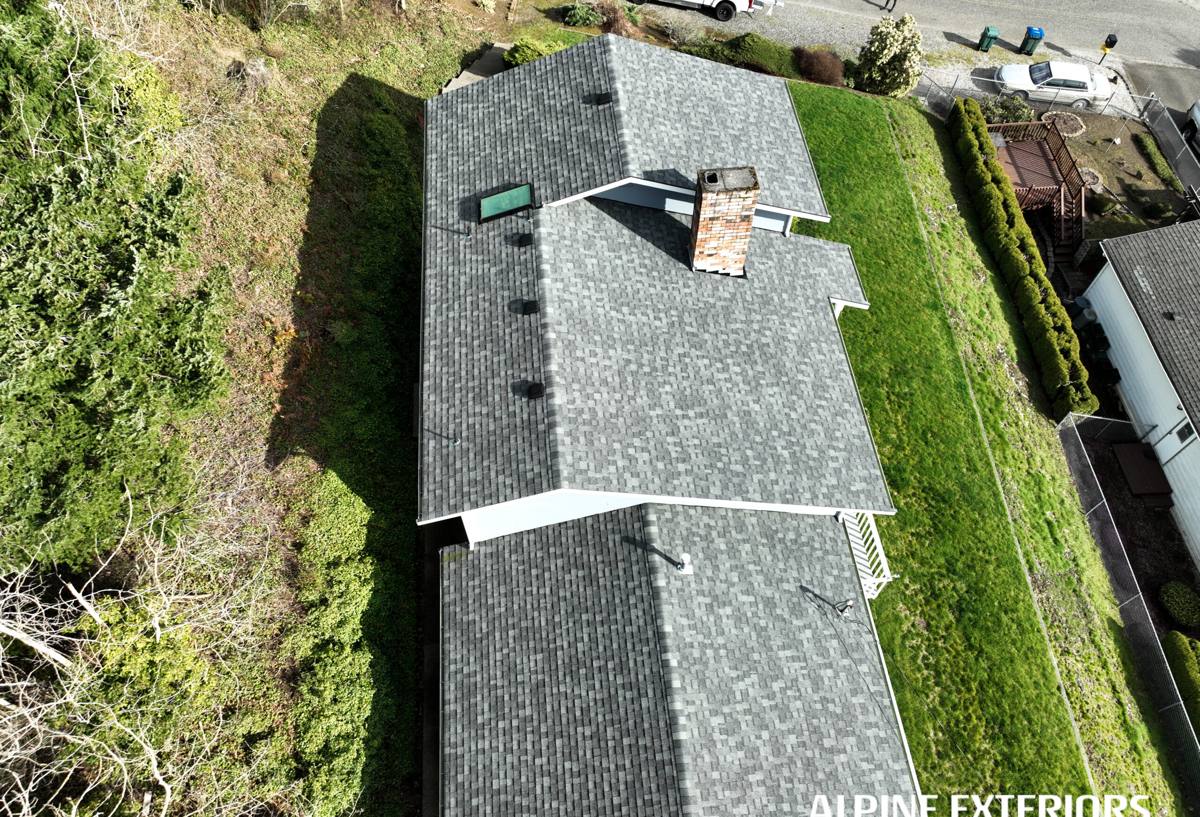
Why Metal Roofing Fits This Specific Site
Metal roofing's biggest advantage on a lot like this is its smooth, non-porous surface. Moss and algae have a much harder time getting a foothold on a properly installed metal roof than they do on shingles, and what does land tends to wash off in the next hard rain rather than accumulating season after season. The panel system itself — whether it's standing seam or a quality exposed-fastener product — is also built around continuous runs and mechanically locked seams rather than overlapping individual shingle tabs, which gives wind-driven rain far fewer entry points to exploit.
Longevity is the other piece. A correctly installed and coated metal roof on a coastal-exposure lot like Skyline can reasonably be expected to outlast two or three cycles of asphalt shingle replacement, which matters on a site where access, scaffolding, and tree removal for staging make every roofing project more involved than a straightforward inland job. Fewer full replacements over the life of the house is a real advantage here, not just a sales point.
Panel Systems and Materials: What the Differences Actually Mean
"Metal roofing" covers a range of products, and the differences between them matter more on an exposed bluff lot than they would somewhere sheltered. We walk homeowners through the real trade-offs rather than defaulting to whichever panel is easiest to install.
| System | Corrosion Resistance | Wind/Water Performance | Fit for Skyline |
|---|---|---|---|
| Standing seam steel (concealed fastener) | Strong with quality coating and proper flashing | Excellent — mechanically seamed, no exposed fasteners to loosen or corrode | Our default recommendation for direct water exposure |
| Standing seam aluminum | Naturally corrosion-resistant, doesn't rust | Excellent, same seam advantages as steel | Strong choice where salt exposure is the top concern |
| Exposed-fastener steel panel | Depends heavily on fastener quality and gasket condition | Good, but fasteners can loosen and gaskets age faster in this climate | Workable on a budget, but needs more upkeep on an exposed lot |
| Stone-coated steel | Good, coating protects the steel core | Good; profile mimics shingle or tile | Reasonable middle option where a traditional look is wanted |
For a Skyline home taking direct wind and salt exposure, we lean toward standing seam in either steel or aluminum. The concealed-fastener design removes the weak point that exposed-fastener systems carry — screws and washers that sit out in the weather and are the first thing to corrode or work loose over time.
What a Correct Installation Actually Involves
Metal roofing rewards correct installation and punishes shortcuts more than some other materials do, because a mistake in the underlayment or flashing doesn't show up right away — it shows up as a leak two or three winters later, after the wind-driven rain has finally found the gap.
Underlayment and Deck Prep
We start with a full inspection of the roof deck, since metal roofing is unforgiving of a deck that's already soft or moisture-damaged underneath the old roofing. A high-temperature, self-adhering underlayment goes down as the water barrier beneath the panels — this matters more here than in a drier climate, since it's the backup layer that has to perform if wind-driven rain ever gets past the panel seams.
Fastening and Thermal Movement
Metal panels expand and contract with temperature swings, and a system that doesn't account for that movement will eventually work fasteners loose or distort panels at the seams. Concealed-clip standing seam systems are built to let panels move slightly without stressing the fastening points, which is one more reason we favor that system on an exposed lot where temperature and moisture cycling happen constantly.
Flashing at Valleys, Walls, and Penetrations
Nearly every roof leak we trace back to its source starts at a flashing detail, not a failure of the roofing material itself. Valleys, chimney and vent penetrations, and roof-to-wall transitions all need flashing that's lapped correctly and fastened with materials compatible with the panel metal — mixing incompatible metals at a flashing joint can set off galvanic corrosion that eats through material from the inside, something that shows up faster in salt air than almost anywhere else.
Ventilation
A roof deck that can't breathe holds moisture longer, which shortens the life of the underlayment and any wood framing underneath it. We check existing ventilation and correct it where needed as part of a metal roof installation rather than treating it as a separate, optional line item.
Coatings and Finish: Why the Details Matter Near Saltwater
The paint or coating system on a metal roof isn't just about color — it's the layer standing between the metal and the salt air, UV exposure, and moisture cycling this site sees year-round. A PVDF (Kynar 500-type) coating resists fading, chalking, and film breakdown far better than a basic polyester coating over the panel's service life, and that difference is more visible on an exposed bluff roof than on a sheltered one. We also pay attention to panel gauge — thicker material resists dents and handles wind uplift better — and to whether the fastener and flashing hardware supplied with a system is actually rated for coastal exposure, not just standard-grade.
Our Process for a Skyline Metal Roofing Project
- Full roof and deck inspection, checking for existing moisture damage, soft decking, and the condition of current flashing and ventilation
- An honest conversation about panel system, material, and coating options, with real trade-offs explained rather than a single default pitch
- Tear-off of the existing roofing where needed, with deck repair addressed before anything new goes down
- Underlayment, panel installation, and flashing detailed for this site's wind and water exposure specifically
- A final walkthrough covering what was done, what to expect going forward, and any maintenance notes specific to the site
We don't skip steps to save a day on the schedule, and we don't treat flashing and ventilation as afterthoughts. On a lot like Skyline, those details are the difference between a roof that performs for decades and one that needs attention again in a handful of years.
Signs a Skyline Roof Might Be Ready for a Metal Roof Conversion
- Moss that keeps coming back on shaded slopes no matter how often it's cleaned off
- Granule loss, curling, or cracking on an aging asphalt shingle roof
- Rust staining or visible corrosion on existing flashing, vents, or fasteners
- Water staining on interior ceilings or near chimneys and wall transitions
- A roof that's had repeated patch repairs without the underlying problem being resolved
- An upcoming remodel or addition where a longer-term roofing solution makes sense
Any one of these is worth a look before another wet season passes. On an exposed lot, small problems tend to compound faster than they would somewhere sheltered.
Why a Crew That Already Works Skyline Matters
Skagit County's coastal microclimates aren't uniform, and Skyline's particular combination of elevation, open water exposure, and tree shade is something you learn by working on roofs here repeatedly, not by reading a spec sheet. We know which parts of a Skyline roof take the brunt of a winter storm, which flashing details matter beyond code minimums on this kind of site, and how tree cover and driveway access on a bluff lot affect staging and scaffolding compared to a flat, open lot elsewhere in Anacortes. That local experience shapes how we scope a job before a single panel goes up, and it's part of why we'd rather walk a Skyline roof in person than quote one off a photo.
What to Expect From an Estimate
We'll walk the roof, check the deck and existing flashing where accessible, and give you a straight read on condition — what's failing from age versus what's failing from exposure or a shortcut in a prior installation. From there we'll talk through panel system and material options suited to your specific roof, budget, and how long you plan to stay in the house, and put together a written scope with no pressure to sign that day.
If you're in Skyline and dealing with moss that won't quit, an aging shingle roof, or you're simply weighing metal roofing for a home in this exposure, we're glad to come take a look. Reach out for a free, no-pressure estimate through the form below.