 Anacortes Siding
 Why Decks in Bow Wear Out Faster Than You'd Expect
Bow sits in that stretch of Skagit County where the weather off Samish Bay and the wider Salish Sea does real work on exterior wood and hardware. It's not one dramatic storm that takes a deck down — it's the accumulation. Salt-laden air corrodes fasteners and connectors from the inside of the joints where you can't see it. Driving rain, often blown sideways off the water, gets pushed up under boards and around ledger connections instead of just falling straight down and running off. And Skagit County's long, damp shoulder seasons mean moss and algae have months at a time to colonize any surface that doesn't dry out quickly.
None of that is unique to Bow, but the combination — coastal exposure plus a long wet season plus tree cover on a lot of rural and semi-rural properties — is harder on a deck here than it would be on the same structure fifty miles inland. When we get called out to look at a deck in this area, the failure pattern is almost always the same: the surface still looks okay from a distance, but the framing, fasteners, or ledger connection underneath has been quietly failing for years.
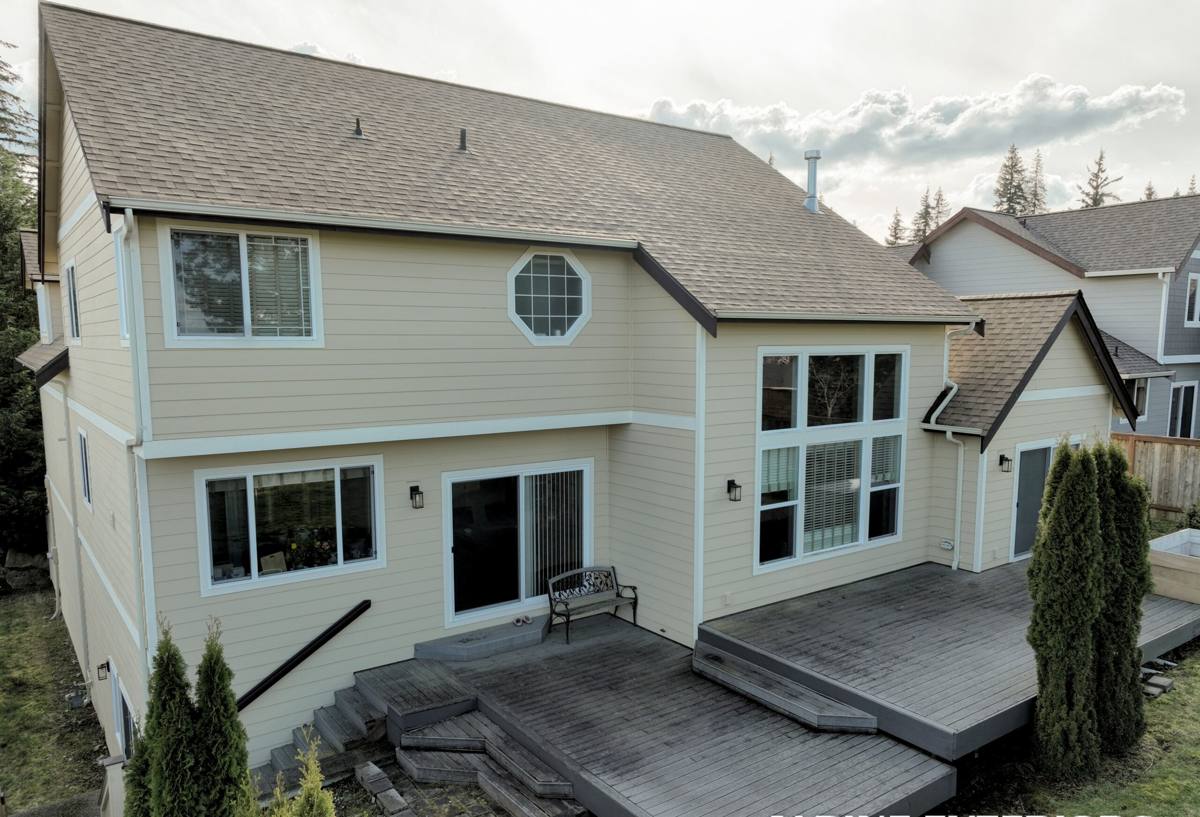
Signs a Deck Needs Replacement, Not Another Repair
Repair makes sense when the problem is isolated. Replacement makes sense when the problem is systemic. Here's how we tell the difference on a service call:
- Soft or spongy spots in more than one area of the decking, not just around a single board
- Rust streaking or bleeding from joist hangers, ledger bolts, or post bases
- Gaps or movement where the ledger board meets the house — this is a structural safety issue, not cosmetic
- Persistent moss or black staining that comes back within weeks of cleaning, which usually means the deck isn't shedding water and drying the way it should
- Posts that feel loose at the base, or visible rot at ground contact points
- A deck more than 15-20 years old built before current flashing and hardware standards were common practice
If what you're seeing is limited to a few boards and the framing underneath is sound, a repair is the honest answer and we'll tell you that. If the issues above show up in multiple places, patching individual boards just delays a bigger problem and spends money on a structure that's already at the end of its service life.
Why "It Looks Fine From the Top" Is Misleading
Composite and capped-board decking especially can look presentable on the surface long after the framing underneath has started to go. The decking's job is to shed water and take foot traffic — it's not designed to hide structural problems, but it's very good at doing so anyway. That's why we always inspect from underneath the deck, not just walk the surface, before quoting repair versus replacement.
Choosing Decking Material for This Climate
There's no single "best" decking material — there's a best material for this specific site, this specific budget, and how much upkeep you actually want to do. Here's how the common options hold up against salt air, standing moisture, and moss pressure:
| Material | Moisture/Salt Resistance | Moss Resistance | Maintenance |
|---|---|---|---|
| Pressure-treated lumber | Good if properly sealed and re-sealed | Low — porous surface holds moisture and organic growth | Annual cleaning and re-sealing recommended |
| Cedar | Naturally rot-resistant but still needs sealing near salt air | Moderate | Periodic staining/sealing to keep resistance up |
| Capped composite | Excellent — non-porous cap sheds moisture and salt | Good, though still needs cleaning in shaded, damp areas | Low — occasional washing |
| PVC decking | Excellent — fully synthetic, no wood core to absorb moisture | Good | Low |
For a lot in Bow with real tree cover or a north-facing exposure that stays damp longer, we usually steer homeowners toward capped composite or PVC — not because wood is a bad product, but because the maintenance burden of keeping a wood deck sealed and clean in this specific microclimate is a real, ongoing cost that a lot of people underestimate when they first choose it. If you want the look and feel of real wood and are prepared to keep up with sealing on a schedule, cedar remains a solid choice — we just want that decision made with full knowledge of what it takes to maintain it here, not somewhere drier.
What a Correct Deck Replacement Actually Involves
A deck replacement that's done right isn't just new boards on old framing. It's a full evaluation of everything the decking sits on, because that's the part that fails first in this climate.
Ledger and House Connection
This is the single most important structural connection on an attached deck, and it's also the one most exposed to water intrusion if it isn't flashed correctly. We install proper ledger flashing that directs water away from the house sheathing, not just a bead of caulk over lag bolts — caulk is not a substitute for flashing, and it fails long before the deck does.
Framing and Fasteners
We use corrosion-resistant, coated or stainless fasteners and hangers rated for the coastal exposure this area gets. Standard electro-galvanized hardware can start corroding within a few years this close to salt air, and once a joist hanger fails, the deck's load path is compromised even if the surface still looks fine.
Footings and Posts
Post bases that hold posts up off the concrete rather than embedding them directly, and footings sized and set to current code depth for this area. Ground-contact rot at post bases is one of the most common failure points we find on older decks.
Decking Surface and Gapping
Board spacing matters more here than in a dry climate — proper gapping lets the deck dry out between rain events instead of trapping moisture between boards, which is exactly the condition moss needs to take hold.
Our Deck Replacement Process
- On-site assessment — we inspect the existing deck from above and below, check the ledger connection, and identify what's driving the failure so you understand exactly what you're paying to fix.
- Honest scope and estimate — a clear breakdown of what's being removed, what's being rebuilt, and material options with real trade-offs explained, not just a single quote.
- Demo and disposal — full removal of the old deck surface and any compromised framing, with the site kept clean and safe throughout.
- Structural rebuild — ledger flashing, framing, corrosion-resistant hardware, and footings brought up to current standards.
- Decking and railing install — your chosen material installed with proper gapping and fastening for this climate.
- Final walkthrough — we go over the finished deck with you, including what maintenance (if any) it needs going forward.
Railings and Hardware That Actually Hold Up Here
Railings take a lot of the same coastal punishment as the deck itself, often worse, since they're more exposed to wind-driven rain. Wood railings need the same sealing commitment as wood decking. Metal railing systems should be aluminum or a coated steel rated for coastal exposure — untreated or poorly coated steel hardware is one of the fastest things to show rust streaking in this area, usually within the first couple of winters. Whatever railing style you choose, we match the fastener and bracket spec to the exposure the deck actually gets, not a generic inland spec.
Keeping a New Deck Looking Good Through Skagit County's Wet Season
A properly built deck in this climate still needs some basic upkeep — the difference is how much, and how often. A simple seasonal routine goes a long way:
- Sweep debris and standing leaves off the surface regularly, especially under tree cover — trapped organic matter is what feeds moss growth
- Rinse salt residue and grime off the surface a few times a year, more often if the deck faces open water or wind exposure
- Check railing and post connections annually for any looseness or corrosion starting at fastener heads
- For wood decking, keep to a sealing schedule rather than waiting until it visibly needs it — by the time graying and cracking show up, moisture has already gotten in
- Keep gutters and downspouts near the deck clear so runoff isn't dumping extra water onto or under the structure
Composite and PVC decking cut most of this down to occasional cleaning, which is exactly why they've become the practical choice for a lot of Bow-area homeowners who want a deck they can actually use instead of one they have to manage.
Why Hiring a Crew That Already Works This Area Matters
A deck built to a generic regional spec and a deck built for the specific conditions around Bow are not the same product, even if they look identical on installation day. Crews who work Anacortes and the surrounding Skagit County communities regularly know which fastener grades actually hold up here, which ledger flashing details matter most given the rain patterns, and which materials are worth the added upfront cost versus which ones just add maintenance without adding durability. That knowledge doesn't come from a manufacturer's spec sheet — it comes from going back to decks we've built or repaired in this exact area and seeing what held up and what didn't.
If you're weighing repair versus replacement, or just want a straight answer about what material makes sense for your specific lot, we're happy to come take a look. There's no pressure and no obligation — just an honest assessment and a written estimate you can think over. The form below will get you started.