 Anacortes Siding
 Deck Repair Built for La Conner's Waterfront Climate
La Conner sits right on the Swinomish Channel, which means decks here take a different kind of beating than decks ten miles inland. Salt-laden air off the water accelerates corrosion on fasteners and hardware, driving rain off Puget Sound drives moisture into end grain and joints, and the long gray stretch from fall through spring keeps wood surfaces damp for days at a time. Add in the shade and moss growth that comes with mature trees and tight lots common around La Conner, and you have a recipe for decks that look fine on the surface while quietly failing underneath.
We work throughout Skagit County, and La Conner decks are some of the most consistent repair calls we get precisely because of this combination: coastal humidity, heavy rain volume, and moss that holds water against boards and framing long after a storm has passed. A repair here isn't just cosmetic touch-up — it has to account for what the marine environment is doing to the structure underneath.
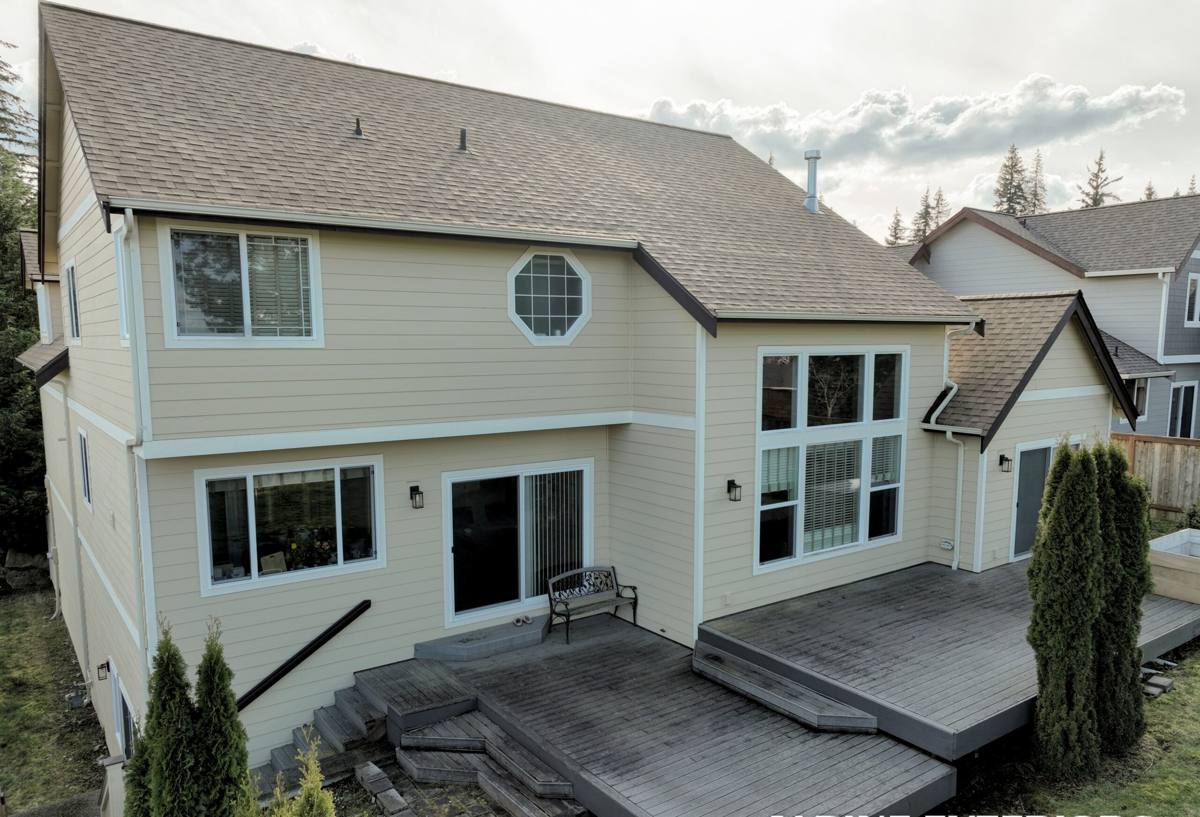
What Actually Fails on La Conner Decks
Before we talk about repair, it helps to know what we're usually looking for when we inspect a deck near the water in this area.
Ledger Board and Framing Rot
The ledger board — where the deck attaches to the house — is the single most important structural point on most decks, and it's also the most common failure point. Flashing that was installed poorly, or wasn't installed at all, lets water track behind the board and into the rim joist. In a climate with this much sustained rainfall, that slow leak can go undetected for years until the wood is soft enough to probe with a screwdriver.
Fastener and Hardware Corrosion
Proximity to salt water speeds up corrosion on nails, screws, and structural hardware like joist hangers and post bases. We regularly find galvanized fasteners that have rusted through in homes near the channel, even when the wood around them still looks serviceable. Corroded hardware is a structural issue, not a cosmetic one — it's holding the deck together.
Moss and Surface Moisture Retention
Moss doesn't just look bad. It holds moisture directly against the decking surface, which keeps boards wet far longer than open sun and air would allow. Over a full La Conner winter, that constant dampness breaks down wood fiber and creates the soft, spongy spots homeowners usually notice first with their feet before they see them with their eyes.
Post Base and Footing Deterioration
Posts that sit in standing water or damp mulch, or that were never properly isolated from concrete footings, wick moisture upward. This shows up as soft wood at the base of support posts — a serious structural concern since these posts carry the deck's load.
Railing and Guard Post Movement
Loose or wobbly railings are usually a sign that the fasteners or the post connection have degraded, often from the same moisture and corrosion issues affecting the rest of the structure. This is also a safety issue we prioritize, since a failing guard post is a fall risk.
What a Correct Deck Repair Actually Involves
A lot of deck "repairs" amount to swapping a few obviously bad boards and calling it done. That approach misses the point in an environment like La Conner's, where the damage that matters most is often hidden. Our process is built around finding out why a board failed, not just replacing it.
- Full structural inspection of the ledger board, rim joist, and flashing — not just a visual pass, but probing suspect areas with an awl to check actual wood integrity
- Inspection of all support posts and footings for base rot and proper standoff from soil or concrete
- Check of every joist hanger, post base, and structural fastener for corrosion, not just the ones near visibly damaged boards
- Assessment of decking board condition, including underside inspection where accessible, since rot often starts on the hidden face
- Railing and guard post stability check, including fastener condition at each connection point
- Evaluation of drainage and grading around post footings, since standing water at the base is a recurring issue on lower-lying La Conner lots
From there, the repair plan depends on what we find. Isolated rot at a few boards is a straightforward board-and-fastener replacement. Rot at the ledger or framing level is a bigger job that involves opening up the connection, replacing compromised structural members, and correcting the flashing detail so the same failure doesn't happen again in a few years. We tell homeowners honestly which category their deck falls into — there's no benefit to either of us in patching over a structural problem.
Repair vs. Replacement: How We Help You Decide
Not every deck with problems needs to be torn out. But not every deck is worth repairing either. The decision usually comes down to how much of the structure — versus just the surface — has been compromised.
| Condition | Usually Repairable | Usually Needs Replacement |
|---|---|---|
| Decking boards | A handful of soft or cupped boards, isolated by moss or standing water | Widespread soft boards across most of the deck surface |
| Ledger board | Minor surface rot caught early, flashing correctable | Deep rot compromising the house-to-deck connection |
| Support posts | One or two posts with base rot, framing otherwise sound | Multiple posts affected, or footing movement present |
| Railings | Loose posts from corroded fasteners, wood otherwise solid | Widespread rot in rail posts or top rail structure |
| Overall age | Under 15-20 years, quality lumber, isolated issues | Original construction with mixed problems and aging materials |
When a deck is on the fence between repair and replacement, we walk homeowners through the actual condition we found, room by room on the structure, so the decision is based on what's really there rather than guesswork.
Materials: Matching the Repair to a Marine Climate
What we use to repair a La Conner deck matters as much as the workmanship. Pressure-treated lumber rated for ground contact is the standard for framing and posts in this environment — anything less doesn't hold up to the sustained moisture exposure common here. For fasteners and hardware, we use stainless steel or heavy-duty coated products rated for coastal and treated-lumber contact, since standard galvanized hardware is exactly what we're often replacing when we find corrosion damage on an existing deck.
On decking material, homeowners in this area typically choose between quality wood decking and composite boards. Both can perform well near the water if installed correctly, but each has real trade-offs worth understanding before you decide, rather than picking based on price alone.
- Wood decking costs less upfront and can be refinished or spot-repaired board by board, but it needs regular sealing and cleaning to resist moss and moisture in this climate — skipping maintenance is what leads to the rot we see most often.
- Composite decking resists moisture and moss better with less upkeep, but it costs more initially, and damaged boards typically need full replacement rather than sanding or spot repair.
- Whichever material is already on your deck, we generally recommend repairing with matching or compatible material so the structure ages evenly rather than mixing old and new products that expand, contract, or weather differently.
Why Flashing and Drainage Detail Matter More Here
Anacortes and the surrounding Skagit County shoreline get a lot of driving rain, not just straight-down rain — wind off the water pushes moisture sideways into ledger connections and under decking edges that would stay dry in a calmer inland climate. This is why flashing detail at the ledger board is something we treat as non-negotiable on every repair, even when it wasn't the reason for the original service call. A deck can have brand-new boards and still fail again in a few years if the flashing behind them was never corrected.
Similarly, drainage at the base of support posts deserves more attention in La Conner than it might in a drier part of the state. Grading that lets water pool against a post base, even briefly after a heavy rain, is enough to start rot in ground-contact-rated lumber over several wet seasons. Part of our repair scope includes checking and, where needed, correcting the grading or adding drainage gravel around footings that are holding water.
Our Process for La Conner Deck Repairs
- On-site inspection. We walk the full deck structure — surface, framing, posts, and ledger connection — and probe any area that looks or feels suspect.
- Honest scope and estimate. We explain what we found in plain terms, what's structural versus cosmetic, and give a written estimate before any work starts.
- Repair or rebuild the affected areas. This includes structural framing, ledger and flashing correction, decking replacement, and hardware upgrades as needed.
- Final safety check. Before we call the job done, we test railings, stair connections, and structural points to confirm everything is solid, not just freshly painted or capped.
Seasonal Timing for Deck Repair in This Area
Late spring through early fall is the best window for deck repair work in the La Conner area, since it gives lumber and any protective finishes time to dry and cure properly before the wet season returns. That said, structural issues — soft ledger boards, wobbly railings, rotted post bases — shouldn't wait for ideal weather. A deck with a compromised ledger or guard post is a safety issue regardless of the calendar, and we can often stabilize or repair the structural elements even in wetter months, with cosmetic and finish work scheduled for a drier stretch.
Signs Your La Conner Deck Needs a Repair Inspection
- Boards that feel spongy, springy, or noticeably softer underfoot than the rest of the deck
- Visible moss buildup that doesn't dry out between rain events
- Railings or guard posts that move or wobble when pushed
- Rust staining around fasteners or hardware
- Gaps, dark staining, or peeling paint where the deck meets the house at the ledger board
- Stairs that feel less rigid than they used to, or visible movement at stringer connections
- Standing water that lingers around post bases after rain
If any of these sound familiar, it's worth having the deck looked at before the next wet season adds to the damage.
Why Local Experience Matters for This Work
A crew that mostly works drier inland climates can miss the specific failure patterns that show up on decks near the Swinomish Channel — the corrosion rate on hardware, how far moss retention actually degrades boards in a Skagit County winter, and where driving rain from the water tends to find its way into ledger connections. We work on homes throughout Anacortes and the surrounding communities, including La Conner, and we bring that pattern recognition to every inspection: knowing what to check first, and knowing which quick fixes won't hold up against another wet season on the water.
If your deck needs an honest look — whether it's a few soft boards or something more structural — we're happy to come out, walk the whole structure with you, and give you a straightforward assessment. The estimate is free, there's no pressure, and you'll know exactly what condition your deck is really in before you decide anything.