 Anacortes Siding
 Why Storm Damage Looks Different on an Edison Roof
Edison sits out on the flats between the Skagit Valley farmland and the water, which means roofs here take a specific kind of beating. There's very little to break the wind coming off Samish and Padilla Bay, so gusts move across open fields and hit rooflines at odd angles instead of the more sheltered wind pattern you'd get tucked into Anacortes proper. Add in salt-laden air drifting inland off the water, near-constant driving rain through fall and winter, and heavy tree cover in the shadier lots, and you get a roof that ages differently than one twenty miles inland. We service roofs all over Skagit County, but Edison's combination of open-field wind exposure and coastal moisture is one we see often enough to plan for specifically.
Storm damage repair here isn't just about patching what a single windstorm broke. It's about recognizing that the same storm that lifted a few shingles also pushed rain sideways into gaps that were only marginal before, and that the moss quietly working under those shingles has been softening the mat for months. A repair that only addresses the obvious tear does the homeowner a disservice if it ignores what set it up.
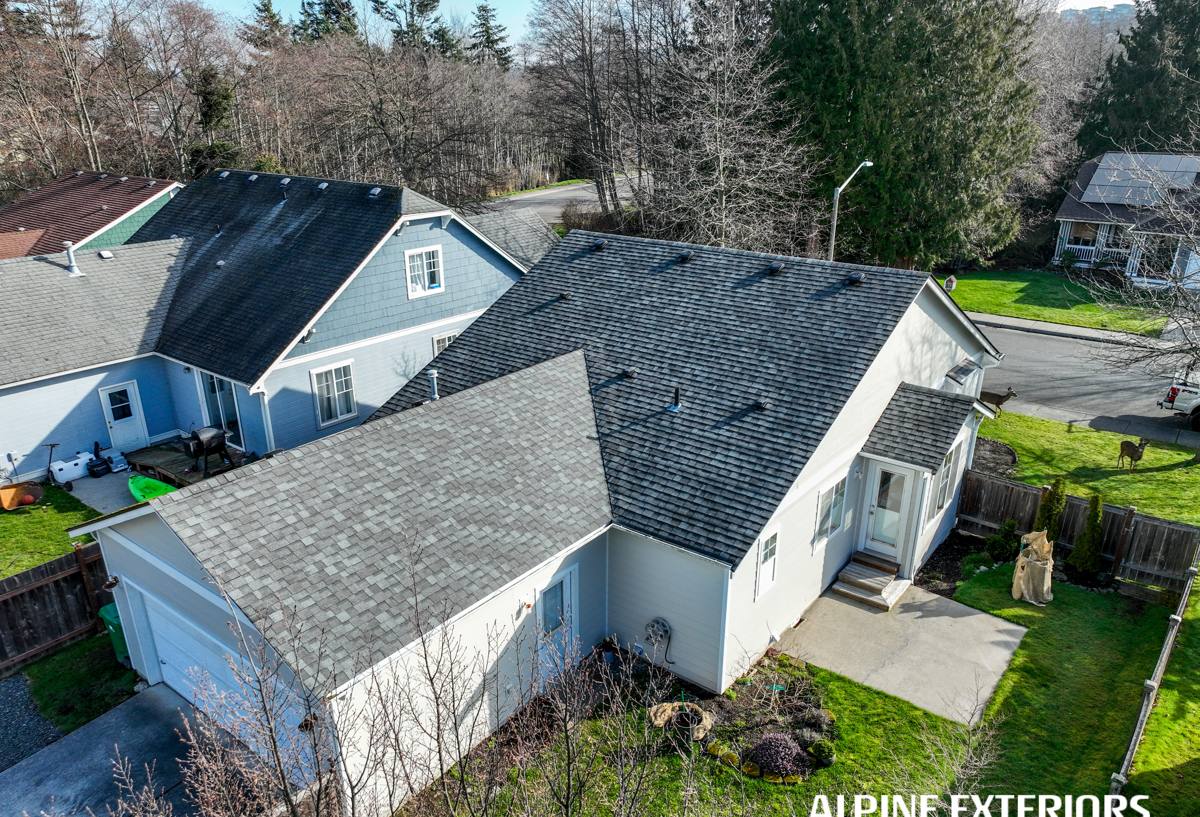
What Actually Counts as Storm Damage
Homeowners often picture storm damage as a hole punched through the roof by a falling limb. That happens, but it's the rare case. Most of what we get called out for after a wind event or a hard rain stretch falls into a few categories:
- Wind-lifted or creased shingles — tabs that got peeled back and either resealed crooked or cracked at the fold
- Flashing separation — around chimneys, skylights, and roof-to-wall junctions, where sealant and fasteners loosen under repeated wind stress
- Granule loss from wind-driven debris — needles, twigs, and grit scouring the shingle surface during a gusty rain event
- Gutter and downspout damage — bent hangers, pulled fascia boards, and overflow points that let water back up under the roof edge
- Moss-related lifting — mats that trap moisture and physically push shingles apart at the edges, which then fail the next time wind gets under them
That last one is worth calling out on its own, because in Edison it's rarely a separate issue from wind or rain damage — it's usually the reason the wind and rain damage happened in the first place.
Moss: The Slow-Motion Storm Damage
A long moss season means moss isn't just a cosmetic problem on shaded, tree-covered roofs around Edison — it's a structural one. Moss holds moisture against the shingle mat for weeks at a time, which softens the asphalt, degrades the seal strips between shingles, and creates a slightly raised surface that wind can get a grip on. A roof with heavy moss going into a windstorm is far more likely to lose shingles than a clean one, even if the shingles themselves aren't old. We treat moss removal and prevention as part of storm damage repair, not a separate add-on service, because ignoring it just resets the clock on the next windstorm.
What a Correct Storm Damage Repair Actually Involves
A Real Inspection, Not a Glance from the Ground
We get on the roof. Storm damage is frequently worse — or in some cases far more minor — than it looks from the driveway. We check every slope, not just the side facing the direction the storm came from, since wind in this area can swirl around a structure rather than hit it head-on.
Matching the Repair to the Actual Failure
A lifted shingle that resealed on its own needs different treatment than one that's cracked at the fold — the first can often be hand-sealed, the second has to be replaced or it will fail again in the next gust. We identify which is which before we start, rather than defaulting to a blanket approach.
Flashing and Underlayment Get the Same Attention as Shingles
Most leaks that show up after a storm didn't start with the shingles at all — they started at a flashing joint or a seam in the underlayment that finally gave way under sustained wind-driven rain. A repair that reshingles over failed flashing is a repair that will leak again at the next hard rain.
Material Matching
For partial repairs, we match shingle profile, color, and exposure as closely as the product line allows. Asphalt shingles fade with UV and salt air exposure over time, so a perfect match on an older roof isn't always possible — we'll tell you honestly what to expect rather than promise an invisible repair we can't deliver.
Repair or Replace? How We Make That Call
Not every storm-damaged roof needs a full replacement, and not every roof that looks fine after a storm is actually sound. The honest answer depends on a handful of factors we walk through with the homeowner before recommending anything.
| Factor | Repair usually makes sense | Replacement usually makes sense |
|---|---|---|
| Roof age | Under 12-15 years, asphalt shingles | Nearing or past manufacturer's expected lifespan |
| Extent of damage | Isolated area, one or two slopes | Damage spread across most of the roof |
| Moss history | Light, recently treated | Heavy, long-term moss with mat softening underneath |
| Underlying decking | Solid, no soft spots | Soft, delaminated, or water-stained decking found |
| Prior repairs | First storm event on this roof | Multiple past patch jobs stacking up |
We'll never recommend a full replacement when a targeted repair will genuinely hold up — but we also won't patch over a roof that's structurally past the point where patching makes sense. If we find decking damage or widespread mat failure during an inspection, we'll show you what we found before we recommend anything.
Working With Insurance on Storm Claims
Most storm damage repair in Edison ends up going through a homeowner's insurance policy, and the process goes more smoothly when the documentation is solid from the start. We photograph the damage before touching anything, note the likely cause (wind event, falling debris, ice, prolonged moss saturation), and provide a written scope of work that an adjuster can review. We're not a public adjuster and we won't inflate a scope to pad a claim — but we will make sure the damage we actually find gets documented accurately, since underscoping a claim is just as much of a problem as overscoping one.
Signs Your Edison Home May Have Storm Damage
Some damage is obvious right after a storm. Some doesn't show up until the next hard rain finds the weak point. Here's what we'd suggest checking, or having us check, after any significant wind or rain event:
- Shingles or shingle pieces in the yard or gutters
- Visible gaps, curling, or lifted tabs when viewed from ground level with binoculars
- New or worsening water stains on interior ceilings, especially near chimneys or skylights
- Gutters pulling away from the fascia or overflowing during rain
- Granules collecting at downspout outlets after a storm
- Fresh moss growth or moss patches that look disturbed or lifted at the edges
- Daylight visible through the attic roof deck (a sign of a hole or badly separated seam)
Our Process, Start to Finish
We keep storm damage repair straightforward: an on-roof inspection with photos, a written explanation of what we found and why it happened, a clear repair or replacement recommendation with a real price range, and — once you approve the work — a crew that shows up prepared to finish in one visit for most repairs. We clean up debris and old material before we leave, and we'll flag anything else we noticed on the roof while we were up there, even if it wasn't part of the original call.
Why Hire a Crew That Already Works Edison
Storm damage repair done by a crew unfamiliar with this stretch of Skagit County tends to miss the compounding factors — treating a wind-lifted shingle as an isolated event instead of recognizing the moss mat or the salt-corroded fastener underneath it that actually caused the failure. We work roofs across Anacortes and the surrounding county regularly enough to know which failure patterns show up on open-exposure roofs near the water versus tree-covered lots further inland, and we price and schedule accordingly rather than guessing. That local familiarity also means a faster response after a widespread storm event, when a lot of roofs in the same area need attention at once.
Keeping It From Happening Again
After a storm repair, we'll usually recommend a few maintenance steps that reduce the odds of a repeat call: a moss treatment schedule suited to how much shade the roof gets, a gutter cleaning routine that accounts for the amount of fir and cedar debris common around Edison properties, and a once-a-year visual check before the fall storm season starts. None of this eliminates storm risk entirely — nothing does, given the wind and rain this area gets — but it closes the gaps that turn ordinary weather into repeat repair calls.
If you've had storm damage, suspect you might, or just want a roof checked before the next system rolls through, we're happy to take a look. The estimate is free, there's no pressure to book anything on the spot, and you'll get a straight answer about what we find — just fill out the form below to get started.