 Anacortes Siding
 Guemes Island sits just across the Guemes Channel from Anacortes, reached only by a short ferry ride rather than a bridge. That single fact changes more about a siding project than most homeowners expect going in — not just the climate a home's exterior has to survive, but how materials get delivered, how a crew schedules its days, and how quickly anyone can get back out if something needs a second look. This page is about one specific job: installing James Hardie fiber cement siding correctly on a Guemes Island home, in a climate that doesn't forgive shortcuts.
Siding on an Island: What Guemes Adds to the Equation
Every siding job in Skagit County has to account for Pacific Northwest weather. A Guemes Island job adds a second layer on top of that: everything from a work truck to a pallet of trim boards has to make the ferry crossing, and every return trip for a warranty check or a repair does too. That doesn't change what correct installation looks like, but it changes who should be doing the installing. A crew that treats Guemes like any other stop on the mainland route tends to under-plan the logistics, and under-planned logistics on an island job usually show up later as rushed details or delayed follow-up.
We install James Hardie fiber cement siding exclusively, and on Guemes specifically, we plan the ferry schedule, material staging, and crew days around the job before the first board ever goes up. That planning is as much a part of "doing the job right" here as the flashing details are.
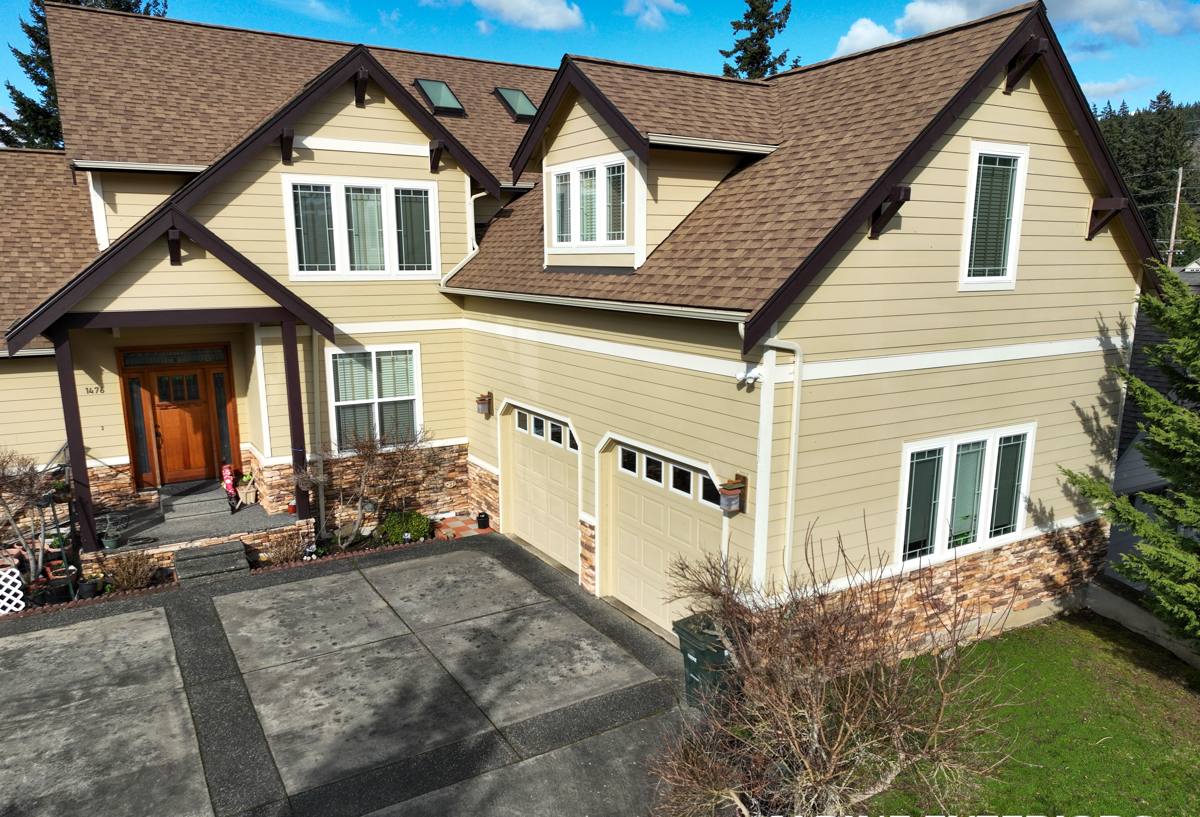
What This Climate Does to Guemes Island Homes
Guemes sits fully exposed to the marine air moving through the channels and straits around it, and that exposure shapes what a siding system needs to hold up to over the life of the home.
Salt Air Off the Water
Salt-laden air moving across the island accelerates corrosion in fasteners, flashing, and any metal trim, and it breaks down lower-grade paints and finishes faster than a drier, inland site ever would. Any material or hardware choice on a Guemes exterior needs to account for that corrosion load from day one, not after rust or streaking shows up.
Driving Rain and Wind Exposure
An island setting with open water on multiple sides gets wind-driven rain pushed sideways into walls, not just straight down onto roofs. That sideways force finds its way into butt joints, corner trim, and window openings that a finish film alone is never enough to seal. Installation details that hold up fine on a sheltered inland lot can fail specifically because Guemes weather is testing them at an angle they weren't built for.
A Moss Season That Runs Most of the Year
Mild temperatures, high humidity, and plenty of tree cover across the island add up to a moss and mildew season that stretches across most of the calendar, especially on shaded, north-facing walls. Moss and mildew don't just look bad — sustained organic growth against a wall keeps moisture in contact with the siding surface far longer than an open, sun-exposed wall ever sees, which is exactly the condition that wears out a lesser material's finish and joints.
Why We Install Only James Hardie Fiber Cement Siding
This company installs one siding product, and it's James Hardie fiber cement. We don't install LP SmartSide, vinyl siding, Cemplank, Allura, primed spruce, or cedar. That's not a brand loyalty question — it's a standard built around what actually holds up to salt air, driving rain, and a long moss season without asking a homeowner to carry a heavy maintenance schedule, especially on a property where a maintenance visit means coordinating a ferry crossing.
- Non-combustible core: fiber cement doesn't feed a fire the way wood-based products can, which matters for both safety and insurance underwriting.
- Factory-applied ColorPlus finish: the color is baked on under controlled factory conditions rather than brushed on in the field, and it resists fading, chalking, and moisture intrusion far longer than site-applied paint.
- Climate-engineered HZ5 formulation: James Hardie's HZ5 product line is built specifically for regions with heavy moisture exposure, which describes Guemes Island's marine climate well.
- Dimensional stability: fiber cement doesn't swell, cup, or warp the way wood or wood-composite products can after repeated wetting through a long wet season.
- Strong transferable warranty: James Hardie backs its product with a substantial warranty, provided installation follows their published spec.
Each of the products we don't install has a legitimate place in the market, and plenty of homeowners elsewhere are satisfied with them. On an island property dealing with this combination of salt air, wind-driven rain, and moss, we've made a professional call to install the one system we're willing to fully stand behind rather than offer something that quietly shifts long-term maintenance risk back onto the homeowner.
What a Correct Fiber Cement Installation Involves
Fiber cement only performs the way it's engineered to when the installation follows James Hardie's published specifications. On a Guemes Island home, that means:
- Proper clearance between the siding's bottom edge and grade, decks, and roof lines, so the material never sits in standing water
- Correct flashing at every window, door, and roof-to-wall transition, sized for wind-driven rain rather than straight-down rainfall alone
- Fasteners rated for marine, salt-air exposure, placed at the manufacturer's specified spacing rather than a generic pattern
- A properly lapped weather-resistant barrier behind the siding, not house wrap stapled up and left as the only defense
- Correct joint treatment at every butt joint and corner, since a poorly sealed joint is the single most common place driving rain finds its way behind the cladding
None of these steps are unique to a Hardie product specifically — they're the difference between a siding job that holds up through repeated wet seasons and one that starts showing problems at the seams within a few years, regardless of what's behind the boards.
Comparing Siding Materials for a Guemes Island Home
| Material | Moisture Behavior | Maintenance in This Climate | Fit for Island Logistics |
|---|---|---|---|
| James Hardie fiber cement | Dimensionally stable, does not swell or rot | Low; factory finish resists fading and moss-friendly moisture retention | Fewer return trips needed over the life of the siding |
| Vinyl siding | Can warp or distort under heat and settle over time | Low upfront, but seams and fasteners remain exposure points | Repairs often require exact panel matches, complicating island sourcing |
| LP SmartSide / engineered wood | Wood-based core is moisture-sensitive at cut edges and joints | Moderate; edge sealing and caulk upkeep matter | Recurring maintenance visits are harder to schedule around a ferry |
| Cedar / primed wood | Absorbs and releases moisture readily | High; regular refinishing needed in wet, salt-laden air | Frequent recoating cycles are the hardest fit for island access |
Every one of those alternatives can perform reasonably well somewhere. On Guemes specifically, the recurring maintenance columns in that table are the real cost, because every visit also carries the added time of getting a contractor and materials back onto the island.
Why a Crew That Already Works Guemes Island Matters
A contractor who regularly works Guemes already has a working answer for the questions that trip up crews who don't: how to time a ferry crossing so a full crew and a full material load arrive together, how to stage siding and trim on-site so a weather delay doesn't strand materials on the wrong side of the channel, and how to plan a punch-list visit efficiently instead of burning a half-day on travel for a small item. None of that shows up in a sales pitch, but it shows up directly in how smoothly a project actually runs once work starts.
It also matters for anything that comes up after the job is finished. A warranty callback, a question about a section that took a hard hit in a windstorm, or a simple caulk check are all easier conversations with a crew that already has Guemes in its regular rotation than with one that has to plan a special trip for a single island property.
A Simple Checklist Before Hiring for a Guemes Island Siding Project
- Ask what siding product they install and why, and whether they can back it with a written manufacturer warranty
- Confirm current Washington contractor licensing and active liability insurance
- Ask specifically how they detail flashing and fastener choice for salt-air, wind-driven rain exposure
- Ask how they plan ferry logistics for materials, crew, and any follow-up visits
- Get a clear, written scope of work and timeline before signing anything
Our Process for a Guemes Island Project
We start with an on-site assessment of the existing siding, looking specifically at how it has handled moisture, salt exposure, and moss over time, and we use that walk-through to identify any underlying issues, like damaged sheathing or failed flashing, before pricing the job. From there we put together a clear written scope and a schedule that accounts for the ferry crossing from the start, rather than treating it as an afterthought once the crew is already committed to a start date. Materials are ordered and staged so a full delivery arrives with the crew, not piecemeal across several trips, and installation follows James Hardie's fastening, clearance, and flashing specifications as standard practice, not an upgrade. Before we leave, we walk the finished job with the homeowner and go over what little maintenance the siding will actually need going forward.
What to Expect After Installation
One of the real advantages of a correctly installed Hardie system on an island property is what it removes from a homeowner's plate afterward. There's no annual repainting cycle to plan around a ferry schedule, and the material isn't feeding the kind of sustained moss and mildew growth that a porous, organic siding surface can. Realistic upkeep looks like an occasional rinse to clear salt residue and general grime, a visual check after major windstorms for any lifted flashing or damaged trim, and keeping landscaping from holding moisture directly against the wall. That's a meaningfully lighter maintenance load than a wood-based product asks for, and on Guemes, lighter maintenance also means fewer trips that depend on catching a ferry.
If you're weighing siding options for a home on Guemes Island, we're glad to take the ferry over, walk the property with you, and give a straight answer about what your exterior actually needs. Reach out below for a free, no-pressure estimate.