 Anacortes Siding
 Fiber Cement Siding Built for March Point's Waterfront Exposure
March Point sits out on its own peninsula along Fidalgo Bay, closer to open water than most of the rest of Anacortes. That location is part of what makes it a great place to live, and it's also exactly why siding fails there faster than it does a few miles inland. Salt-laden air moves across the water and settles on exterior walls day after day. Add Skagit County's long wet season, driving rain off the water, and months of shaded moss growth on north- and west-facing walls, and you've got a combination that punishes anything but the right material installed the right way.
We install James Hardie fiber cement siding exclusively. This page covers what that means specifically for a March Point home — not siding in general, but what a correct fiber cement job looks like on a house dealing with this particular stretch of coastline.
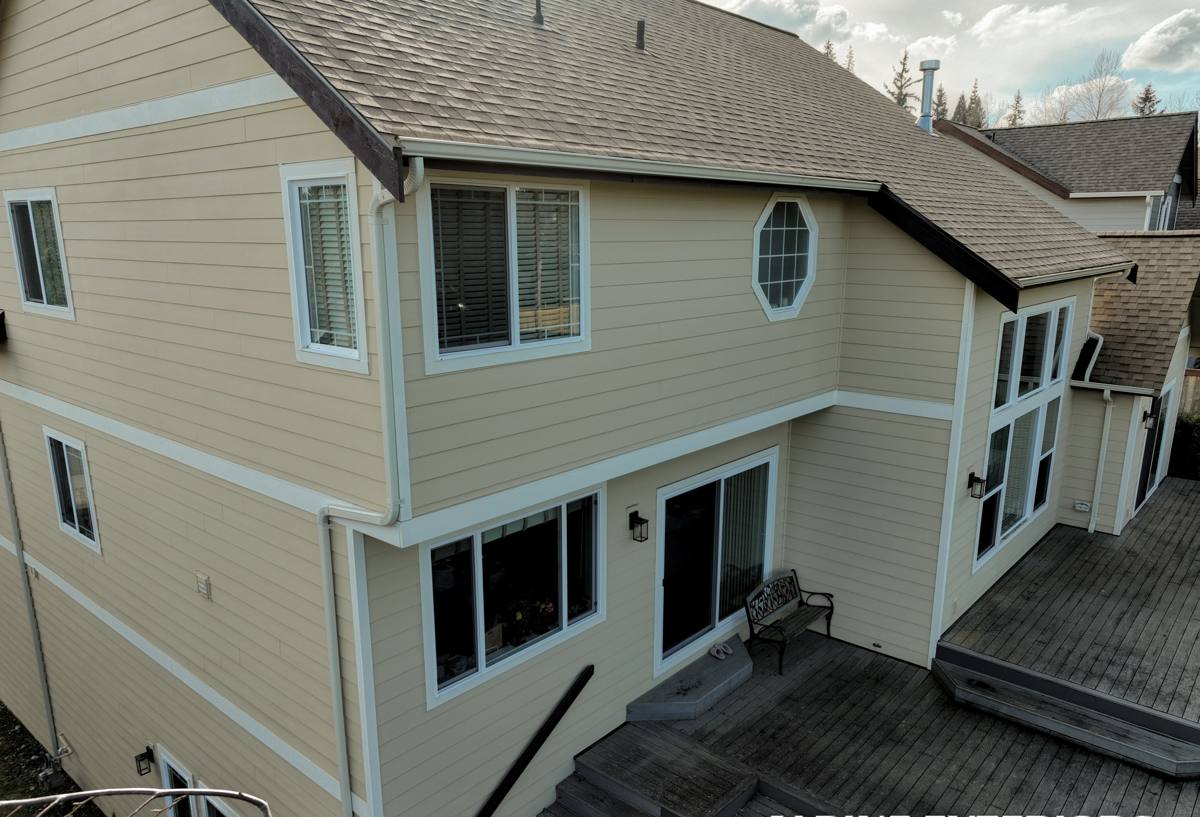
What Salt Air and Moss Season Actually Do to Siding
It helps to understand the failure modes before talking about the fix. Homes in the March Point area typically deal with three compounding stresses:
- Salt exposure: Airborne salt accelerates corrosion of fasteners, trim flashing, and any exposed metal, and it can leave a fine residue on siding surfaces that holds moisture longer than clean rain would.
- Driving rain: Wind off the bay pushes rain sideways into wall assemblies rather than letting it run straight down, which stresses seams, laps, and butt joints that weren't detailed with enough overlap or the right flashing.
- Moss and algae growth: Shaded, damp wall sections in this climate grow moss almost year-round. Moss holds water against the siding surface for days at a time, which is a problem for any material that can absorb or swell with sustained moisture.
Wood-based and wood-adjacent siding products are the most vulnerable to this combination — moisture absorption leads to swelling, paint failure, and eventually rot at the vulnerable points (butt joints, bottom edges, anywhere caulking has failed). Vinyl doesn't rot, but it doesn't hold up structurally to sustained wind-driven rain intrusion behind the panel, and it becomes brittle over time in this climate's temperature swings. Fiber cement, installed correctly, is dimensionally stable under moisture exposure and doesn't feed the organic growth the way wood-based products can.
Why We Only Install James Hardie
"Fiber cement" isn't one product — it's a category, and the manufacturing and formulation differences matter more in a climate like this one than they would somewhere dry. We standardized on James Hardie for a few concrete reasons:
- HZ5 engineered formulation: Hardie's HZ5 product line is engineered specifically for wet, high-moisture climates like the Pacific Northwest, with a formulation built to resist moisture-related damage better than a general-purpose fiber cement board.
- ColorPlus factory finish: A baked-on factory finish holds up to UV and moisture cycling far longer than field-applied paint, which matters on a home that's going to see near-constant damp exposure for months at a time.
- Non-combustible core: Not a March Point-specific concern the way climate is, but it's part of why we don't compromise on the material category at all.
- Warranty backing: A manufacturer warranty is only worth something if the product it's backing is proven in the field over decades, in this exact kind of climate, not just in a lab.
We don't install LP SmartSide, vinyl, Cemplank, Allura, or bare cedar/spruce siding. Each of those has legitimate uses somewhere, but for a home exposed to this specific mix of salt air, wind-driven rain, and sustained moss cover, we've made the professional call that Hardie's engineered-for-climate products are what we're willing to put our name behind.
What a Correct Installation Involves Here
The product is only half the equation. Most fiber cement failures we get called out to inspect aren't material failures — they're installation shortcuts that let moisture in behind a siding system that was designed to keep it out. For a March Point home specifically, correct installation means:
Water management behind the siding
A weather-resistive barrier (housewrap) installed with proper shingle-lap sequencing, correctly flashed window and door openings, and a drainage plane that lets any moisture that does get behind the siding find its way back out rather than sitting against the sheathing.
Fastener and flashing spec
Corrosion-resistant fasteners driven to the manufacturer's exact spacing and depth, not overdriven (which cracks the board over time) or underdriven (which lets the board move and fail at the nail line). Any exposed metal — flashing, trim caps — needs to be a material that won't corrode faster than the siding around it in salt air.
Joint and clearance details
Butt joints backed and sealed per Hardie's specification, proper gaps at deck ledgers and grade lines so the siding never sits in standing water or direct soil contact, and rain-screen furring where the wall assembly calls for one — which is common on more exposed, water-facing walls in this area.
Caulking and sealant discipline
Every penetration and trim intersection sealed with a sealant rated for the movement and exposure it'll actually see, not just whatever was on hand that day.
How the Job Runs, Start to Finish
- On-site assessment: We walk the exterior, check the current siding and any existing moisture or rot damage, and look specifically at which walls take the most direct wind-driven rain and which stay shaded and damp longest.
- Written estimate: A clear scope covering product line, color, trim details, and any repair work needed to the sheathing or framing underneath before new siding goes on.
- Tear-off and inspection: Removing the old siding is also when we find out what's actually happening behind it — this is often where hidden moisture damage from a prior installation shows up.
- Weather barrier and flashing: Housewrap, window and door flashing, and any rain-screen furring installed before a single piece of siding goes up.
- Hardie installation: Installed to manufacturer spec — fastener pattern, joint treatment, and clearances all built in, not left to chance.
- Final detailing and walkthrough: Caulking, touch-up, and a walkthrough so you know exactly what was done and why.
Comparing Siding Options for This Kind of Exposure
| Factor | James Hardie Fiber Cement | Vinyl | Wood / Wood-Composite |
|---|---|---|---|
| Moisture absorption | Very low, engineered HZ5 line for wet climates | None, but prone to warping and gapping | Absorbs moisture, swells and rots at joints |
| Salt air resistance | Strong; factory finish resists corrosion-related fading | Can become brittle faster near salt exposure | Vulnerable; salt speeds paint and finish breakdown |
| Moss/algae resistance | Doesn't feed organic growth; cleans up well | Doesn't feed growth but traps moisture behind panels at seams | More vulnerable to sustained moss-related moisture |
| Finish longevity | Factory-baked ColorPlus finish | Color molded in, but fades and chalks over time | Field-applied paint, needs repainting on a cycle |
| Fire resistance | Non-combustible core | Combustible | Combustible |
Cost Factors for a March Point Project
Every home is different, so we don't publish flat pricing, but the main variables that move the number for homes in this area are:
- How much of the existing siding and sheathing needs to be removed versus repaired
- Whether hidden moisture or rot damage is found once tear-off starts
- Home size, wall complexity, and number of stories
- Which Hardie product line and profile you choose (lap, shingle, panel)
- Trim and detail work — window casing, corner boards, fascia
- Whether a rain-screen furring system is called for on your most exposed walls
We give you a firm written number after the on-site assessment, not a phone estimate, because the hidden-damage question genuinely changes the scope on older homes in this area more often than people expect.
A Pre-Estimate Checklist for March Point Homeowners
- Note which walls face the water or prevailing wind — those usually need the most attention
- Look for moss or dark staining on shaded walls, especially north-facing sections
- Check around window and door trim for soft spots, gaps, or peeling paint
- Check the bottom few feet of siding near grade for swelling or discoloration
- Have your current siding's age and any past repair history handy if you know it
Why Hire a Crew That Already Works This Area
A siding crew that mostly works drier, inland jobs will still build a technically sound wall assembly — for a different climate. Working repeatedly in and around Anacortes and Skagit County's coastal neighborhoods means we've already seen how wind-driven rain, salt exposure, and long moss seasons actually play out on a wall over years, not just on install day. That shows up in small decisions — where we add a rain-screen gap, which walls get extra flashing attention, how we sequence the weather barrier — that don't show up on a spec sheet but matter a great deal once the siding's been up through a few Pacific Northwest winters.
If you're planning a siding project in March Point or anywhere else in the Anacortes area, we're happy to come take a look and give you a straightforward, no-pressure written estimate — just fill out the form below to get started.