 Anacortes Siding
 La Conner's Climate Is Harder on Siding Than Most Homeowners Realize
La Conner sits right on the Swinomish Channel, with Padilla Bay and the open Salish Sea close enough to shape the weather nearly every home in the area deals with. That means salt-laden marine air, wind-driven rain that gets pushed sideways into wall assemblies instead of just falling straight down, and a moss season that can stretch from early fall through late spring in a typical Skagit County year. Siding here doesn't just get rained on — it stays damp for long stretches, dries slowly under gray skies, and gets hit with salt air even on homes that aren't waterfront.
That combination is rough on materials that weren't built for it. Wood siding swells, checks, and rots faster than it would inland. Vinyl gets brittle and can warp or buckle over years of temperature swings and UV exposure. Lower-grade composites and primed wood products can hold moisture at cut edges and fastener points, which is exactly where problems start. Siding for a La Conner home needs to handle sustained dampness, resist moss and algae staining, and hold its finish without constant repainting.
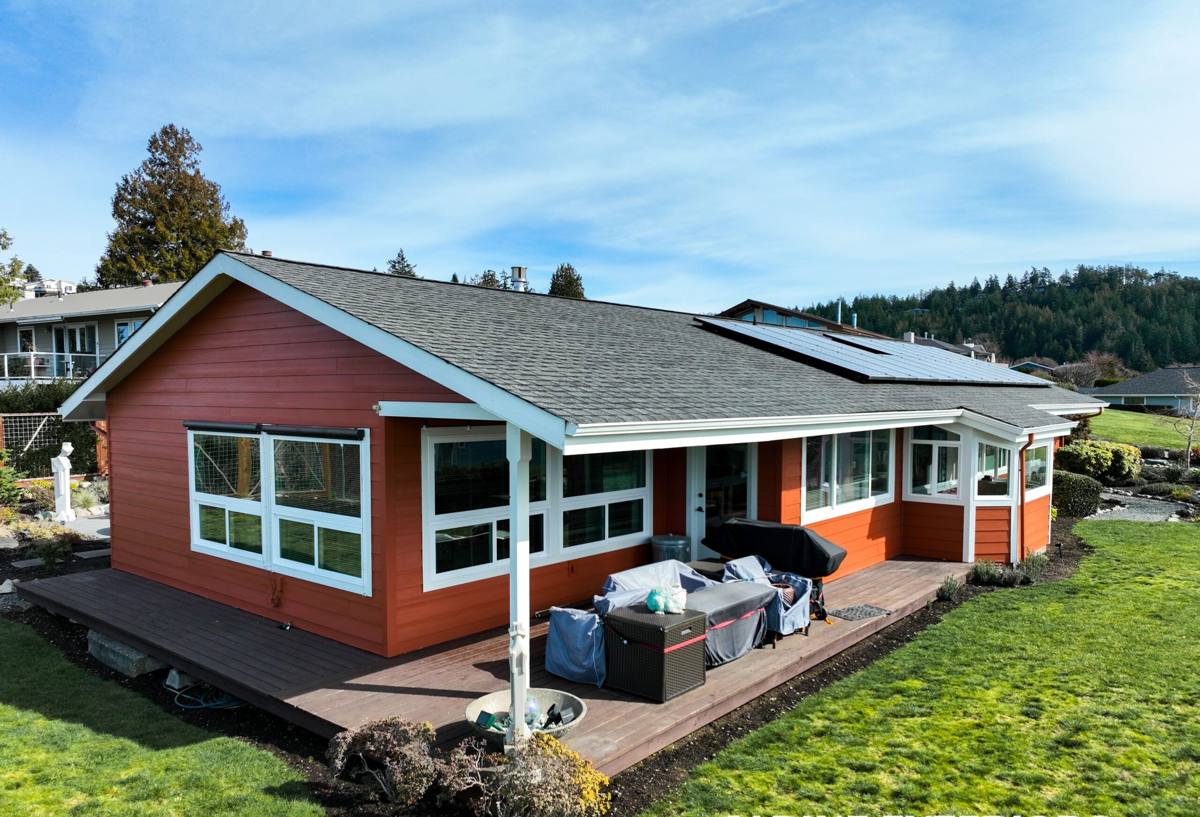
Why James Hardie Fiber Cement Fits This Environment
James Hardie fiber cement is engineered specifically for regional climate demands, and the HZ5 product line used in the Pacific Northwest is built around exactly the conditions La Conner sees: sustained moisture, humidity, and freeze-thaw cycling. Fiber cement doesn't absorb water and swell the way wood or wood-composite products can, and it's non-combustible, which matters for wildfire-adjacent risk during the region's drier summer stretches. It holds a straight, tight reveal line for decades instead of cupping or warping the way vinyl and lower-grade materials tend to over time in wet, salty air.
The factory-applied ColorPlus finish is a meaningful part of this too. Instead of a job-site paint job that starts breaking down under UV and salt exposure within a handful of years, ColorPlus is baked on under controlled factory conditions and backed by its own finish warranty. For a home dealing with near-constant marine humidity, that difference shows up in how long the color and finish actually hold up before anyone has to think about repainting.
What "HZ5" Actually Means
James Hardie assigns siding to climate zones based on moisture exposure and freeze-thaw risk, and the Pacific Northwest — including Skagit County — falls into the HZ5 zone. That's not a marketing label; it determines the formulation of the product itself. Installing the correct zone-rated product, and installing it to the manufacturer's specifications for that zone, is part of what makes the difference between siding that performs for decades and siding that fails early despite looking fine on installation day.
Signs Existing Siding Is Losing the Fight in La Conner
Homeowners in and around La Conner tend to see the same handful of warning signs, especially on north-facing walls and anywhere siding sits close to landscaping or shaded areas that stay damp longer:
- Green or black staining that comes back within weeks of being cleaned — a sign moss and algae have a foothold, not just a surface issue
- Paint that's peeling, bubbling, or chalking well before it should, especially on wood or older composite siding
- Soft or spongy spots when you press on wood-based or LP-style siding, which usually means moisture has gotten behind the surface
- Visible warping, buckling, or gaps at seams on vinyl siding, particularly after a cold snap
- Caulk that's cracked or pulled away at joints and trim, letting wind-driven rain get behind the siding
- Rising utility bills or drafty walls, which can point to moisture-damaged sheathing or insulation behind failing siding
Any one of these on its own might be minor. Several at once, especially combined with siding that's approaching or past its expected service life, usually means it's time to look at a real replacement rather than another round of patching.
What a Correct James Hardie Installation Involves
The siding material only does half the job. The other half is installation detail, and in a wet marine climate like La Conner's, shortcuts here are exactly what turns into moisture problems five or ten years down the road.
Moisture Management Comes First
Before any siding goes up, the wall needs a proper weather-resistive barrier, correctly lapped and sealed, with flashing at every window, door, and penetration so water is directed out and away from the wall assembly rather than trapped behind the siding. This is the step that matters most in a place where wind-driven rain is a regular occurrence, not an occasional storm.
Clearance and Fastening
James Hardie specifies minimum clearances from grade, roof lines, decks, and other horizontal surfaces so water doesn't wick up into the bottom of the siding. Fasteners need to be the correct type and length for the substrate, driven at the proper depth and spacing — over-driven or under-driven nails are one of the most common causes of early failure, and it's an easy thing for a crew unfamiliar with fiber cement to get wrong.
Joints, Gaps, and Cut Edges
Cut edges and joints need to be sealed and caulked according to Hardie's specifications, with the correct gap sizes at butt joints and trim to allow for expansion without letting water in. Skipping factory-edge sealing or caulking joints incorrectly is a quiet mistake — it won't show up on installation day, but it will show up in a few wet winters.
How James Hardie Compares to Other Siding Choices in La Conner's Climate
| Factor | James Hardie Fiber Cement | Vinyl | Wood / Cedar | LP SmartSide |
|---|---|---|---|---|
| Moisture & rot resistance | High — doesn't absorb water or swell | Doesn't rot, but can warp with heat/cold cycling | Prone to rot and moisture damage over time | Engineered wood core; vulnerable if moisture gets behind or into edges |
| Moss/algae resistance | Better surface for holding a clean finish; still needs periodic cleaning | Resists moss growth but can trap moisture at seams | Prone to moss and staining, especially on shaded walls | Wood-based surface can be susceptible to moss and edge swelling |
| Fire resistance | Non-combustible | Combustible, can melt/deform near heat | Combustible | Combustible |
| Finish longevity | ColorPlus factory finish, long-lasting | Color molded in but can fade and chalk over time | Requires regular repainting/staining | Factory finish available, needs edge maintenance |
| Typical service life | Decades when installed to spec | Moderate, shorter in harsh coastal exposure | Shorter without diligent maintenance | Moderate, sensitive to installation quality |
Our Process for a La Conner Siding Project
We treat every siding project as a wall system, not just a material swap. That starts with an on-site assessment of the existing walls, including checking for hidden moisture damage behind the current siding before we ever price the job. From there:
- We inspect sheathing and framing during tear-off and flag any rot or moisture damage that needs repair before new siding goes on — this is common on older homes in wet climates and shouldn't be covered up
- We install a properly lapped weather-resistive barrier and flash all windows, doors, and penetrations before any siding is hung
- We install James Hardie siding to manufacturer specifications for clearance, fastening, gapping, and joint sealing — not a generic install, but one built for HZ5 conditions
- We clean up thoroughly and walk the finished job with the homeowner before calling it done
We schedule around the weather where we can, since a driving-rain day is not the day to be installing a weather barrier or sealing joints. That kind of scheduling judgment comes from working in this climate regularly, not from a generic install calendar.
Why Local Experience Matters for a Project Like This
A crew that works Skagit County waterfront and near-water homes regularly knows the difference between a home right on the channel and one a few miles inland — the exposure, wind direction, and moisture load aren't identical, even within a small area like La Conner. That local knowledge shapes decisions like fastener selection, how aggressively to flash a given wall, and how much clearance to build in at grade. It also means familiarity with local permitting and any relevant review processes for the area, so a project doesn't stall on paperwork a crew unfamiliar with the area wouldn't anticipate.
Just as important is understanding what's realistic for the season. Siding installation depends on dry working conditions for a lot of the critical steps — barrier installation, flashing, caulking — and a crew that knows the local weather patterns can plan a project to avoid rushing those steps during a wet stretch.
Maintaining James Hardie Siding in a Marine Climate
Correctly installed Hardie siding is low-maintenance, not no-maintenance. A few habits go a long way in a climate like La Conner's:
- Rinse siding down once or twice a year to keep salt residue and organic buildup from settling in, especially on north-facing and shaded walls
- Inspect caulking at joints and trim annually and have any cracked or failing caulk redone before wet season
- Keep landscaping and vegetation trimmed back from walls so air can circulate and walls can dry out between rain events
- Clean gutters and downspouts regularly — overflow running down siding is a common cause of localized staining and moisture problems
- Address moss or algae spots early with a gentle cleaning approach rather than pressure-washing aggressively, which can damage the finish
If your home's siding is showing its age — or if you're planning ahead rather than waiting for a problem — we're happy to take a look and walk you through what we're seeing, with no pressure to commit. Fill out the form below for a free estimate on James Hardie siding for your La Conner home.