 Anacortes Siding
 Similk Beach's Waterfront Exposure Is Hard on Ordinary Siding
Similk Beach sits along the water on the Anacortes side of Skagit County, which means homes here take on weather that inland neighborhoods simply don't deal with. Salt-laden air drifts off the bay and settles on exterior surfaces year-round. Wind-driven rain off the Salish Sea hits siding at an angle, working its way into seams and laps that would stay dry on a more sheltered lot. And the tree cover common around this stretch of Fidalgo Island keeps north- and shade-facing walls damp for long stretches, which is exactly the environment moss and algae need to take hold.
None of this is unusual for the Anacortes area, but it adds up faster on a waterfront or near-waterfront property than it does a few miles inland. Siding that would look fine for a decade in a drier, more sheltered part of Skagit County can show fading, staining, soft spots, or panel separation much sooner out here. That's the starting point for every recommendation on this page: the product and the installation both have to be matched to this specific exposure, not a generic Pacific Northwest average.
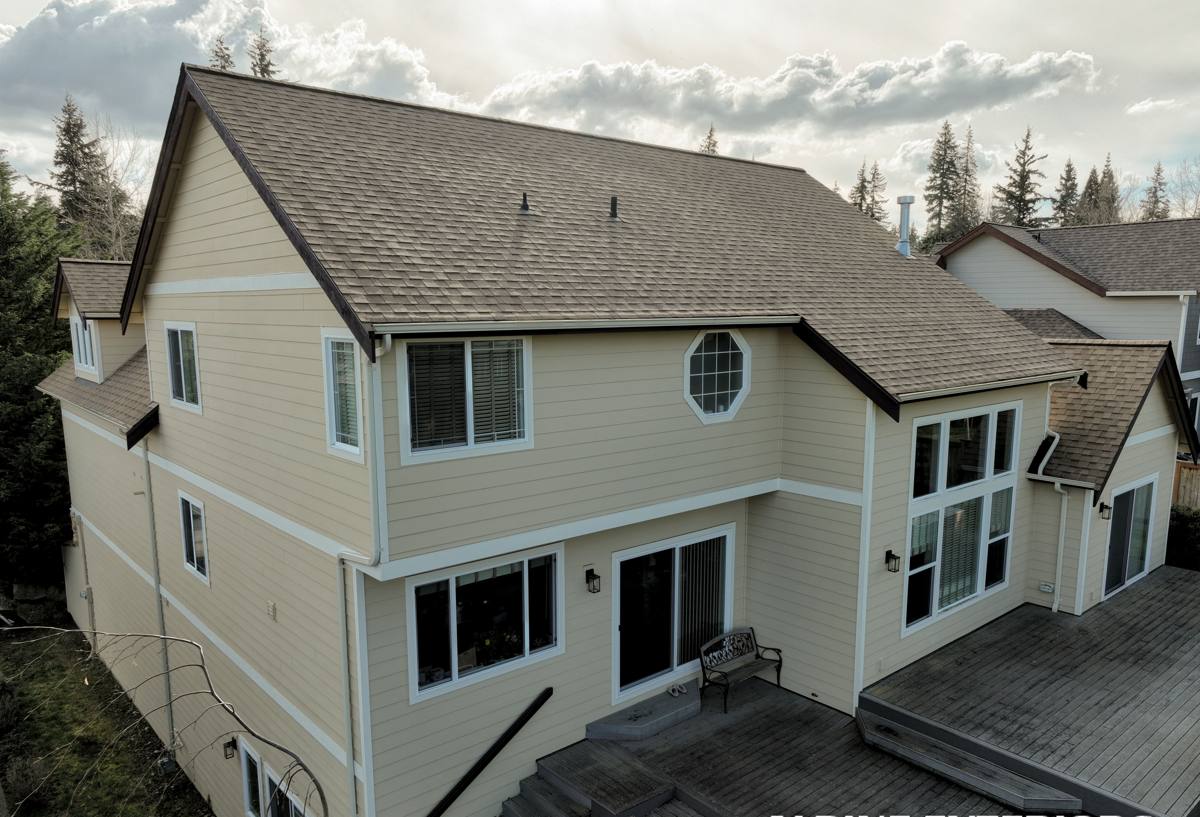
Why We Only Install James Hardie Fiber Cement Siding
We don't install vinyl, LP SmartSide, cedar, primed spruce, Cemplank, or Allura. That's a deliberate standard, not a lack of options. Each of those products has legitimate strengths, but they each carry a trade-off that shows up hardest in an environment like Similk Beach's — vinyl can warp and its seams give salt-laden moisture a path in; engineered wood products depend on an intact factory coating that's difficult to fully protect at every cut and fastener on a job site near open water; cedar and primed wood need a maintenance commitment most homeowners don't want to keep up with once the algae and moss pressure sets in.
James Hardie fiber cement siding is engineered from cement, sand, and cellulose fibers. It doesn't rot, it isn't a food source for moss or algae the way wood is, and it holds up to sustained damp exposure far better than wood-based or vinyl products. It's also non-combustible, which matters in a region where wildfire smoke and ember exposure have become a more regular late-summer concern. Hardie backs its siding with a factory-applied ColorPlus finish and a strong transferable warranty, both of which depend on the product being installed correctly — which is the next thing worth understanding.
HZ5 Engineering for This Climate
James Hardie manufactures its siding in climate-specific formulations called HZ (HardieZone) products. The Pacific Northwest, including Skagit County, falls into the HZ5 zone, engineered for regions with sustained moisture exposure and freeze-thaw cycling. That's a meaningful distinction from siding built for a drier climate — it's not just marketing, it affects how the product resists moisture absorption and cracking over the decades it's expected to last on the wall.
What a Correct Installation Actually Involves
Fiber cement siding is only as good as the installation behind it. Hardie's own warranty terms require installation to their specifications, and in a marine environment like Similk Beach, skipping steps is exactly what shows up as a callback two or three years later. A correct job includes:
- A drainable weather-resistive barrier behind the siding, not just a wrapped house — this gives incidental moisture a path out instead of trapping it against the sheathing
- Proper flashing at every window, door, and roof-to-wall transition, sequenced so water sheds outward at each layer
- Correct fastener type, spacing, and penetration depth — under- or over-driven nails are one of the most common causes of premature panel failure
- Manufacturer-specified gaps at butt joints and trim, caulked and painted per Hardie's guidelines rather than jammed tight
- Starter strips and proper clearance from grade, decks, and roof lines so the bottom edge of the siding isn't sitting in standing water or splash-back
- Field-cut edges sealed before installation, since a factory-finished panel that's cut on site exposes raw fiber cement at that edge
On a waterfront-adjacent property, we pay particular attention to wall sections that face prevailing wind and rain — those get the most scrutiny on flashing detail and fastening, because that's where driving rain finds any gap in the work.
Product Lines and Color Choices That Hold Up Here
Most Similk Beach homes end up with one of two Hardie profiles, sometimes combined for architectural interest:
| Product | Look | Where It Works Best |
|---|---|---|
| HardiePlank lap siding | Traditional horizontal lap, smooth or woodgrain texture | Full-house siding on most home styles |
| HardiePanel vertical siding | Clean vertical panels, often with battens | Accent walls, gables, modern or craftsman detailing |
| HardieShingle siding | Staggered or straight-edge shingle look | Accent sections, coastal-style homes |
| HardieTrim boards | Corner boards, window and door trim, fascia | Finish detail on every job |
ColorPlus finishes are baked on at the factory under conditions a job-site paint job can't replicate, and they come with better fade resistance than field-applied paint. In a bright, salt-air environment, that matters — field-painted surfaces on this stretch of coastline tend to chalk and fade noticeably faster. We also talk through color with an eye on moss: darker, matte finishes on heavily shaded north walls can show green streaking sooner than lighter colors, so wall orientation is worth a conversation before you pick a color, not after.
Fiber Cement vs. the Alternatives, for This Exposure
| Factor | James Hardie Fiber Cement | Vinyl | LP SmartSide / Wood |
|---|---|---|---|
| Salt air resistance | Strong — non-organic material | Moderate — can become brittle over time | Weaker — coating breach exposes wood substrate |
| Moss/algae resistance | Doesn't feed organic growth | Resistant but growth sits on surface | Wood-based core is vulnerable if coating fails |
| Wind-driven rain performance | Excellent when flashed correctly | Seams can allow water intrusion | Dependent on maintained factory coating |
| Fire resistance | Non-combustible | Combustible | Combustible |
| Typical maintenance | Occasional wash, repaint decades out | Low, but limited repair options | Regular coating inspection and touch-up |
How Our Process Works on a Similk Beach Home
We start with a walk-around assessment of the exposure specific to your lot — which walls take the brunt of the weather off the water, where shade and moss pressure are worst, and what condition the existing siding and sheathing are in. If there's any question about moisture that's already gotten behind the current siding, we check before we ever price the job, because covering up a wet wall with new siding just delays a bigger problem.
From there: removal of the old siding, inspection and repair of the sheathing and weather barrier underneath, installation of a drainable house wrap where needed, then the Hardie siding itself — installed to manufacturer spec on fastening, flashing, and clearances. We finish with trim, caulking at the specified joints, and a final walk-through so you know exactly what was done and what to expect from the product going forward.
Why a Crew That Already Works This Area Matters
Similk Beach isn't a huge neighborhood, but its exposure is distinct enough that experience here counts for something. A crew that's already flashed walls facing the water, dealt with the wind patterns specific to this stretch of Fidalgo Island, and knows which wall orientations need extra moss-conscious color planning is going to make fewer assumptions than a crew pricing their first job in the area. Permitting and inspection expectations in unincorporated Skagit County versus inside Anacortes city limits can also differ slightly, and it helps to have that sorted out before the job starts, not during it.
Living With Hardie Siding in a Marine Climate
Correctly installed James Hardie siding is low-maintenance, not zero-maintenance. A few habits keep it performing the way it's supposed to over its long service life:
- Rinse the exterior with a garden hose once or twice a year to clear salt residue and organic buildup, especially on walls facing the water or under tree cover
- Avoid pressure washing directly at joints and caulked seams — a gentle rinse is enough and won't force water behind the panels
- Keep gutters clear so overflow isn't running down the siding face repeatedly in the wet season
- Trim back vegetation and tree limbs that keep a wall shaded and damp, which is the single biggest factor in moss growth
- Have caulking and paint touch-ups inspected periodically — ColorPlus finishes last a long time, but joint sealant is the first thing to show wear
- Address any small paint or caulk gaps promptly rather than waiting, since that's the entry point for moisture in a driving-rain climate
What Drives the Cost of This Project
| Factor | Why It Matters |
|---|---|
| House size and wall complexity | More corners, gables, and dormers mean more cutting, flashing, and trim work |
| Tear-off and substrate condition | Rot or moisture damage found underneath adds repair scope before new siding goes up |
| Product mix | Combining lap siding with panel accents or shingle detailing adds material and labor variety |
| Site access | Waterfront lots with limited staging space or steep grades can affect labor time |
| Trim and color complexity | Multiple colors, extensive trim work, or custom detailing add time over a single-color, simple-trim job |
We give a firm number after that initial walk-around, not a rough guess over the phone, because exposure and substrate condition vary enough house to house on the water that a phone estimate isn't reliable.
If you're thinking about re-siding a home in Similk Beach, we're glad to walk the property, look at what your specific exposure is doing to the current siding, and put together a free, no-pressure estimate for a correctly installed James Hardie system. Fill out the form below to get started.