 Anacortes Siding
 Why La Conner Roofs Take a Different Kind of Beating
La Conner sits right on the Swinomish Channel, tucked into the Skagit Valley between tide flats and farmland. That location is part of what makes the town beautiful, and it's also exactly why roofs here wear differently than roofs twenty miles inland. Homes get a steady dose of moist, salt-tinged air off the water, near-constant driving rain through the fall and winter, and enough shade and humidity around the surrounding trees and low-lying areas to grow moss on almost any roof that isn't watched. None of that is unusual for Skagit County, but La Conner's waterfront exposure tends to push all three factors — salt, rain, and moss — a notch harder than you'd see on a roof further from the channel.
We're not describing anything exotic. It's the same basic recipe that wears down roofs all along the Salish Sea shoreline. What matters is that a roof repair done without accounting for that combination tends to fail again in a year or two, in the same spot, for the same reason. A repair done right the first time takes the local conditions into account from the start.
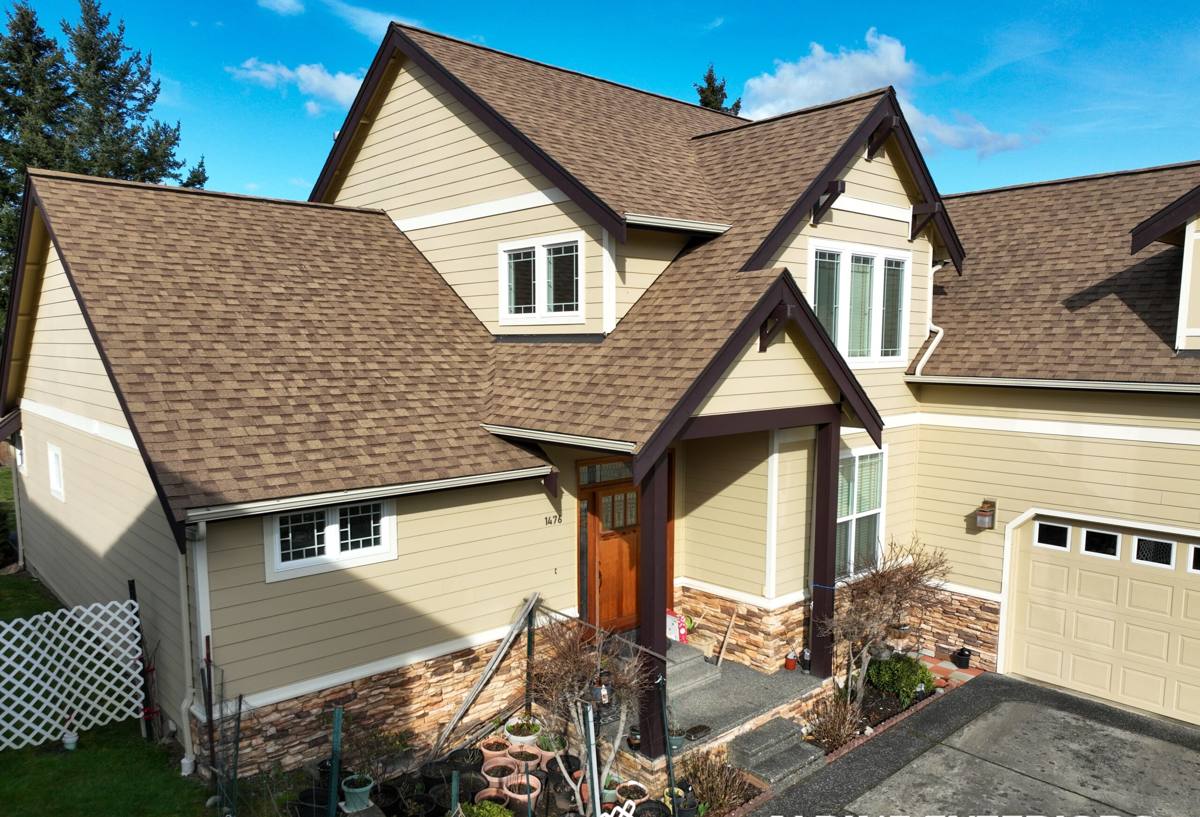
What Salt Air and Moisture Actually Do to a Roof
It helps to understand the mechanics, because it explains why some repairs hold up and others don't.
Moss and the Long Wet Season
Moss doesn't just sit on a roof looking messy — it actively holds water against the roofing material. On shingle roofs, that trapped moisture accelerates granule loss and lets water work under shingle edges and into fastener holes. On roofs with any wood components, sustained dampness invites rot. Moss also grows fastest exactly where roofs are already vulnerable: in valleys, along north-facing slopes that stay shaded, and around anything that interrupts water flow, like chimneys, skylights, or vent stacks. In a town with as much tree cover and shoreline humidity as La Conner, moss isn't a once-a-decade nuisance — it's an ongoing maintenance item for most roofs.
Salt-Laden Air and Metal Fatigue
The metal components of a roof — flashing, fasteners, drip edge, vent caps — are usually the first things to show wear near the water. Salt in the air accelerates corrosion on lower-grade or mismatched metals, and once a fastener or flashing seam starts to corrode, it stops sealing the way it should. That's how a small, boring maintenance item like worn flashing around a chimney turns into an active leak. It's also why we pay close attention to what metal we're using for repairs on La Conner homes, not just what's fastest to grab off the shelf.
Common Roof Repair Needs We See in La Conner
Most of the repair calls we get in this area fall into a handful of categories. None of them are dramatic on their own, but left alone through a wet Skagit County winter, any of them can turn into interior damage.
| Repair Type | Typical Cause | Why It Matters Locally |
|---|---|---|
| Flashing repair/replacement | Corrosion, sealant failure, storm movement | Salt air accelerates metal wear faster than inland areas |
| Moss and organic growth removal | Shaded roof areas, poor drainage, tree cover | Long wet season keeps roofs damp enough for constant regrowth |
| Valley and transition repair | Granule wear, debris buildup, seam separation | Concentrated water flow makes valleys the first place leaks start |
| Ridge cap and fastener repair | Wind exposure, nail back-out, sealant breakdown | Open water exposure means more direct wind-driven rain |
| Gutter and roof-edge repair | Debris clogging, sagging, fascia rot | Constant moisture makes wood edges vulnerable if drainage backs up |
| Skylight and penetration reseal | Aging sealant, flashing movement | Every penetration is a potential entry point in a high-rain climate |
Older homes in and around La Conner's historic core sometimes carry an added wrinkle: original roofing systems, past patch jobs from different eras, or transitions between roofing materials that were never fully compatible. Repairing those roofs correctly means understanding what's actually underneath the surface layer, not just patching what's visible.
What a Correct Roof Repair Actually Involves
Diagnosing the Real Problem, Not Just the Symptom
A water stain on a ceiling almost never marks the exact spot where water is entering the roof. Water travels along rafters, sheathing, and underlayment before it shows up inside, sometimes several feet from the actual failure point. A repair that just patches the spot above the stain, without tracing the path water actually took, often "fixes" nothing. Proper diagnosis means getting on the roof, checking flashing, fasteners, valleys, and underlayment condition around the affected area, and confirming the actual entry point before any material gets replaced.
Matching Materials and Fasteners to the Coastal Environment
Not all flashing, fasteners, and sealants perform the same in a salt-air environment. We use corrosion-resistant metals and fastener types suited to coastal exposure rather than whatever is cheapest or most convenient, because a repair that corrodes out in three years isn't a repair — it's a delay. The same logic applies to sealants and underlayment: products rated for sustained moisture exposure hold up better here than products rated for a milder, drier climate.
Blending New Work Into the Existing Roof
A repair should tie into the surrounding roofing system correctly — proper shingle or panel overlap, correctly lapped flashing, and fasteners set to manufacturer spec — so the repaired section sheds water the same way the rest of the roof does. A patch that sits "on top of" the roof instead of integrating with it is one of the more common reasons repairs fail early.
Our Roof Repair Process
- Inspection and diagnosis. We get on the roof (not just the ladder) to trace the actual source of the leak or damage, checking flashing, valleys, penetrations, and moss buildup.
- Honest assessment. We tell you what's actually needed — a targeted repair, a broader section replacement, or in some cases, a conversation about whether the roof is nearing the end of its useful life.
- Written scope and estimate. You know what's being repaired, with what materials, and what it costs before work starts.
- Repair work. Corrosion-resistant flashing and fasteners, correctly lapped materials, and attention to how the repair integrates with the surrounding roof.
- Site cleanup. Debris, moss, and old material removed — we don't leave organic matter sitting on the roof to start the next moss patch.
Repair vs. Replacement: How We Help You Decide
Not every roof problem calls for a full replacement, and not every leak can be permanently solved with a patch. The honest answer depends on the roof's age, how widespread the damage is, and how many previous repairs it's already carrying.
| Factor | Leans Toward Repair | Leans Toward Replacement |
|---|---|---|
| Roof age | Well within expected lifespan | At or past typical material lifespan |
| Damage extent | Localized to one area or component | Spread across multiple sections |
| Repair history | First or second repair in that area | Same area repaired multiple times already |
| Underlying decking | Solid, no rot found | Soft spots or rot present |
| Moss/algae condition | Surface growth, manageable | Growth has degraded granules or shingles broadly |
We'll walk you through where your roof lands on that spectrum and why, rather than defaulting to whichever option is more profitable for us. Sometimes a repair genuinely is the right call for years to come.
Signs Your La Conner Roof Needs Attention Now
Given how quickly moisture and moss can turn a small issue into a bigger one in this climate, it's worth checking your roof — or having it checked — if you notice any of the following:
- Visible moss or dark streaking on shingles, especially on shaded or north-facing slopes
- Granules collecting in gutters or at the base of downspouts
- Water stains on interior ceilings or upper walls, even faint ones
- Daylight visible through the roof deck from inside an attic
- Curling, cracked, or missing shingles after a windstorm
- Rust streaking or visibly corroded flashing around chimneys or vents
- Sagging sections along the roofline or at gutter edges
- Musty odor in upper rooms or attic spaces during wet months
Catching any of these early is almost always cheaper than waiting until they cause interior damage, especially heading into a Skagit County winter.
Why a Crew That Already Works La Conner Matters
Roofing crews who mainly work drier, inland areas don't always think about salt-air corrosion or moss cycles the same way — because it's not what their usual jobs demand. Working regularly along the Swinomish Channel and throughout La Conner and the surrounding Skagit Valley means we're used to the specific failure patterns this environment produces: which flashing details corrode first, which roof orientations grow moss fastest, and which repairs from other climates simply don't hold up out here. That's not a marketing point — it's the difference between a repair that lasts and one you'll be calling someone about again next winter.
If you're dealing with a leak, storm damage, moss buildup, or just want an honest read on where your roof stands, we're happy to take a look. Reach out for a free, no-pressure estimate using the form below.