 Anacortes Siding
 Mount Vernon sits inland from Anacortes on the flat valley floor of the Skagit River, but the weather reaching it is the same Pacific Northwest system that shapes every home in this part of Skagit County: salt-tinged air carried up from Skagit Bay and the broader Puget Sound, driving rain pushed sideways by storm wind rather than falling straight down, and a moss season that runs most months of the year because the valley rarely dries out completely between fronts. Our crew is based in Anacortes and works Mount Vernon regularly, which means we're not guessing at how this specific stretch of the valley treats a wall. This page is about James Hardie fiber cement siding specifically — what the climate here demands of it, what a correct installation actually involves, and why the crew putting it on your house matters as much as the product itself.
What Mount Vernon's Climate Asks of a Siding System
Three conditions do most of the work wearing down exterior siding in this part of Skagit County. Salt-laden air moving inland from the bay accelerates the breakdown of lower-grade finishes and corrodes fasteners faster than it would further from the water. Wind-driven rain finds any gap in flashing or any under-sealed joint, because it isn't falling straight down onto a roof — it's being pushed sideways into the wall itself. And moss, which thrives in the shaded, damp conditions common on north-facing walls and tree-lined lots, holds moisture against a surface long after a storm passes, extending how long that surface stays wet.
None of these three are dramatic on their own. The damage is cumulative — years of paint film breakdown, caulk failure, and fastener corrosion that eventually shows up as a real maintenance problem, usually well after the original installer has moved on.
Why the Valley Floor Is Its Own Challenge
Mount Vernon's lower, flatter position in the Skagit Valley means less of the direct wind exposure a bluff-top Anacortes home might see, but it also means less air movement to dry a wall face out between storms. Shaded and tree-covered lots — common on residential streets around Mount Vernon — hold humidity at the wall longer than a more open, breezier site would, which is exactly the condition moss and mildew favor. A siding system that performs fine on an exposed, windy lot doesn't automatically perform the same way here.
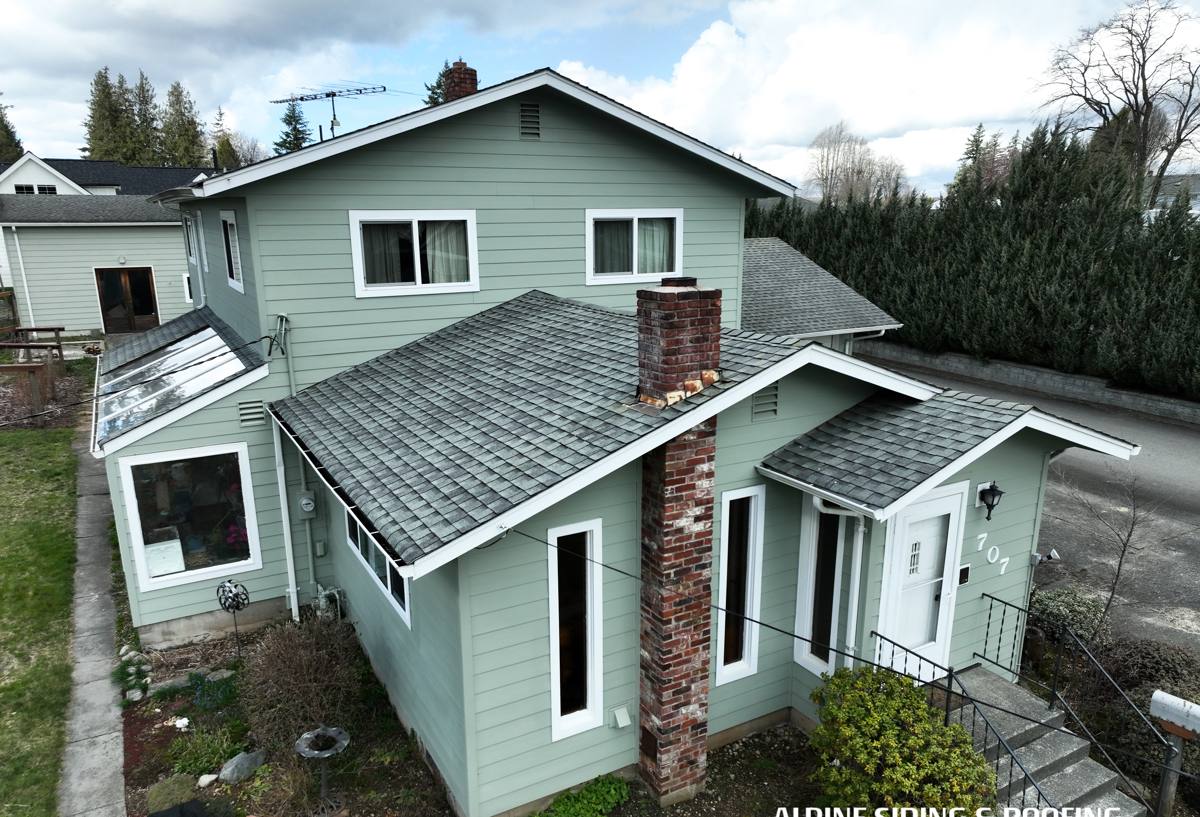
Why James Hardie Fiber Cement Is the Only Siding We Install
We install one siding product, full stop: James Hardie fiber cement. We don't offer vinyl, LP SmartSide, Cemplank, Allura, primed spruce, or cedar, and that's a professional standard we hold to on every job, not a limited menu. Each of those alternatives has genuine strengths — vinyl is inexpensive, engineered wood installs quickly and takes paint well, cedar has real visual character — but each also carries a trade-off we don't think holds up well enough in this climate to put our name behind.
Vinyl can go brittle and warp with age and temperature swings, and its seams are a natural point for wind-driven rain to work its way behind the panel. Wood-based products, however well treated, still have an organic core that depends on flawless field priming and caulking at every cut edge to keep sustained moisture out — a hard standard to hold across every job, every season, for the life of the siding. Cedar is a genuine, attractive material, but it's organic too, and it asks for real ongoing upkeep — refinishing, sealing, moss control — to keep performing through a valley climate that doesn't hand you much of a dry season to recover in.
Fiber cement sidesteps the core problem: it isn't organic. There's no wood substrate for moisture to migrate into, and nothing for moss and mildew to feed on the way there can be with wood-based siding. That single difference is why it holds up in Mount Vernon's conditions in a way the alternatives often don't over a full ownership timeline.
The HZ5 Product Line
James Hardie doesn't sell one generic board everywhere — it builds region-specific HZ product lines engineered around the moisture and temperature conditions of a given climate zone. For Skagit County and the rest of the Pacific Northwest, that's the HZ5 line, formulated for colder, wetter zones with sustained moisture exposure rather than the drier or hotter conditions other HZ lines are built for. Specifying the correct HZ line for the region is part of what "correct installation" means before a single panel goes up — the wrong formulation for the climate zone undercuts the product's own engineering.
What a Correct James Hardie Install Looks Like on a Mount Vernon Home
Fiber cement is only as good as the installation underneath it, and in a wet, moss-prone valley climate the margin for skipped detail is thin. A correct install accounts for grade clearance, flashing integration at every penetration, manufacturer-specified fastening, and joint treatment that reflects how much sun or shade a given wall actually gets — a north-facing wall under trees doesn't get treated the same way as a south-facing wall in the open, even on the same house.
- Flashing integrated at every window, door, and roofline transition — not caulked over as an afterthought
- Correct starter strip placement and clearance from grade, patios, and decks to keep the bottom edge out of standing moisture
- Fastener pattern and spacing matched to the HZ5 product and the wall's wind exposure
- Joint and seam treatment adjusted for sun-exposed versus shaded, moss-prone wall faces
- Factory ColorPlus finish matched cleanly at trim and any touch-up points, rather than a mismatched field repaint
- A final walkthrough that checks these details before the crew leaves, not just a finished look from the curb
How We Approach a Mount Vernon Hardie Project
We start with a walkthrough of the actual house — not a generic estimate template — looking at existing siding condition, wall exposure, trim detail, and any signs of moisture that got in under the old system. If there's rot or hidden damage once tear-off starts, we flag it before covering it back up, since that's exactly the kind of thing that turns into a bigger problem if it's sealed behind new siding instead of repaired first.
From there, installation follows the HZ5 specification: proper flashing at every opening, correct clearance and fastening, and joint treatment matched to each wall's actual sun and moisture exposure rather than a single blanket approach across the whole house. We walk the finished job with the homeowner before calling it done, and we register the manufacturer warranty so there's a paper trail if a question comes up years down the road.
Why an Anacortes Crew That Already Works Mount Vernon Matters
A contractor who only occasionally works this part of Skagit County is relying on a general spec sheet. A crew that works Mount Vernon regularly has actually seen how a shaded lot near the river ages differently than an open lot a few blocks over, and adjusts joint treatment and moss-prone areas accordingly instead of applying the same detail everywhere. That judgment comes from repetition in this specific valley climate — not from a manual written for the national average.
Reachable After the Job Is Done
Being based a short drive up the road in Anacortes also means we're still around if a flashing detail or warranty question comes up after the fact. That matters more than it sounds — a siding job is supposed to perform for decades, and a contractor who's moved on to a different region entirely isn't much help if something needs a second look.
Matching the Right Hardie Product to a Mount Vernon Home
James Hardie makes several siding profiles, and which one fits best depends on the home's style and how much of the wall is exposed to sun, shade, or tree cover.
| Product | Profile | Best Fit for Mount Vernon Homes |
|---|---|---|
| HardiePlank lap siding | Horizontal overlapping boards | The most common choice; even reveal lines handle both open and shaded wall exposures well |
| HardiePanel vertical siding | Vertical panel with battens | Often used as an accent on gables or a more modern-styled home |
| HardieShingle | Staggered or straight-edge shingle profile | Suits craftsman and cottage-style homes common in the valley; shadow lines help hide moss buildup between cleanings |
| HardieTrim | Fascia, corner, and window trim boards | Paired with any of the above to keep trim detail as moisture-resistant as the field siding |
What Drives Cost on a Mount Vernon Hardie Project
We don't publish blanket pricing, because doing so honestly isn't possible — the real cost drivers are specific to each house. The factors below are consistent enough across projects to lay out plainly.
| Factor | How It Affects Cost |
|---|---|
| Existing wall condition | Hidden rot or moisture damage found during tear-off adds repair scope before new siding goes on |
| Home size and wall complexity | More corners, gables, and penetrations mean more flashing detail and labor time |
| Siding profile chosen | Shingle profiles and heavier trim packages generally run higher than standard lap siding |
| Site access and lot conditions | Tree cover, tight lot lines, or difficult staging can add labor time |
| Scope bundling | Combining siding with trim or other exterior work in one project can reduce overlapping setup costs |
Keeping Hardie Siding Performing Through the Wet Season
Correctly installed Hardie siding is low-maintenance, but "low-maintenance" isn't "no-maintenance," especially in a valley climate that stays damp most of the year. Clearing gutters ahead of the wet season keeps overflow from soaking siding and trim at the eaves. Checking shaded, north-facing walls periodically for early moss growth and addressing it before it spreads keeps moisture from sitting against the surface for extended periods. Looking over caulked joints at trim and penetrations every year or two catches small gaps before wind-driven rain has a chance to work its way in. None of this is a heavy lift, but it's real upkeep, and a crew that installed the job correctly should be able to tell you exactly what to watch for on your specific house.
Get a Free, No-Pressure Estimate
If you're weighing James Hardie siding for a Mount Vernon home, we're happy to come take a look and give you a straight read on what your house needs — no pressure, no generic sales pitch. Reach out for a free estimate and we'll walk the property with you and talk through what we see.