 Anacortes Siding
 Why Old Town Anacortes Is a Different Kind of Roofing Job
Old Town Anacortes sits close to the water, with the kind of exposure that shapes how a roof ages here differently than it would twenty miles inland. Homes in this part of Anacortes deal with a near-constant marine layer, salt-laden air off the surrounding straits, and long stretches of the year where surfaces simply don't dry out between rain events. Add in mature tree cover on many of the older lots, and you get the two conditions that do the most damage to a roof over time: sustained moisture and organic growth that holds that moisture against the surface.
A lot of the housing stock in this neighborhood predates modern roofing standards. That's not a knock on the homes — it just means the roof deck, flashing details, and ventilation underneath whatever is on top today were often built to a different era's expectations. When we quote a metal roof for a home in this area, we're not just pricing panels; we're looking at what's underneath them and whether it can actually support a roof meant to last 40-plus years.
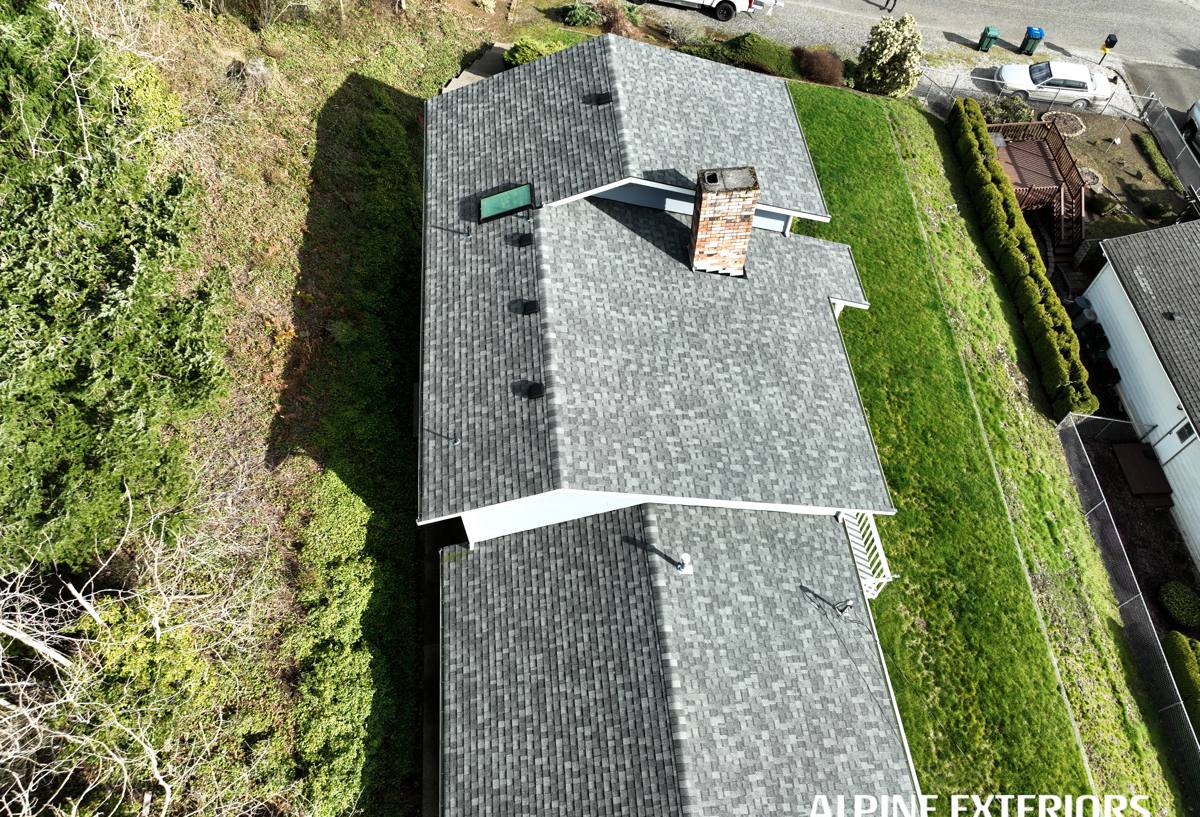
What This Climate Actually Does to a Roof
Skagit County's coastal weather isn't dramatic in any single event — it's the accumulation that causes problems. A few specifics worth understanding before you choose a roofing material:
- Salt air accelerates corrosion. Bare or poorly coated metal fasteners and flashing corrode faster this close to saltwater than they would even a short distance inland.
- Moss season runs long. Shaded, north-facing slopes under tree canopy can stay damp for months, giving moss and moss-adjacent growth time to root into shingle mat or seams.
- Driving rain finds weak laps. Wind off the water pushes rain sideways during storms, which means standard vertical-lap logic isn't always enough — flashing and panel overlap have to account for wind-driven water, not just gravity.
- Freeze-thaw is mild but present. We don't get deep freezes often, but the occasional cold snap after a wet stretch is exactly when marginal seams or trapped moisture cause the most damage.
None of this is unique to Old Town specifically — it's Anacortes and Fidalgo Island generally — but the tree cover and older construction common in this neighborhood make the effects show up sooner than on a newer, more exposed build elsewhere in the county.
Why Metal Holds Up Better in This Environment
Metal roofing isn't the right call for every home or every budget, but for the conditions this neighborhood deals with, it addresses several problems at once:
- A properly coated metal surface sheds moss and organic debris far more readily than a shingle mat, because there's no porous surface for spores and roots to grip.
- Standing seam profiles in particular give wind-driven rain fewer places to get pushed backward under a lap.
- Metal doesn't absorb water the way composite shingles can over time, which matters when a roof spends half the year damp.
- A correctly installed metal roof typically outlasts two or more shingle roof cycles, which changes the long-term math even though the upfront cost is higher.
We're not going to tell you metal is maintenance-free — nothing on a roof in this climate is — but it removes the moisture-retention problem that drives most of the moss, algae, and premature wear we see on older Old Town roofs.
Panel Types and Finishes: What We Actually Recommend
"Metal roofing" covers a range of products, and the right one depends on the home, the roof pitch, and the budget. Here's how the common options compare for a coastal, tree-covered neighborhood like this one:
| Option | Best For | Trade-offs Near Salt Air |
|---|---|---|
| Standing seam steel (concealed fastener) | Most Old Town roofs — clean lines, best water shedding | Higher upfront cost; needs a crew experienced with tight seam tolerances |
| Exposed-fastener panel (screw-down) | Outbuildings, budget-conscious re-roofs, low-slope sections | Fastener gaskets degrade faster in salt air and need periodic checking |
| Stone-coated steel | Homes wanting a shingle or shake look with metal's durability | Coating and lap details matter more here — poor installs trap moisture under the coating |
| Aluminum panel systems | Homes closest to the water or with a history of corrosion issues | Naturally corrosion-resistant but softer — more careful handling during install |
For most homes in this neighborhood, we lean toward standing seam with a quality Galvalume or aluminum-zinc coated substrate and a factory paint finish rated for coastal exposure. It's not the cheapest option, but it's the one that best matches what this specific environment demands.
A Note on Coatings
The paint or coating system matters as much as the base metal. A coastal-rated finish resists chalking and fading from salt exposure and UV, and it holds its color longer under the kind of persistent damp-and-dry cycling this area gets. We won't put an interior-grade or bargain coating on a roof this close to saltwater — it's a maintenance and warranty problem waiting to happen, and it's not a trade-off worth making to save a small amount up front.
What a Correct Metal Roof Installation Involves
The panels get the attention, but most metal roof failures we're called to fix trace back to what's underneath or around them, not the metal itself. A correct install includes:
- Deck inspection and repair. Any soft, rotted, or previously water-damaged decking gets addressed before anything goes down — panels over a bad deck just hide the problem.
- Underlayment suited to the climate. A synthetic, high-temp underlayment with proper lap orientation for prevailing wind and rain direction, not a generic felt.
- Ice-and-water barrier at vulnerable points. Valleys, eaves, and low-slope transitions get self-adhering membrane, since these are the spots where wind-driven rain and standing moisture cause the most trouble.
- Flashing built for this wind pattern. Step flashing, valley flashing, and penetration boots sized and lapped to handle sideways rain, not just straight-down runoff.
- Fastener and clip spec matched to the panel system. Concealed clips, correct spacing, and corrosion-resistant fasteners rated for coastal exposure.
- Ventilation that actually balances. Intake and exhaust that work together — a metal roof over a poorly vented attic just moves the moisture problem to the underside of the deck.
Our Process on an Old Town Anacortes Job
1. On-Site Assessment
We walk the roof, check the attic or crawlspace where accessible, and look at existing moss, staining, and flashing condition. On older homes, we're specifically checking deck condition and how much of the existing ventilation setup can be kept versus needs correcting.
2. Straightforward Scope and Pricing
You get a written scope that spells out panel type, underlayment, flashing approach, and any deck repair — no vague "roofing package" line item. If something on your roof needs more than a standard re-roof, we tell you before work starts, not after.
3. Tear-Off and Deck Prep
We remove the old roofing down to the deck, replace any compromised sheathing, and address ventilation before a single panel goes down.
4. Install
Underlayment, flashing, and panels go in following the spec we agreed on — with the seam and fastener details built for this specific wind and moisture pattern, not a one-size-fits-all approach.
5. Final Walkthrough
We walk the finished roof with you, cover basic care, and make sure gutters, downspouts, and any surrounding trim tie in cleanly.
Cost Factors on a Metal Roof in This Area
We're not going to quote a number without seeing the roof, but these are the variables that move the price up or down on most Old Town jobs:
| Factor | Effect on Cost |
|---|---|
| Roof pitch and complexity (valleys, dormers, multiple planes) | More cuts, flashing, and labor time |
| Existing deck condition | Rot or soft sheathing found on older homes adds repair cost |
| Panel type (exposed-fastener vs. standing seam) | Standing seam runs higher due to labor and hardware |
| Coating/finish grade | Coastal-rated finishes cost more but hold up longer here |
| Tear-off layers | Multiple existing roof layers add disposal and labor time |
| Access and tree cover | Tight lots and mature trees common in Old Town can add setup and cleanup time |
Moss, Debris, and Long-Term Care
Metal roofing cuts down on maintenance considerably, but it doesn't eliminate it — especially under the tree cover common in this neighborhood. A short, honest checklist for keeping a metal roof performing here:
- Clear needles, leaves, and debris from valleys and around penetrations a couple of times a year — this is where organic buildup actually causes problems on metal, not the open panel field.
- Keep gutters and downspouts flowing freely so water isn't backing up against eave flashing.
- Trim back branches that overhang the roof to cut down on both debris and prolonged shade that keeps sections damp.
- Have fasteners and gaskets on exposed-fastener systems checked periodically — this is the one component that ages faster in salt air than the panels themselves.
- Watch for any staining or moss starting at seams or flashing laps, which usually points to a spot worth a closer look rather than a roof-wide issue.
Why Hiring a Crew That Already Works This Neighborhood Matters
Old Town Anacortes has enough of its own quirks — older framing, mature trees, tighter lots, and full-time salt exposure — that a crew unfamiliar with the area can miss things a local team catches automatically. We're not guessing at how wind-driven rain behaves off the water here, or how long moss season really runs on a shaded, tree-covered slope. We've priced and built for these exact conditions on homes throughout Anacortes and the rest of Skagit County, and that shows up in the details: where we put ice-and-water membrane, how we vent an older attic, and which fastener and coating specs we won't compromise on for this environment.
If you're weighing a metal roof for a home in Old Town Anacortes, we're happy to take a look and walk you through what your specific roof needs — no pressure, no generic package pricing. Use the form below to request a free estimate.