 Anacortes Siding
 Why March Point's Location Makes Window Replacement Different
March Point sits out on open water, with exposure most inland Skagit County neighborhoods never deal with. Homes here take wind and salt-laden air from more than one direction, and that combination is hard on window systems in ways that aren't always obvious from the inside of the house. Salt air accelerates corrosion on hardware, fasteners, and metal window components. Wind-driven rain doesn't just hit the glass — it gets pushed sideways and upward into gaps that a calmer inland install would never expose. And the long, wet Pacific Northwest fall-through-spring stretch means moss and algae get a foothold on any horizontal surface that stays damp, including window sills and the trim around them.
None of this means March Point homes need exotic products. It means the installation details — flashing, sealant choice, drainage paths, hardware finish — matter more here than they would on a sheltered lot a few miles inland. A window that's "good enough" in a protected yard can fail early on a point exposed to open water on more than one side.
What "Exposure" Actually Does to a Window Over Time
Windows don't usually fail all at once. They fail slowly, through small amounts of water finding their way past seals and flashing, year after year, until wood framing softens, insulation gets wet, and the sash starts to stick or won't seal tight anymore. On a wind-exposed site like March Point, that timeline compresses. A flashing detail that would last 20 years in a sheltered spot might only buy 10-12 years here if it's not done right the first time.
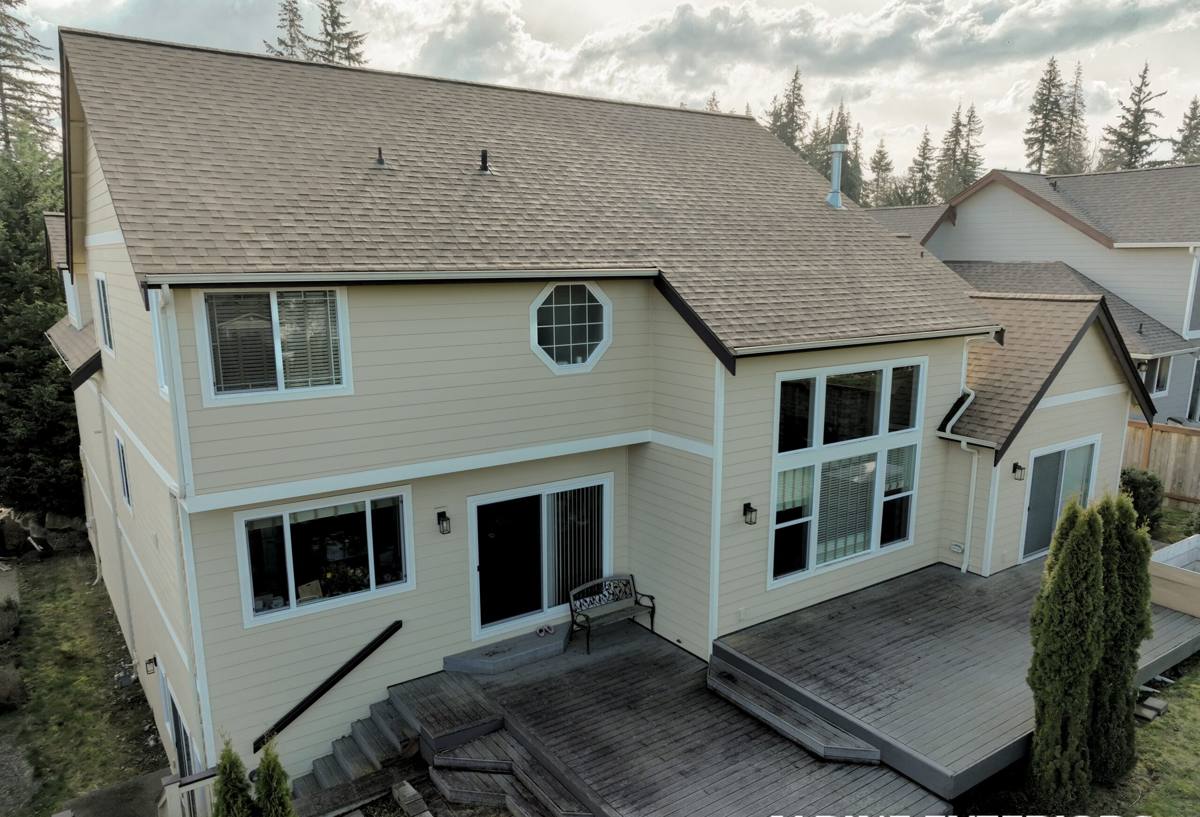
Signs a March Point Home Needs Window Replacement
Most homeowners call us after noticing one or two of the issues below — rarely all of them at once. Any single item on this list is worth a look; several together usually means it's time to plan for replacement rather than another round of caulk and patch.
- Visible fog or moisture trapped between panes of double-pane glass — the seal has failed and can't be repaired
- Soft or discolored wood trim or sill, especially on window walls facing the water or prevailing wind
- Drafts you can feel with a hand near the frame, even with the window fully latched
- Windows that are hard to open, close, or lock — frames have swelled, warped, or racked out of square
- Moss, algae, or black streaking building up on sills or the wall below the window every wet season
- Rising heating bills without another clear explanation
- Paint that keeps peeling or bubbling around the window opening no matter how often it's repainted
- Rust staining on hardware, cranks, or fasteners
What a Correct Window Replacement Involves
Setting a new window in the opening is the easy part. What separates a window that lasts from one that leaks in five years is everything around the glass — the flashing, the sealant, and how water that does get past the outer defenses is given a way back out.
Flashing and Drainage Come First
Before a new window ever goes in, the opening gets inspected for hidden rot and water damage that built up under the old unit — this is common on wind-exposed walls and is usually invisible until the old window is out. The rough opening gets properly flashed with a weather-resistant barrier that integrates with the house wrap or siding, so water is directed out and down rather than trapped behind the new window. On a site like March Point, we pay particular attention to sill pan flashing, since a sill pan is what catches and drains any water that gets past the primary seal — cheap or skipped installs often leave this step out entirely.
Sealant and Fastening
The right sealant, applied in the right places (and left out of the places where it would trap water instead of releasing it), makes a real difference in salt air. Fasteners and hardware exposed to marine air should be corrosion-resistant — standard hardware can start showing rust streaks within a couple of seasons on an exposed elevation.
Insulation and Air Sealing
Gaps between the window frame and rough opening get filled with low-expansion foam or backer rod and sealant, not just stuffed with fiberglass. This closes the air leaks that cause drafts and helps the new window perform at the efficiency rating it's actually built for.
Choosing a Window Type for a Marine Environment
There's no single "best" window for every home — the right choice depends on budget, the style of the house, and how exposed a particular wall is. Here's how the common options compare for a site with salt air and wind-driven rain:
| Frame Material | Salt Air / Moisture Behavior | Maintenance | Typical Fit |
|---|---|---|---|
| Vinyl | Won't rust or rot; performs well in coastal air | Low — occasional cleaning | Budget-conscious replacement, most house styles |
| Fiberglass | Very stable in moisture and temperature swings; strong seal retention over time | Low | Higher-exposure walls, longer-term investment |
| Aluminum | Prone to corrosion near salt air unless properly coated/finished | Moderate — watch hardware and finish | Modern styling; needs a marine-rated finish here |
| Wood / wood-clad | Attractive but the wood core is vulnerable if the exterior cladding or seal is ever compromised | Higher — needs monitoring and occasional refinishing | Historic or high-end aesthetic where upkeep is expected |
We don't push one brand or material on every job. We do steer homeowners away from standard-finish aluminum and low-grade wood units on wind-exposed elevations, not because those products are bad in general, but because they ask for more upkeep than most owners want to commit to on a site that gets this much weather. That's a judgment based on maintenance burden and moisture behavior, not a knock on any manufacturer.
Our Window Replacement Process
- On-site assessment. We look at each window individually — exposure, current condition, any hidden rot around the opening — rather than quoting a flat per-window price sight unseen.
- Honest recommendation. We tell you which windows genuinely need replacing now, which can wait, and which material makes sense for that wall's exposure.
- Removal and opening inspection. Old units come out carefully so we can check the rough opening and framing underneath before anything new goes in.
- Repair as needed. Any soft framing or water damage found during removal gets addressed before the new window is installed — not covered up.
- Flashing, sill pan, and install. The new window goes in plumb, level, and square, with proper flashing and sealant sequencing so water sheds outward.
- Interior and exterior finish. Trim, caulking, and paint or stain get finished to match the home.
- Final walkthrough. We test operation and locks and walk the job with you before calling it done.
Cost Factors for March Point Window Replacement
Every home is different, so we don't quote window replacement by a flat per-unit number without seeing the job. The factors below are the main things that move a project's cost up or down:
| Factor | How It Affects Cost |
|---|---|
| Frame material | Vinyl is generally the most budget-friendly; fiberglass and wood-clad cost more upfront |
| Number of windows | Replacing a full house at once is typically more cost-effective per window than one-off replacements over time |
| Hidden framing damage | Rot found around an opening during removal adds repair time before the new window can go in |
| Window size and configuration | Large picture windows, bays, or custom shapes cost more than standard double-hung or slider sizes |
| Exposure level | Wind- and rain-exposed elevations may warrant upgraded flashing details and hardware, adding modest labor cost |
| Trim and finish work | Matching existing trim profiles or repainting/staining adds to the overall scope |
We give straightforward written estimates that break these factors out, so you know what you're paying for and why — not a single lump number with no explanation behind it.
Why Hiring a Crew That Already Works March Point Matters
A contractor who mostly works sheltered, inland lots in Skagit County can still do a technically fine install — but they may not automatically account for the extra exposure a March Point wall sees. A crew that regularly works this area already knows to check sill pan flashing twice, to spec corrosion-resistant hardware without being asked, and to expect that a north- or water-facing wall needs more attention than a sheltered one on the same house. That local pattern recognition is the difference between a window that's still performing well in fifteen years and one that starts showing problems in five.
We also know the practical side of working on the point — wind conditions that affect scheduling, and building the job around the wet season rather than fighting it.
Maintaining New Windows Through Moss Season and Beyond
A correctly installed window still benefits from a little seasonal attention on an exposed site like this. A few habits go a long way toward protecting your investment:
- Clear moss, leaves, and debris off sills and tracks before the wet season sets in each fall
- Rinse salt residue off exterior frames periodically, especially on water-facing walls
- Check and re-caulk any exterior trim joints if you notice cracking or gaps forming
- Exercise locks and hardware a few times a year so they don't seize up from disuse
- Watch for any new staining or soft spots on interior sills, which can be an early sign a seal needs attention
None of this is heavy maintenance — it's the kind of five-minute check most homeowners can fold into normal fall and spring yard work. The goal of a correct installation is to make that maintenance minor rather than urgent.
If your March Point home has windows showing any of the signs above, or you're just ready to stop fighting drafts and moisture through another wet Skagit County winter, we're happy to take a look. Fill out the form below for a free, no-pressure estimate — we'll assess your home's actual exposure and give you a straightforward recommendation, not a sales pitch.