 Anacortes Siding
 Fidalgo Island sits mostly surrounded by saltwater — Rosario Strait to the west, Guemes Channel to the north, and Padilla Bay and the Swinomish Channel to the east and south. That geography is part of what makes Anacortes and the rest of the island a beautiful place to own a home, and it's also exactly why siding here takes a beating that inland Skagit County properties don't see nearly as often. Salt-laden air, wind-driven rain coming off open water, and a moss season that can run most of the year all work on a wall assembly around the clock, not just during a storm. When siding starts to fail on a Fidalgo Island home, it's rarely one dramatic event — it's the slow accumulation of small failures that finally show up as a soft spot, a stain, or a crack.
This page is specifically about siding repair — patching, replacing damaged sections, and correcting problem areas on homes that don't need (or aren't ready for) a full re-side. We do complete James Hardie installations across the island too, but a lot of the calls we get are homeowners who just need a section fixed correctly, want an honest read on whether that's even the right call, and don't want to be upsold into a bigger job than the house actually needs.
What Fidalgo Island's Climate Does to a Wall
Salt Air and Marine Exposure
Even homes set back from the water get a steady dose of salt-carrying air moving across the island. Salt accelerates corrosion in fasteners, flashing, and any exposed metal trim, and it breaks down lower-grade finishes faster than you'd see in a drier inland climate. A repair that ignores what's actually corroding behind the visible damage tends to fail again within a season or two.
Wind-Driven Rain
Rain around here rarely falls straight down. Open water exposure means wind regularly pushes rain sideways into lap joints, trim seams, and anywhere a wall assembly has a gap. That's a very different load than a simple annual rainfall total suggests, and it's why damage often starts at seams and corners rather than in the middle of a flat wall section.
Moss, Mildew, and Prolonged Dampness
Mild temperatures, shade from mature trees, and consistent moisture add up to a long moss and mildew season on Fidalgo Island. Any siding surface that stays damp for extended stretches — typically north-facing walls or areas shaded by structures and trees — becomes a growth surface over time, and organic growth holding moisture against a wall is one of the more common root causes behind the repair calls we get.
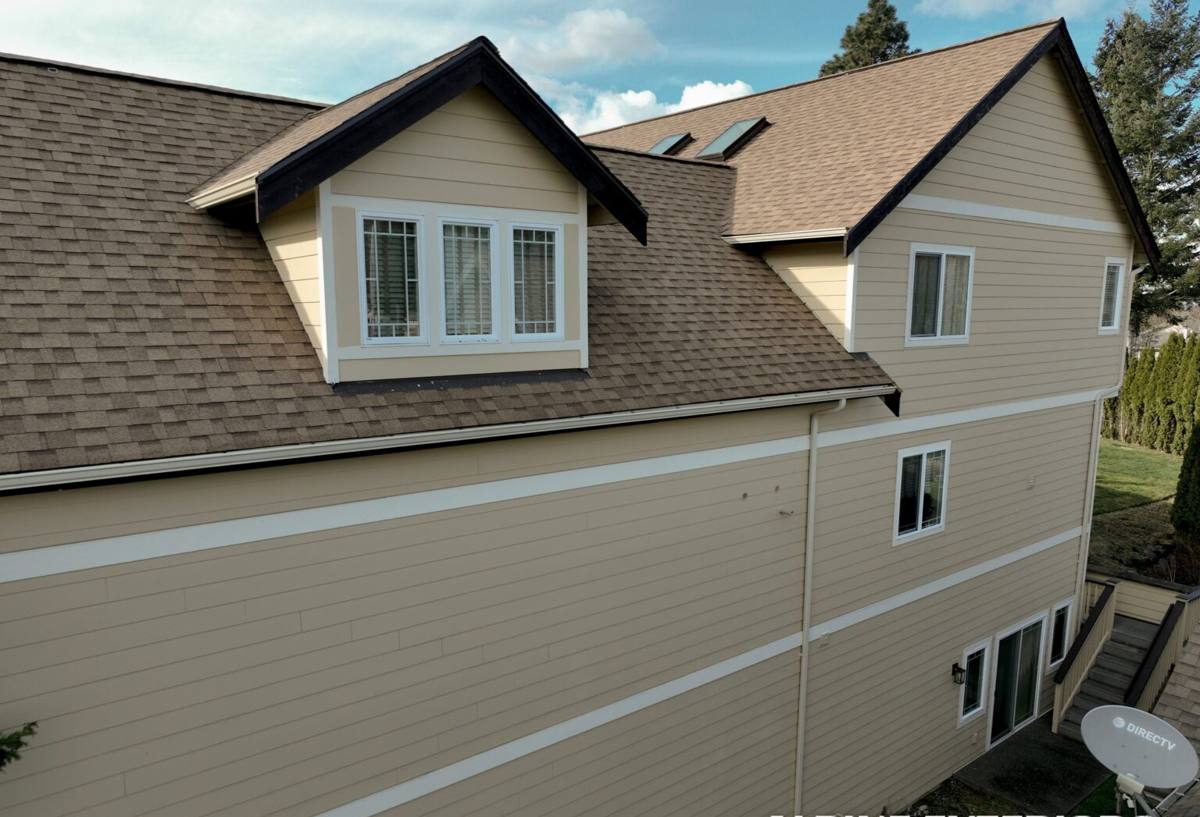
Signs a Fidalgo Island Home Needs Siding Repair
Some of these are obvious from the ground. Others take a closer look, which is part of why we walk the whole exterior rather than just inspecting the spot a homeowner called about.
- Soft or spongy siding when you press on it, especially low on the wall or near window and door trim
- Cracked, chipped, or missing sections, often from storm impact or age
- Moss or dark staining that returns quickly after cleaning, particularly on shaded or north-facing walls
- Visible gaps at seams, corners, or trim joints where wind-driven rain can track in
- Peeling paint, bubbling, or warping on siding boards or trim
- Bulging or rippled sections, which usually points to moisture trapped behind the material
- Rising energy bills that may signal a wall assembly that's no longer sealing the way it should
Repair vs. Replacement: How We Make the Call
Not every siding problem on Fidalgo Island calls for a full tear-off, and we're not going to tell you it does just because a bigger job pays more. Localized damage — a section that took storm impact, trim that failed around one window, a corner where flashing was never quite right — can usually be repaired and matched into the surrounding siding without touching the rest of the wall. But when moisture has been tracking behind the wall for a while, or the existing material is an older product at the end of its useful life, patching it often just delays a larger job and can mask damage that keeps spreading underneath.
| Situation | Usually Points To | Typical Approach |
|---|---|---|
| Isolated crack or storm damage in one section | Impact damage, not systemic moisture failure | Targeted repair and re-match |
| Soft or spongy siding around one window | Local flashing failure at that opening | Repair the flashing detail, replace the affected boards |
| Widespread soft spots across multiple walls | Long-term moisture intrusion behind the siding | Deeper inspection; often points toward replacement |
| Original siding is 25+ years old and failing broadly | Material at the end of its service life | Replacement usually more cost-effective than repeated patching |
| Cosmetic fading or minor caulk failure only | Normal aging, no moisture intrusion | Maintenance-level repair, often just caulking and touch-up |
We'll tell you plainly which category your home falls into, including when the honest answer is that a repair will hold up fine and a full re-side isn't necessary yet.
What a Correct Siding Repair Actually Involves
Matching Material and Finish
On homes already sided in James Hardie, a good repair means sourcing the correct profile and matching the ColorPlus factory finish as closely as possible, since a mismatched patch is obvious and doesn't age the same way as the surrounding boards. On homes with older or different siding products, we'll be straightforward about what can realistically be matched versus what will look like a visible patch, and what your options are if a clean match isn't possible.
Flashing and Water Management
Most siding damage we find on Fidalgo Island traces back to a flashing or water-management detail that wasn't right in the first place — not the siding material itself failing on its own. A repair that just replaces the visible damaged board without correcting the flashing or house wrap detail underneath is a repair that's going to fail again in the same spot. We treat that underlying detail as part of the job, not an optional add-on.
Fastening for Marine Exposure
Fasteners and hardware rated for coastal, salt-air exposure matter more here than in a drier inland climate. Using standard-grade fasteners on an island property is one of the more common shortcuts that leads to premature corrosion, staining, and repeat failures a few years down the road — we spec hardware for the actual environment, not the minimum code requirement.
Our Repair Process
- Walk-around inspection of the affected area and the surrounding siding, checking for hidden moisture beyond what's visible
- An honest assessment of whether the damage is isolated or a sign of a broader problem, explained in plain terms
- Investigation of the underlying cause — flashing, sealant failure, trapped moisture — not just the surface symptom
- A written scope covering material, matching approach, and flashing corrections, with no pressure to expand the job
- Repair work completed to the same fastening and flashing standards we'd use on a full installation
Repair Cost Factors on Fidalgo Island
| Factor | What It Affects | Why It Matters Here |
|---|---|---|
| Extent of hidden moisture damage | Whether sheathing or framing repair is needed | Trapped moisture behind failing siding is common after years of marine exposure |
| Material match availability | Whether an exact color/profile match is possible | Older or discontinued siding products can be harder to match cleanly |
| Flashing correction scope | Labor beyond simple board replacement | Fixing the root cause, not just the symptom, prevents repeat repairs |
| Site access | Labor time and equipment needs | Waterfront or bluff-facing lots can add staging complexity |
| Number of affected areas | Total scope of the repair | Storm damage often affects more than one wall or elevation |
Exact numbers depend on what we find once we get eyes on the actual damage, which is why we walk the property in person rather than quoting off a phone description.
Why We Repair and Install Only James Hardie Siding
We don't install or repair-match LP SmartSide, vinyl siding, Cemplank, Allura, primed spruce, or cedar. That's a professional standard, not a sales pitch: fiber cement is non-combustible, dimensionally stable, and Hardie's ColorPlus finish is baked on at the factory rather than field-applied, so it holds color and resists moisture damage far longer than site-painted alternatives in a marine climate like this one. When we do encounter a Fidalgo Island home sided in one of those other products and the damage is significant, we'll say so honestly and talk through what a transition to Hardie would look like — but we won't pretend every repair needs to turn into a full re-side just to get there.
Why a Crew That Works Fidalgo Island Regularly Matters
Skagit County's coastal microclimates aren't uniform, and the island's mix of open-water exposure, elevation changes, and tree cover is something you learn from working on homes here repeatedly, not from a spec sheet. We know which wall orientations take the worst of a winter storm off the water, where moss keeps coming back no matter how often it's cleaned, and which flashing details are worth extra time versus which ones are just code minimums. That local pattern recognition is a big part of why a repair we do holds up, rather than needing a callback in a year or two.
Get a Free, No-Pressure Estimate
If you're seeing soft spots, cracked boards, moss that keeps returning, or trim damage anywhere on a Fidalgo Island home, we're glad to take a look. Reach out using the form below for a free estimate — we'll give you a straight answer about whether a repair makes sense, what it involves, and why, with no pressure to sign up for more than the house actually needs.