 Anacortes Siding
 Fiber Cement Siding, Built for Skyline's Exposure
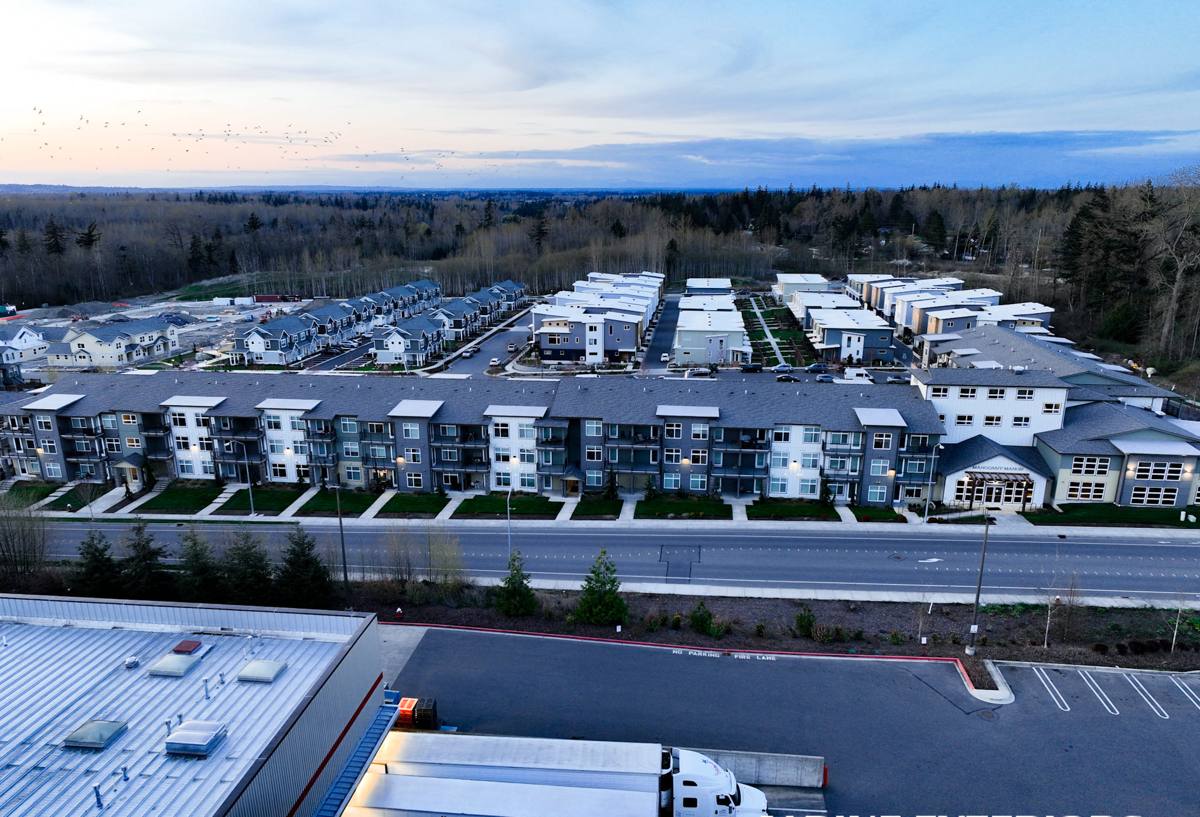
Skyline sits up on the bluff on the west side of Anacortes, and that stretch of view comes with a trade-off: the same open sightline to the water that makes the neighborhood desirable also means homes here catch wind, salt, and driving rain more directly than properties tucked farther into town. Siding is the material standing between that weather and the framing of the house, and on a site like this, the difference between a correctly installed wall and a corner-cut one shows up faster and more visibly than it would somewhere more sheltered.
We install James Hardie fiber cement siding exclusively — no vinyl, no LP SmartSide, no Cemplank, Allura, primed spruce, or cedar. This page is specifically about what fiber cement siding needs to look like on a Skyline home: what the site does to a wall, what a correct installation actually involves, and how we approach the work here after doing enough of it in this neighborhood to know where the weather usually wins and where it doesn't.
What Skyline's Site Does to Siding
Three things define the exposure here, and each one stresses siding in a different way. Salt-laden air off the Salish Sea accelerates corrosion on anything metal — fasteners, flashing, trim hardware — and it also degrades paint and coatings faster than an inland site would see. Wind-driven rain hits west- and water-facing walls directly rather than falling straight down, which means it's testing every seam, joint, and piece of trim on the house, not just the roof. And the region's long, damp season, combined with shade from mature evergreens on many Skyline lots, gives moss and algae a steady foothold on siding that doesn't get much sun to dry out.
None of that is unique to this one neighborhood — it's the reality for a lot of coastal Skagit County. What's different about Skyline is degree: a bluff lot facing open water gets more of all three than a lot a few blocks inland with some terrain or tree cover breaking the wind. That's the calculation we're making before we ever talk about which siding profile or color a homeowner wants.
How This Shows Up on Existing Siding
- Cracked, chalking, or peeling paint on wood or engineered wood siding that's been through repeated wet-dry cycles
- Caulking at trim and butt joints that has opened up, giving wind-driven rain a direct path behind the cladding
- Corroded fasteners or flashing on older installations that weren't specified for coastal exposure
- Moss and algae staining on shaded, north- or east-facing walls that rarely get direct sun
- Soft or delaminating siding near grade or roof intersections, where moisture has been sitting against the material longer than it should
Why Fiber Cement Is the Right Material Here
Fiber cement doesn't expand and contract with moisture the way wood does, and it doesn't rely on an unbroken factory finish and tight joints the way vinyl does to keep water out. James Hardie's ColorPlus finish is baked on at the factory under conditions a field-applied coat can't match, and it's formulated to hold color and resist cracking under UV and salt exposure — the exact combination a Skyline wall deals with year-round. That's the core reason we standardized on it rather than offering several material options: we've seen how each one performs specifically in this kind of exposure, and fiber cement, installed correctly, holds up better than the alternatives.
"Installed correctly" is doing real work in that sentence. Fiber cement is not a maintenance-free material that forgives a sloppy install — it still needs the right clearances, the right fasteners, and properly primed cut edges. The material gives you a better starting point than wood or vinyl in this climate, but the installation is still what determines whether that advantage actually shows up ten or twenty years down the road.
The HZ10 Climate Designation
James Hardie engineers its siding formulation for different climate zones across the country, and most of western Washington, including Anacortes and Skagit County, falls under the HZ10 zone — the designation for wetter, harsher exposure conditions. The core fiber cement material is the same across zones, but the formulation and moisture-management engineering are tuned for the freeze-thaw and sustained-moisture conditions a marine climate produces. For a Skyline home specifically, that's the baseline product, not an upgrade — it's what the site calls for.
What a Correct Installation Actually Involves
The finished look of a Hardie wall is straightforward — clean lines, a factory-finished surface, tight reveals. What's less visible is everything that has to happen correctly behind and around that surface for it to perform the way it's supposed to on an exposed lot:
- A weather-resistive barrier installed and lapped correctly, shingle-style, before any siding goes up, so water that does get past the cladding has somewhere to go besides the sheathing
- Flashing at every window, door, and penetration, integrated with the barrier so water is directed out and down, not behind the siding
- Correct clearances — Hardie's specification calls for a minimum 6 inches from grade and 2 inches from roofing, decking, or other horizontal surfaces, which matters more on a lot where wind-driven rain and splash-back are a regular occurrence, not an occasional storm
- Corrosion-resistant fasteners, sized and spaced to Hardie's specification, since standard fasteners degrade faster in salt air and a failed fastener is one of the more common causes of siding problems we find on older coastal installs
- Field-cut edges primed before installation, since the factory ColorPlus finish only covers the manufactured face and edges — an unprimed cut edge is an entry point for moisture that has nothing to do with the material's overall durability
- Gaps left at butt joints and trim per manufacturer spec, then sealed with a quality exterior sealant rated for the movement and moisture this climate produces — caulked tight with no gap at all is a common shortcut that traps rather than sheds water
Skip or rush any one of these and the wall can still look right for a season or two. The problems that follow — staining, soft trim, paint failure at seams, fastener bleed — take a few wet winters to show up, which is exactly why they're easy for a corner-cutting install to get away with until it's the homeowner dealing with the repair.
Details That Matter More on a Site Like This
Every one of the items above matters on any Hardie installation, anywhere. On a Skyline lot, a few of them carry more weight than they would on a sheltered site. Flashing details around windows and doors need to account for wind-driven rain hitting at an angle, not just falling straight down. Fastener corrosion resistance isn't a nice-to-have — it's the difference between hardware that lasts the life of the siding and hardware that starts staining and loosening within a decade. And on shaded, moss-prone walls, keeping the bottom of the wall assembly able to drain and dry matters more, since those areas simply don't get the sun exposure that helps a wall shed moisture elsewhere in town.
Our Process on a Skyline Project
Every project starts with a walk-around of the existing exterior — what's original, what's been patched, what's showing wear from age versus what's showing wear from this site's particular exposure. That inspection tells us as much as any conversation about products. From there, our process generally looks like this:
- A written scope covering exactly what's being removed, repaired, and installed, with product line and color selected up front so there are no surprises mid-project
- Removal of the existing siding with an inspection of the sheathing and structure underneath, since that's the one point in a project where hidden moisture damage from a past installation is actually visible and repairable
- Repair of any compromised sheathing or framing before new barrier and siding go on — covering a problem back up doesn't fix it
- Installation of the weather-resistive barrier, flashing, and Hardie siding to manufacturer specification, with the clearances and fastening detailed above
- Trim, caulking, and touch-up of any field-cut edges, followed by a final walk-through before we call the job done
Cost Factors for a Skyline Siding Project
Every home is different, so we don't quote a price without seeing the site, but the factors that move the number tend to be the same ones on most Skyline projects:
| Factor | Why It Matters on This Site |
|---|---|
| Condition of the existing wall assembly | Hidden moisture damage from a prior installation adds repair scope that isn't visible until tear-off |
| Home size and wall complexity | Gables, dormers, and multiple roof intersections mean more flashing and cutting, which is where labor time concentrates |
| Product line and profile | HardiePlank lap, HardiePanel vertical, and different textures and widths carry different material costs |
| Trim and accent detail | Window surrounds, corner boards, and accent panels add both material and labor beyond a plain lap wall |
| Site access | Bluff lots, tree cover, and narrower driveways can affect staging, scaffolding, and how efficiently material moves to the wall |
Fiber Cement vs. Other Siding Options for This Site
We only install James Hardie fiber cement, but homeowners researching a siding project reasonably want to know how it stacks up against what's out there. Here's an honest comparison, specific to the kind of exposure Skyline sees:
| Material | Behavior in Salt Air & Driving Rain | Maintenance Here | Our Take |
|---|---|---|---|
| James Hardie fiber cement | Dimensionally stable; factory finish resists fading and cracking when installed to spec | Low; occasional wash, no repainting on a normal cycle | What we install, and why |
| Vinyl | Not a water barrier on its own; can become brittle with age and UV, relies entirely on what's behind it | Low visible upkeep, but hidden moisture issues are hard to catch early | We don't install it |
| LP SmartSide (engineered wood) | More sensitive to moisture at cut edges and fastener penetrations than fiber cement | Moderate; edge sealing and touch-up need regular attention | We don't install it |
| Cedar | Absorbs moisture readily without diligent sealing; attractive but demanding here | High; recurring sealing or staining to hold up against this much moisture | We don't install it |
These are legitimate products, and other contractors install them competently. We standardized on one system because we've seen, on homes in this exact kind of exposure, which material gives a homeowner the least maintenance and the longest real-world lifespan when the installation is done right.
Why a Crew That Already Works in Skyline Matters
Skagit County's coastal microclimates aren't uniform, and Skyline's particular mix of elevation, open water exposure, and tree-shaded pockets is something you learn by working on homes here repeatedly. We know which walls on a typical Skyline lot take the brunt of a winter storm and need extra attention at flashing and fastening, and which are more sheltered. We're familiar with the practical realities of bluff-lot access — narrower driveways, tree cover that affects scaffolding and material staging, and terrain that isn't always flat and open like a lot elsewhere in town. If a property has an HOA or covenant with exterior material or color requirements, that's worth checking early, and we're glad to work through that alongside the homeowner.
Manufacturer certification matters too. A Hardie warranty is tied to correct installation, and a crew that installs this system regularly — including on sites with this level of exposure — is going to catch the details that a generalist crew installing it occasionally might miss.
What to Expect From an Estimate
- A walk-around inspection of your current siding, trim, and any visible problem areas, with an honest read on what's age versus what's exposure-related
- A clear explanation of product line, profile, and color options, and why we're recommending what we're recommending for your specific walls
- A written scope that spells out barrier, flashing, fastening, and clearance details — not just "siding replacement" as a line item
- A straightforward cost breakdown with no pressure to sign on the spot
If you own a home in Skyline and you're seeing moss buildup, fading or cracked siding, open caulk joints, or soft trim near windows and grade, we're happy to take a look. Reach out for a free, no-pressure estimate — we'll tell you plainly what your siding needs and why.