 Anacortes Siding
 Siding in Bow Has a Different Job to Do Than Siding Inland
Bow sits close enough to Samish Bay and the surrounding Skagit County shoreline that homes here deal with a version of coastal exposure that inland Skagit and Whatcom County properties simply don't face. Salt-laden air moves through the area on a regular basis, driving rain comes in sideways off the water during winter storms, and the shaded, damp conditions common to this part of Western Washington keep moss and algae growth active for a large part of the year. Any siding material installed on a Bow home has to hold up against all three of those forces at once, year after year, without constant homeowner intervention.
That's the lens we use when we talk to Bow homeowners about siding. It's not just about picking a color or matching a style — it's about choosing a material and an installation approach that's actually engineered for this specific combination of salt, moisture, and shade. That's why we install James Hardie fiber cement siding exclusively, and why we think it's worth explaining what makes it hold up here when other common siding choices struggle.
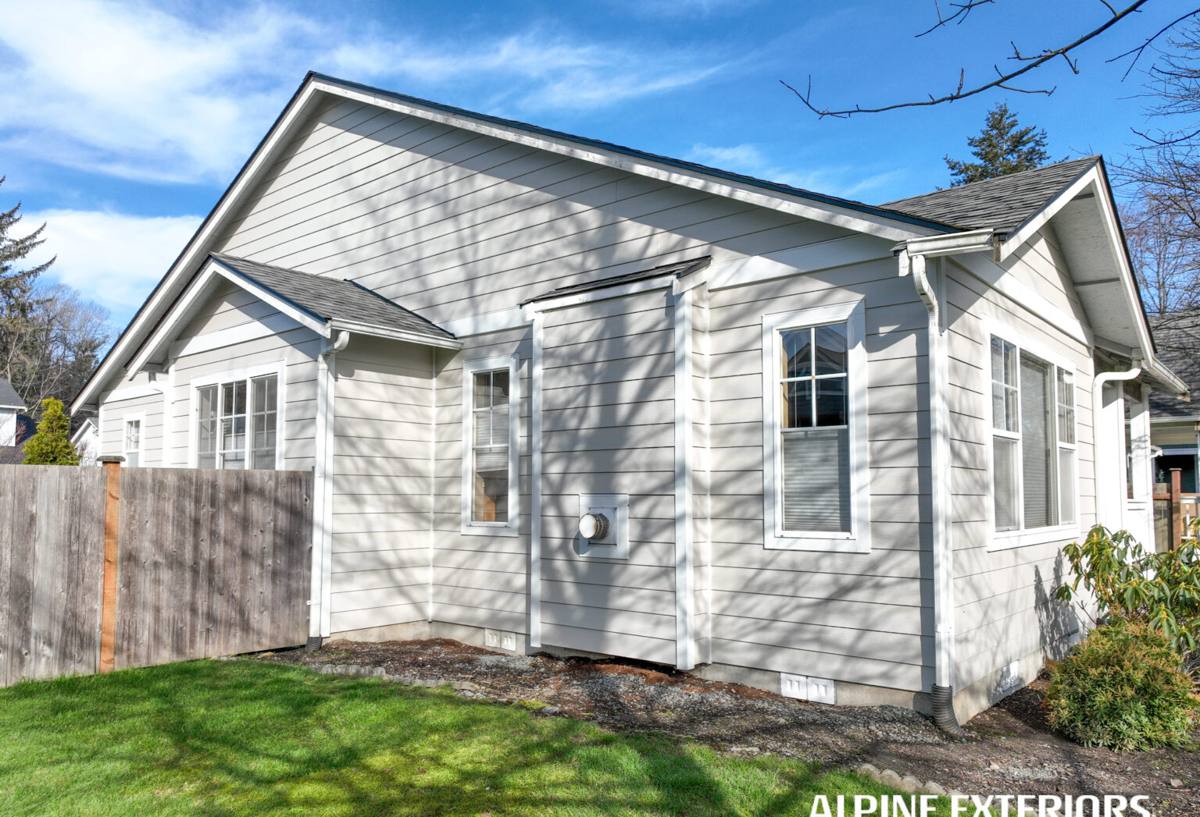
What Salt Air, Driving Rain, and Moss Actually Do to Siding
Each of these three regional conditions attacks siding in a different way, and a lot of siding failures in this area come from a material being weak against one or more of them.
Salt Air
Airborne salt accelerates corrosion on fasteners, trim accessories, and any exposed metal, and it can degrade certain paints and coatings faster than manufacturers' standard warranties assume. Siding systems that weren't engineered with coastal exposure in mind often show fading, chalking, or fastener corrosion well ahead of schedule in areas like Bow.
Driving Rain
Wind-driven rain doesn't just hit a wall — it gets pushed into laps, seams, and butt joints under pressure. If a siding product or installation detail isn't built to shed water that's being forced sideways and upward, moisture works its way behind the cladding. Once water gets behind siding, the problem usually isn't the siding itself — it's what happens to the sheathing, framing, and insulation behind it.
Moss and Algae
Shaded north and west-facing walls, tree cover, and the persistent damp common to Skagit County winters give moss and algae the conditions they need to establish themselves on exterior surfaces. Organic growth traps moisture against the siding surface, and on materials that aren't dimensionally stable or properly finished, that trapped moisture leads to swelling, cracking, or coating failure over time.
Why We Only Install James Hardie Fiber Cement
We made a decision as a company to install James Hardie fiber cement siding exclusively — not vinyl, not LP SmartSide, not cedar, not primed spruce, and not other fiber cement brands. That's a real trade-off worth being upfront about: Hardie siding costs more up front than vinyl, and it's heavier and more labor-intensive to install correctly than engineered wood products. We think that trade-off is worth it for Bow homes specifically, for a few concrete reasons.
- Fiber cement is non-combustible. It doesn't contribute fuel to a fire the way wood-based products can, which matters given wildfire smoke and ember exposure that reaches even damp coastal parts of Western Washington in dry summer stretches.
- It doesn't rot, swell, or absorb water the way wood-based siding can. Vinyl won't rot, but it flexes, fades, and can crack in cold snaps; engineered wood products depend on their coating and edge-sealing staying intact to resist moisture, and once that coating is compromised the substrate is vulnerable.
- ColorPlus factory-applied finish is baked on and backed by its own finish warranty, which holds up better against salt-air fading and chalking than field-applied paint typically does.
- Hardie's HZ5 product line is engineered specifically for wetter, more humid climate zones like the Pacific Northwest, with moisture and freeze-thaw performance tuned for exactly the conditions Bow sees.
We're not going to tell you vinyl or engineered wood siding is junk — plenty of it is installed correctly and performs fine in the right setting. But for the specific combination of salt air, driving rain, and moss exposure that Bow homes deal with, we've standardized on the product we trust most to hold up without surprises.
Choosing the Right Hardie Products for a Bow Home
James Hardie makes several siding profiles, and picking the right one depends on the home's style, exposure, and the look the homeowner wants.
HardiePlank Lap Siding
The most common choice for traditional and craftsman-style homes in this area. Available in several exposure widths and both smooth and cedar-textured finishes.
HardiePanel Vertical Siding
Often used as an accent on gables, entry features, or modern-leaning homes, and sometimes combined with HardiePlank for a mixed-material look.
HardieShingle
A staggered or straight-edge shingle profile for homes that want a cottage or shingle-style look without the maintenance burden of actual wood shingles in a damp climate.
HardieTrim
Fiber cement trim boards used around windows, doors, corners, and fascia so the whole exterior envelope — not just the field siding — resists the same moisture and salt exposure.
For homes closer to open water or with heavier shade and moss history, we lean toward the HZ5 formulation and darker ColorPlus finishes tend to show less moss staining between cleanings than very light colors, though no finish is completely moss-proof without occasional gentle washing.
What a Correct Fiber Cement Installation Actually Involves
Fiber cement siding is only as good as the installation behind it. Most of the siding failures we get called out to inspect in Skagit County aren't a material problem — they're a detail that got skipped or rushed.
Weather-Resistive Barrier and Flashing First
Before a single piece of siding goes up, the wall needs a properly lapped weather-resistive barrier, correctly integrated window and door flashing, and flashing at every horizontal transition — roof-to-wall, deck ledger, and trim intersections. This is the layer that actually keeps driving rain out of the wall assembly; the siding is the second line of defense, not the first.
Correct Fastening
James Hardie specifies fastener type, spacing, and placement for each product and exposure, and following those specs is what keeps panels secure through wind events without over-driving fasteners or blowing out the board edge — both of which create entry points for moisture.
Proper Clearances
Hardie's installation instructions call for minimum clearances from grade, roofing, and decking — typically several inches — so siding isn't sitting in standing water, splash-back, or snow load against the bottom edge. Skipping these clearances is one of the most common causes of premature bottom-edge damage we see on older installations in this area.
Caulking and Joint Treatment
Butt joints, trim intersections, and penetrations need the right sealant applied correctly — not painted-over gaps that look sealed but aren't. Done wrong, this is exactly where wind-driven rain finds its way in.
Fiber Cement vs. Other Siding Materials for a Bow Climate
| Factor | James Hardie Fiber Cement | Vinyl | Engineered Wood (LP SmartSide) |
|---|---|---|---|
| Combustibility | Non-combustible | Melts/deforms under heat | Combustible, wood-based |
| Moisture behavior | Dimensionally stable, engineered HZ5 for wet climates | Doesn't absorb water but can warp/crack in cold | Depends on intact coating/edge seal to resist moisture |
| Salt air / coastal fading | ColorPlus factory finish resists fading and chalking | Can fade and become brittle over time | Field or factory coating can chalk/fade faster near salt air |
| Moss/algae resistance | Stable surface, doesn't swell under trapped moisture | Surface growth is cosmetic, doesn't damage material | Trapped moisture under growth can compromise substrate |
| Typical lifespan when installed to spec | Multiple decades with proper maintenance | 15-40 years depending on product/exposure | Shorter if coating/edge seal is compromised |
Our Process, Start to Finish
We keep the process straightforward and don't push homeowners into decisions they're not ready for.
- Free on-site estimate. We look at your current siding, note problem areas (moss buildup, moisture staining, failed caulk joints, damaged trim), and measure the home.
- Product and profile selection. We walk through Hardie lines, textures, and ColorPlus colors that fit the home's style and exposure.
- Written estimate. Clear scope, product specification, and price — no vague allowances.
- Prep and tear-off. Old siding removed, sheathing inspected and repaired if needed, weather-resistive barrier and flashing installed or corrected.
- Installation to Hardie spec. Fastening, clearances, and joint treatment done to manufacturer requirements, not shortcuts.
- Final walkthrough. We go over the finished job with you before we consider it done.
Signs Your Current Siding May Be Failing
- Persistent moss or algae staining that comes back quickly after cleaning
- Soft or spongy spots when you press on the siding, especially near the bottom edge
- Visible gaps, cracked caulk, or separated joints
- Peeling or bubbling paint, especially on wood-based or engineered wood siding
- Rust streaks around fasteners or trim accessories
- Warping, buckling, or panels that have pulled away from the wall
What Affects the Cost of a Bow Siding Project
| Cost Factor | Why It Matters |
|---|---|
| Home size and wall complexity | More corners, gables, and dormers mean more cutting, trim work, and labor time |
| Condition of existing sheathing | Rot or moisture damage found during tear-off needs repair before new siding goes on |
| Product line and profile | HardiePlank, HardiePanel, and HardieShingle carry different material and labor costs |
| Trim and accessory scope | Full HardieTrim packages around windows, corners, and fascia add cost but improve long-term performance |
| Access and site conditions | Sloped lots, limited access, or extensive landscaping can affect staging and labor time |
We give exact numbers during the in-person estimate rather than a broad range, since the factors above vary so much from one Bow property to the next.
Why a Crew That Already Works in Bow Matters
Siding crews that work regularly in Bow and the surrounding Skagit County area already know what this climate does to a wall system, because they've torn old siding off enough of these homes to see the pattern. That familiarity shows up in small but important ways — knowing to check for moisture intrusion around specific flashing details common in this area's building stock, understanding which orientations on a given lot tend to get the worst wind-driven rain, and recognizing early moss patterns that signal a ventilation or drainage issue rather than just a cosmetic one.
It also matters for permitting and inspection — Skagit County's permitting requirements and local building department expectations are things a crew learns by doing the work here repeatedly, not by reading a manual once. A contractor who treats Bow as just another stop on a route covering multiple counties is less likely to catch the details that are specific to this coastline.
Ready to Talk About Your Home?
If your Bow home's siding is showing moss buildup, moisture staining, or other signs it's not keeping up with the weather anymore, we're happy to take a look. We offer free, no-pressure estimates — we'll walk the exterior with you, point out what we actually see, and give you a straight answer about whether fiber cement replacement makes sense for your situation. Fill out the form below to get started.