 Anacortes Siding
 Building a Deck That Can Actually Handle Conway's Climate
Conway sits low in the Skagit River delta, close enough to Skagit Bay that marine air reaches it regularly, and close enough to the river that ground moisture is a constant fact of life. Add in Skagit County's long, wet winters and the extended gray stretches that never quite dry the yard out, and you've got a setting that is genuinely tough on outdoor wood structures. A deck built here doesn't fail because the homeowner did anything wrong — it fails because it was built the way decks get built in drier parts of the country, without accounting for salt-tinged air, near-constant dampness, and a moss season that can run eight or nine months out of the year.
We're based in Anacortes and build decks throughout Skagit County, including Conway, so this isn't theoretical for us. It shapes which fasteners we spec, how we frame the substructure, and how we detail the ledger board where the deck meets the house. This page walks through what that actually looks like.
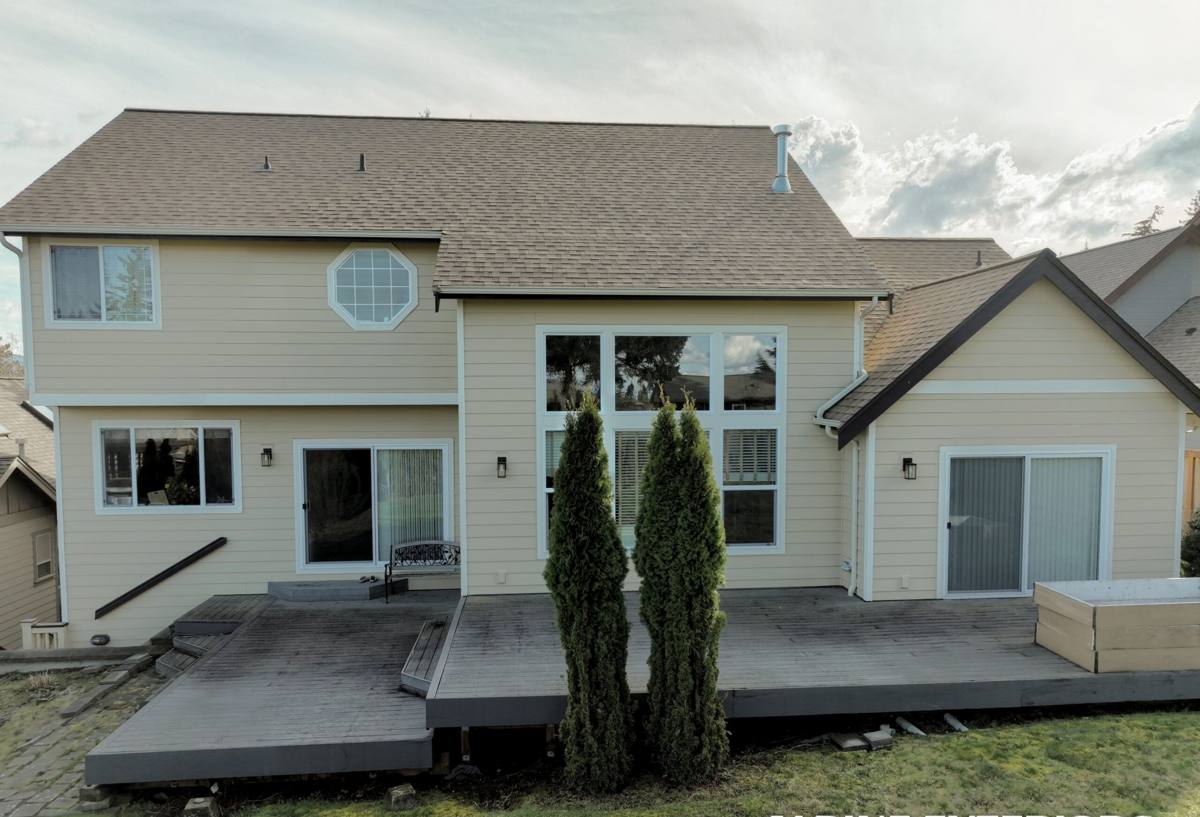
What Local Conditions Demand From a Deck
Salt-Influenced Air
Conway isn't beachfront, but it's low-lying delta country near tidal water, and that means fasteners and connectors see more corrosive exposure over time than they would further inland. Standard coated deck screws and construction-grade brackets can start showing rust streaks and weakening well before the wood around them shows any wear.
Rain Volume and Standing Water
Skagit County's rainfall doesn't come in occasional downpours — it comes in long, steady stretches. A deck needs somewhere for that water to go: proper slope on the decking surface, drainage at grade under the structure, and no low spots where water can pool against ledgers, posts, or joists.
Moss and Organic Growth
Shade, moisture, and mild temperatures are exactly what moss wants, and a deck surface that stays damp for days at a time is prime real estate for it. Moss holds moisture against the wood surface, which accelerates rot and makes boards slick and dangerous underfoot.
Choosing the Right Decking Material for This Climate
There's no single "correct" material for every deck — it depends on budget, how much upkeep the homeowner wants to do, and how the deck will be used. Here's how the common options actually perform in a delta-lowland, marine-air climate like Conway's.
| Material | Moisture Behavior | Moss/Algae Resistance | Maintenance |
|---|---|---|---|
| Pressure-treated fir/pine | Good if sealed regularly; absorbs water if neglected | Low — needs cleaning and treatment | Reseal every 1-2 years |
| Cedar | Naturally moisture- and rot-resistant | Moderate — still benefits from cleaning | Reseal every 2-3 years |
| Composite decking | Doesn't absorb water or swell | Better, but surface film can still grow on shaded boards | Periodic washing, no sealing |
| PVC decking | Fully water-resistant | Best of the group with regular rinsing | Lowest — occasional rinse |
Composite and PVC cost more upfront but remove sealing from the maintenance list entirely, which matters in a climate where "reseal it every spring" is easy to put off. Cedar and pressure-treated lumber cost less and look more traditional, but only hold up if the homeowner actually keeps up with sealing on schedule. We'll give you an honest read on which fits your situation rather than pushing whatever has the best margin.
Framing and Footings Built for Low, Wet Ground
Delta lowland soil holds water longer than well-drained upland soil, and that changes how we approach the substructure. Footings need to sit below frost depth and on undisturbed or properly compacted soil, with drainage gravel so water isn't sitting against concrete year-round. Under the deck itself, we keep enough clearance and grading for air to move and water to drain rather than pool and hold moisture against joists.
Hardware is where we don't cut corners. Given the corrosive exposure this area sees, we spec hot-dip galvanized or stainless connectors, screws, and structural fasteners rather than the lighter coated hardware that's fine in a drier inland climate but starts failing early here. It costs a bit more at the framing stage. It's cheap insurance against a deck that gets loose and squeaky in five years instead of fifteen.
Ledger Attachment: The Single Biggest Point of Failure
Almost every deck failure we get called out to inspect traces back to the ledger board — the point where the deck attaches to the house. Water gets behind it, the rim joist rots, and eventually the whole attachment weakens, sometimes without any obvious sign from the top of the deck.
Doing this correctly means proper flashing above the ledger so water sheds away from the house rather than behind it, a waterproof membrane between the ledger and the siding, and a small gap left at the bottom so any water that does get in has somewhere to drain out instead of sitting against the wall. It also means through-bolting or using structural lag screws sized correctly for the load, not just driving deck screws through the board and calling it done. This is the detail that separates a deck that lasts decades from one that quietly rots from the inside starting year three.
Our Deck Building Process in Conway
- Site visit and assessment — we look at grade, drainage, sun/shade exposure, and how the deck ties into the house before talking materials.
- Design and material selection — sizing, layout, railing style, and an honest conversation about material trade-offs for your budget.
- Permitting — most attached decks in unincorporated Skagit County require a permit; we handle that process rather than leaving it on the homeowner.
- Site prep and footings — excavation, footing placement below frost depth, and drainage prep suited to delta soil.
- Framing — corrosion-resistant hardware throughout, proper ledger flashing and waterproofing, correct joist spacing for the decking material chosen.
- Decking and railing installation — surface material, fastening method, and code-compliant railing and stair details.
- Final walkthrough — we go over the finished deck with you, including what maintenance it actually needs going forward.
Keeping a Conway Deck Sound Through Moss Season
A well-built deck still needs some upkeep in this climate. None of it is complicated, but skipping it is how moss and moisture damage get a foothold.
- Sweep leaves and debris off the deck surface regularly, especially in fall — trapped organic matter holds moisture and feeds moss growth.
- Keep nearby gutters clear so runoff isn't draining directly onto or under the deck.
- Trim back overhanging branches and vegetation to let more light and airflow reach the surface.
- Rinse or gently pressure-wash the surface at least once a year to clear moss and algae film before it gets established.
- Reseal wood decking on the schedule appropriate to the species — don't wait until it looks gray and worn.
- Check visible fasteners and connectors periodically for rust streaks or corrosion.
- Have the ledger flashing and connection inspected every few years, since it's the one area you can't fully see from the top of the deck.
Cost Factors for a Conway Deck Project
Every deck is priced around the specifics of the site and the material chosen, so we won't quote a number without seeing the property. What we can tell you is which factors move the price the most.
| Factor | Why It Affects Cost |
|---|---|
| Size and footprint | More square footage means more footings, framing, and decking material |
| Decking material | Composite and PVC cost more upfront than pressure-treated lumber or cedar |
| Site conditions | Low, wet, or uneven ground can require additional excavation and drainage work |
| Height and multi-level design | Elevated decks and multiple levels add framing, stairs, and railing complexity |
| Railing and stair details | Custom railing styles and stair configurations add labor and material cost |
| Permitting and engineering | Some designs require stamped engineering, which adds a fixed cost |
Why Hire a Crew That Already Works in Conway
A deck built to a generic national standard doesn't automatically hold up in Skagit County's delta lowlands. A crew that already works in this specific area knows how the ground behaves here, understands the permitting process through the county, and has already made the hardware and detailing decisions that matter for salt air and heavy rain — instead of learning those lessons on your project. That familiarity shows up in the small decisions: how deep the footings go, which fasteners get used, how the ledger gets flashed, and how the substructure is graded for drainage. Those aren't things you can easily inspect after the fact, which is exactly why they need to be right the first time.
If you're planning a deck in Conway and want a straightforward, no-pressure look at what your project would involve, we're happy to come take a look and talk through the options. There's a form below to request a free estimate.