 Anacortes Siding
 Deck Replacement Built for Edison's Weather, Not Just Any Deck
Edison sits close to the water on the edge of the Skagit Valley, and that location shapes everything about how a deck ages here. Between the salt-laden air coming off the bay, the long stretch of wet months, and the shade and moisture that farmland and tree cover hold onto, a deck built to a generic spec just doesn't last as long here as it would somewhere drier and further inland. We replace decks in Edison regularly enough to know which parts of a typical build fail first in this environment, and we build replacements to address those specific weak points rather than just swapping old boards for new ones.
A deck replacement is different from a repair. Repair patches the boards or rails that have failed. Replacement means the whole structure — ledger, framing, fasteners, and decking — gets brought up to a standard that can actually hold up to another few decades of Skagit County weather. If your deck is past the point where repairs make sense, this page walks through what that looks like done right.
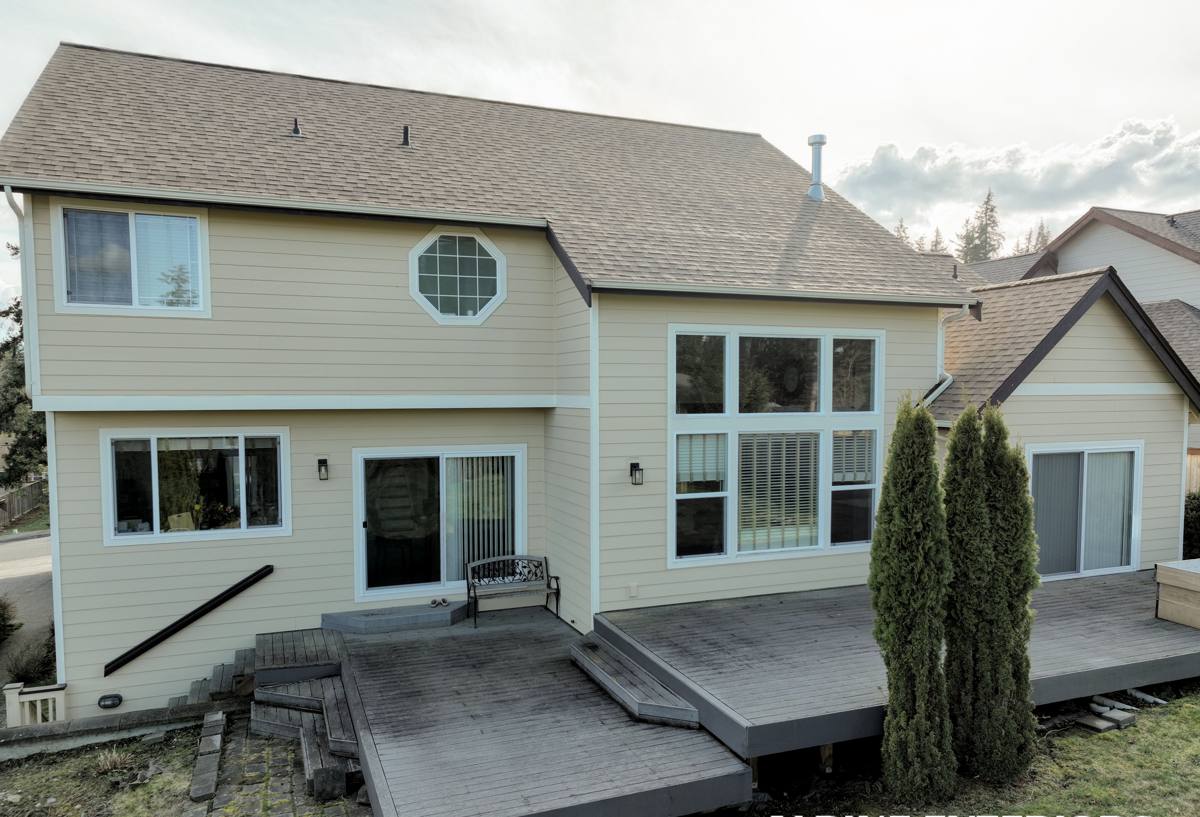
What Salt Air, Rain, and Moss Actually Do to a Deck
Homeowners often assume wood rot is the main enemy of an outdoor deck, and it is part of the story, but it's not the whole picture in a place like Edison. Three separate stresses combine here, and each one attacks a different part of the structure.
Salt Air and Corrosion
Airborne salt from the bay accelerates corrosion on anything metal — fasteners, joist hangers, structural screws, and railing hardware. Standard hot-dip galvanized fasteners can start showing rust streaks and pitting years earlier near the water than they would inland. Once a fastener corrodes, it loses holding strength long before it looks obviously broken, which is part of why decks near the water can develop soft spots or wobble even when the boards themselves still look decent.
Driving Rain and Trapped Moisture
Rain that comes in sideways off open water finds its way into places a straight-down rain never would — under railing caps, behind fascia boards, and into the ledger connection where the deck ties into the house. If flashing at that ledger connection is missing, thin, or was never properly lapped with the house's water-resistive barrier, water gets behind the siding and into the rim joist. That's one of the most common places we find hidden rot when we open up an older deck, and it's usually invisible from the surface until the deck starts to feel spongy near the house.
Moss, Algae, and the Long Wet Season
Skagit County's stretch of overcast, damp months gives moss and algae a long runway to establish themselves on any horizontal wood surface that doesn't dry out quickly. Beyond looking bad, a moss layer holds moisture against the board surface far longer than bare wood would, which speeds up decay in solid wood decking and can void warranties on some composite products if it's left to build up untreated. Decks that sit in partial shade from trees or the house itself are the worst affected, since they get less direct sun to dry between rain events.
Signs Your Edison Deck Needs Replacing, Not Just Repair
It's not always obvious where the line is between "fix a few boards" and "replace the whole thing." Here's what tells us a deck has crossed that line:
- Soft, spongy, or bouncy spots anywhere in the decking, especially near the house
- Visible gaps, cupping, or splitting across more than a handful of boards
- Rust staining or visible corrosion on structural fasteners, hangers, or ledger bolts
- Any separation, gap, or daylight visible where the deck meets the house at the ledger board
- Posts or footings that feel loose, have shifted, or show rot at the base
- Railings that flex or move more than they should when leaned on
- Persistent moss or dark staining that comes back within weeks of cleaning
- A structure that's simply old enough that the framing lumber has never been inspected or upgraded
If you're only seeing one or two of these on an otherwise sound structure, a repair may still make sense. Once several show up together, it usually means the underlying framing has been absorbing moisture for years, and replacement is the more honest recommendation.
Choosing Decking Material for an Edison Property
There's no single "best" decking material — it depends on how much maintenance you want to take on, your budget, and how exposed the deck is to sun, shade, and salt air. Here's how the common options actually compare for this climate:
| Material | Moisture & Salt Air Behavior | Maintenance | Typical Lifespan Here |
|---|---|---|---|
| Pressure-treated wood | Prone to cupping and checking if not sealed regularly; absorbs moisture readily | Annual cleaning and re-sealing recommended | 10-15 years |
| Cedar | Naturally rot-resistant but still needs sealing to hold color and resist moisture uptake | Sealing every 1-2 years | 15-20 years |
| Composite decking | Doesn't absorb moisture or rot, but poor-quality boards can hold surface algae if not cleaned | Occasional washing, no sealing needed | 25-30+ years |
| PVC/capped polymer | Fully moisture-sealed surface, best resistance to salt air and staining | Lowest — occasional rinse | 25-30+ years |
We're generally cautious about recommending untreated or budget pressure-treated lumber for decks with direct water exposure in this area, not because the wood is bad, but because it demands a maintenance schedule most homeowners don't keep up with once the deck is built. Composite and PVC products cost more upfront but need far less attention over their life, which matters more here than in a drier climate where a missed sealing year doesn't cost you much.
What a Correct Deck Replacement Involves
The decking boards are the part everyone notices, but they're the last thing we install, not the first. A replacement done right addresses every layer of the structure:
Ledger Flashing and House Connection
This is the single most important detail on any deck tied to a house in a wet climate. We install proper metal flashing at the ledger board, lapped correctly with the house's existing water barrier, so rain can't track behind the siding and into the rim joist. This is the detail most often missing or done poorly on older decks, and it's the one that causes the most expensive hidden damage.
Framing and Fasteners
We use corrosion-resistant, coated structural screws and stainless or heavy hot-dip galvanized hardware throughout, not standard fasteners that will start corroding within a few years of salt air exposure. Joist hangers, post bases, and structural connectors get the same treatment.
Footings and Posts
Footings get set below frost depth and sized to the deck's actual load, and posts get proper post bases that keep the wood off standing water rather than sitting directly on or in concrete, which is a common shortcut that traps moisture against the post base.
Ventilation and Drainage
Decks built too close to grade or without airflow underneath dry out slower after rain, which shortens the life of everything above. Where we can, we build in enough clearance and, on low decks, a drainage path so water isn't sitting under the structure for days after a storm.
Decking and Railing Installation
Board spacing gets set to allow for material expansion and drainage between boards rather than tight-packed for looks, since gapping that's too tight traps debris and moisture. Railing posts get through-bolted rather than just screwed to the rim, since that connection takes the most stress over the life of the deck.
How Our Process Works
- Free on-site estimate. We look at the existing deck, check the ledger connection and framing where visible, and talk through what you actually want from the new deck — size, material, layout changes if any.
- Written scope and honest pricing. You get a clear breakdown of what's being replaced, what materials are being used, and what it costs — no vague allowances that turn into surprise add-ons later.
- Permit handling. We take care of the Skagit County permit application for the work that requires it, so you're not the one navigating that process.
- Demo and structural inspection. Once the old deck comes off, we inspect the ledger connection, rim joist, and any framing that's being reused or tied into, since this is where hidden rot most often turns up.
- Rebuild from the ground up. Footings, framing, flashing, decking, and railing go in following the details above, not just a like-for-like swap of what was there before.
- Final walkthrough. We go over the finished deck with you, including basic care guidance specific to whatever material you chose.
What Affects the Cost of a Deck Replacement
Every deck is different, but the main variables that move the price are consistent. We'd rather explain these upfront than hand you a number with no context behind it.
| Factor | Why It Matters |
|---|---|
| Decking material chosen | Composite and PVC cost more per square foot upfront than wood, but need far less upkeep over time |
| Deck size and height | Taller decks need more substantial framing, footings, and stair structure |
| Condition of existing structure | Rot found in the ledger, rim joist, or posts during demo adds scope that isn't always visible at the estimate stage |
| Railing style and material | Cable, glass, and composite rail systems cost more than standard wood or metal baluster railing |
| Site access | Decks with limited access for material delivery or demo removal take more labor time |
| Permit and inspection requirements | Larger or taller decks typically require more inspection steps, which affects timeline more than cost |
We won't quote a firm price without seeing the deck in person, since hidden rot at the ledger or posts is common enough here that a phone estimate would be a guess. What we can say honestly: material choice usually moves the total more than any other single factor.
Permits and Local Considerations in Skagit County
Most deck replacements that involve structural changes — new footings, a raised deck, or changes to the attachment at the house — require a building permit through Skagit County. If your property is close to the water or within a designated shoreline or floodplain area, there can be additional review involved, which is common for properties in and around Edison given the proximity to the bay and surrounding wetlands. We handle the permit application and inspection scheduling as part of the job, so this isn't something you need to sort out yourself, but it's worth knowing upfront that a straightforward-looking deck swap can still involve a permit step if it touches the structure.
Maintaining a New Deck in This Climate
Whatever material you choose, a little seasonal attention goes a long way in a place where moss and moisture are a near-constant presence:
- Sweep leaves and debris off the deck surface regularly through fall, since trapped organic matter is what feeds moss growth
- Clean composite or PVC decking a couple of times a year to prevent surface algae buildup
- Re-seal wood decking on the schedule the manufacturer recommends, not just when it starts to look faded
- Check railing connections annually for looseness, especially after winter storms
- Keep gutters and downspouts near the deck clear so water isn't dumping directly onto or under the structure
Why Hire a Crew That Already Works in Edison
A deck built to a spec that works fine in a dry inland climate can fail early here, and that's usually not because the crew that built it was careless — it's because they weren't accounting for salt air corrosion, driving rain at the ledger, or a moss season that lasts most of the year. Working regularly in Anacortes and the surrounding Skagit County communities, including Edison, means we've seen what actually fails first in this environment and we build to avoid it, from the fasteners we choose to how we detail the ledger flashing. That local knowledge doesn't show up as a line item on an estimate, but it's the difference between a deck that needs major work again in ten years and one that doesn't.
If your deck is showing its age, we're happy to come take a look and give you a straight answer about whether it's a repair or a full replacement — no pressure, no inflated scope. Fill out the form below to schedule a free estimate.