 Anacortes Siding
 Why March Point's Location Changes the Board & Batten Equation
March Point sits out on the water, surrounded by bay on multiple sides, which means homes here take a heavier dose of salt-laden wind than houses tucked farther inland in Anacortes. That exposure matters more with board and batten siding than with most other siding styles, because board and batten relies on a series of vertical seams and narrow battens instead of one continuous overlapping surface. Every one of those seams is a place where wind-driven rain can try to work its way behind the cladding, and every batten is a strip of material that has to hold its finish and its fasteners through decades of salt air, humidity, and the long gray moss season Skagit County is known for. Get the product and the installation details right and board and batten is one of the best-looking, most durable siding styles you can put on a house out here. Get them wrong and the same design that looks sharp on day one becomes a maintenance headache within a few years.
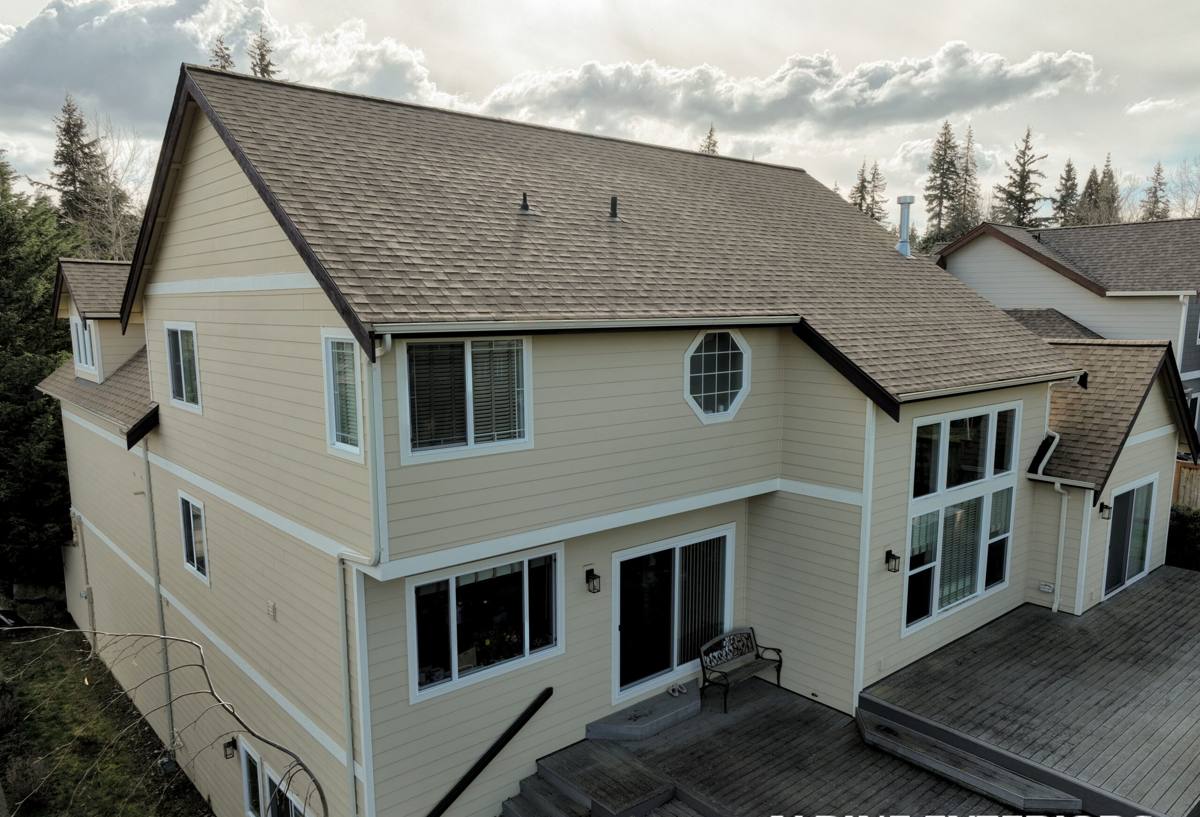
What Board & Batten Siding Actually Is
Board and batten is a vertical siding pattern: wide flat panels or boards installed side by side, with a narrower strip — the batten — covering each seam. It's a classic look on farmhouses, craftsman homes, and modern builds alike, and it reads differently than the horizontal lap siding most common in the area. Because the panels run vertically, water sheds straight down the face of the wall rather than catching on overlapping horizontal edges, which is part of why it holds up well in wet climates when it's built correctly.
The Vertical Look, Built for a Marine Climate
The style only works long-term if the wall assembly behind it is designed for the seams and joints that vertical siding creates. That means the water-resistive barrier, the drainage gap behind the panels, and the way the battens are fastened all matter more here than they would in a drier inland climate. This is where a lot of board and batten installations — regardless of what material is used — go wrong.
What March Point Homes Need From Their Siding
Three climate factors drive almost every siding decision we make for homes in this area:
- Salt air: constant low-level salt exposure accelerates corrosion on fasteners, hardware, and any siding material that isn't engineered to handle it.
- Driving rain: wind off the water pushes rain sideways into vertical seams and around trim, so flashing and drainage details carry more of the load than they would on a sheltered lot.
- Moss season: long stretches of damp, shaded conditions each year mean any siding material prone to holding moisture is going to grow moss and mildew faster here than almost anywhere else in the state.
None of that is unique to March Point specifically, but the combination is more pronounced here than on a lot of the more sheltered lots elsewhere in Anacortes and Skagit County, simply because of how exposed the point is to open water.
Why We Only Install James Hardie Board & Batten
We install James Hardie fiber cement exclusively — we don't install vinyl, LP SmartSide, Cemplank, Allura, primed spruce, or cedar board and batten, on this job or any other. That's not a marketing position, it's a standard we hold because of what we've seen these products do over time in exactly the conditions March Point deals with.
Vinyl board and batten is inexpensive and low-maintenance in the sense that it never needs painting, but it's also a thin material that expands and contracts with temperature swings, can warp or crack under impact, and its seams and battens are typically just overlapped rather than truly sealed — not ideal when wind is actively driving rain sideways into those joints. Engineered wood products like LP SmartSide use real wood strand material, which means the cut edges and any point where the coating is compromised become a place moisture can get in and start breaking the material down from the inside, a real risk given how much of the year this area spends damp. Primed spruce and cedar are traditional, attractive choices, but they're wood — they need ongoing paint or stain maintenance, and in a climate with this much rain and this long a moss season, that maintenance schedule gets demanding fast.
James Hardie fiber cement is non-combustible, dimensionally stable across temperature and humidity swings, and doesn't rot, absorb water, or feed the organic growth that thrives in shaded, damp conditions. The ColorPlus factory finish is baked on under controlled conditions rather than field-applied, which gives it better adhesion and UV resistance than a coating applied on site — and it comes backed by a strong transferable warranty. For a siding style that depends on tight, well-sealed vertical seams holding up for decades, that combination is why we standardized on it.
Comparing Board & Batten Materials in This Climate
| Material | Moisture behavior | Maintenance | Notes for this area |
|---|---|---|---|
| James Hardie fiber cement | Doesn't absorb water or rot; stable in humidity swings | Occasional rinse; no repainting needed with ColorPlus | What we install — built for marine exposure |
| Vinyl | Sheds water but seams rely on overlap, not sealing | Low, but prone to warping and fading over time | Not installed by us |
| Engineered wood (LP SmartSide) | Vulnerable at cut edges and coating breaks | Moderate; coating needs monitoring | Not installed by us |
| Cedar / primed spruce | Absorbs moisture; needs consistent sealing | High; repaint or restain on a regular cycle | Not installed by us |
What a Correct Board & Batten Installation Involves
The siding material is only part of the job. The details behind and around it are what actually determine whether a board and batten installation holds up on a site as exposed as March Point.
- Water-resistive barrier: a continuous, properly lapped weather barrier behind the panels, with every penetration and seam sealed.
- Drainage gap: furring strips or a rain screen system behind the panels so any moisture that does get past the surface has somewhere to drain and dry out instead of sitting against the wall sheathing.
- Batten spacing and fastening: battens installed per James Hardie's engineering specs, with the correct fastener type, spacing, and embedment for wind and moisture exposure in this zone.
- Flashing at every transition: windows, doors, rooflines, and horizontal trim all need proper flashing so wind-driven rain can't work its way behind the siding at those junctions.
- Sealant placed correctly: caulking only where Hardie's specifications call for it — over-caulking joints that are supposed to stay open for drainage traps water instead of shedding it.
Skip any one of these and the siding can look fine for a year or two while a real problem develops behind it — which is exactly the kind of failure that's expensive to catch late and cheap to prevent up front.
Our Process for March Point Projects
We walk every project through the same sequence, adjusted for what's actually happening on the specific house:
- On-site assessment of the existing siding, sheathing, and any signs of moisture intrusion behind the current wall assembly.
- Removal of old siding with a check of the sheathing underneath — this is often where we catch problems that started long before the siding showed any sign of trouble.
- Installation of a continuous water-resistive barrier and drainage plane built for this site's wind and rain exposure.
- Installation of James Hardie panels and battens to manufacturer spec, with fastening and spacing calculated for the local wind exposure.
- Flashing and trim work at every window, door, and roofline transition.
- Final walkthrough covering seams, fastener lines, and finish quality before we call the job done.
Maintenance in a Salt Air, High-Moss Climate
James Hardie board and batten is low-maintenance, not no-maintenance. A simple seasonal routine keeps it performing the way it's designed to:
- Rinse the siding once or twice a year to clear salt residue and organic buildup before it has a chance to take hold.
- Keep gutters clear so water isn't sheeting down the wall face during heavy rain.
- Trim back vegetation and tree cover where it's keeping sections of the wall shaded and damp longer than the rest of the house.
- Check caulking at windows, doors, and trim annually — sealant is the one component that ages faster than the siding itself.
- Have any impact damage or loose fastener addressed promptly rather than left through another wet season.
Cost Factors for Board & Batten in This Area
| Factor | Why it affects cost |
|---|---|
| Tear-off and sheathing condition | Existing moisture damage found during removal adds repair scope before new siding goes on |
| Wall complexity | More corners, windows, and trim transitions mean more flashing and cut work |
| Wind exposure of the specific lot | More exposed sites may call for tighter fastening schedules and additional flashing detail |
| Trim and batten profile chosen | Batten width and spacing options affect material quantities and labor time |
| Color and finish | Factory ColorPlus finishes vary slightly in cost by color line |
We give exact numbers only after seeing the house — anyone quoting board and batten pricing sight unseen is guessing.
Why Hire a Crew That Already Works in March Point
A crew that regularly works this part of Skagit County already understands what the wind off the water does to a wall assembly, how much rain a west-facing elevation actually takes in a typical winter, and how fast moss establishes itself on a shaded section of siding here compared to a more sheltered lot inland. That's not something you can fully account for from a generic installation manual — it comes from having done the work in these exact conditions and having gone back to see how those choices held up. When it comes to a siding style like board and batten, where the difference between a correct installation and a mediocre one doesn't show up until a few winters in, that local track record is worth as much as the material itself.
If you're considering board and batten siding for a home in March Point, we're happy to take a look and walk you through what your specific house needs. Reach out for a free, no-pressure estimate — there's a form right below this page.