 Anacortes Siding
 Why March Point's Location Changes What a Roof Needs to Do
March Point sits out on the water side of Fidalgo Bay, close enough to the shoreline and the refinery corridor that homes here take a different kind of weathering than a roof twenty minutes inland in Mount Vernon or Burlington. Salt-laden marine air moves through constantly, wind off the bay drives rain sideways during winter storms instead of letting it fall straight down, and the combination of shade, moisture, and mild temperatures keeps moss and algae active for most of the year instead of a few months. None of that means a roof here is doomed to fail early. It means the install has to account for conditions a generic roofing job in a drier part of the state would never plan around.
We've worked on enough roofs in this pocket of Skagit County to know which failure points show up first: fastener corrosion in exposed metal, moss lifting shingle tabs at the eaves, and wind-driven rain finding its way under flashing that was installed to a lower standard than the site actually needs. A correct install for March Point starts by treating those as design problems to solve up front, not repairs to deal with later.
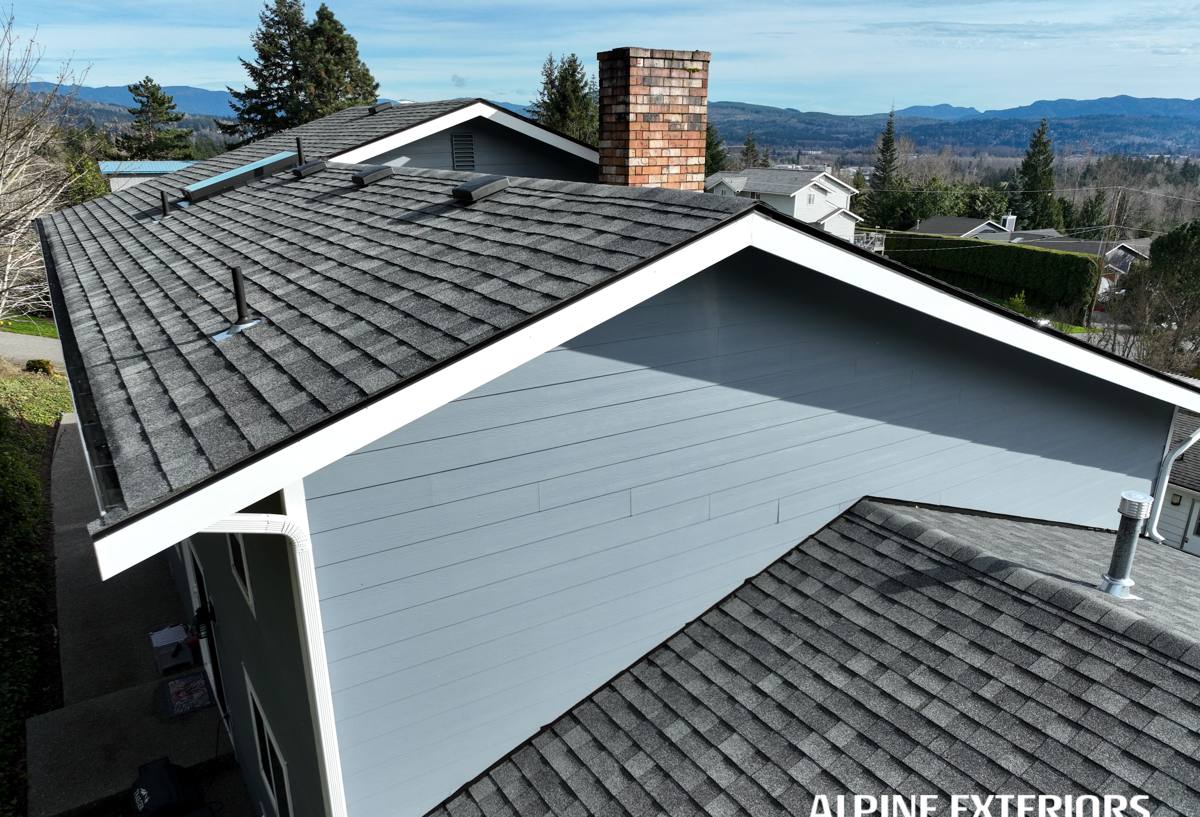
What a Correct Installation Requires on This Site
Underlayment and Water-Shedding
In a climate where wind can push rain uphill under shingle laps, the underlayment layer matters as much as the shingle itself. We use synthetic underlayment across the full deck for its tear resistance and water-shedding performance, and we run self-adhering ice-and-water membrane at the eaves, valleys, and any roof-to-wall transitions — the spots where wind-driven rain and ponding are most likely to find a gap. This isn't an upgrade we push to add cost; on a bayside property it's the baseline we build to.
Fasteners and Flashing Metal
Salt air is hard on bare or lightly coated metal. Cheap flashing and standard fasteners can start showing corrosion and staining well before the shingles above them are due for replacement. We specify corrosion-resistant flashing and fastener packages for anything within reach of the marine air coming off the bay, which costs a little more up front and avoids a maintenance headache a few years down the road.
Choosing a Roofing Material for a Marine, Moss-Prone Climate
There's no single "best" roofing material — the right choice depends on the home's roof pitch, budget, and how much long-term maintenance the owner wants to take on. Here's how the common options actually perform in March Point's conditions:
| Material | Moss/Algae Resistance | Salt Air Durability | Typical Lifespan Here |
|---|---|---|---|
| Algae-resistant asphalt composition shingle | Good — copper/zinc granules resist streaking | Good with corrosion-resistant flashing | 25–30 years |
| Standard asphalt composition shingle | Fair — will show algae streaking sooner | Fair | 20–25 years |
| Standing seam metal | Very good — sheds moisture, little surface for moss to grip | Depends on coating — needs a marine-rated finish | 40–50+ years |
| Composite/synthetic shake | Good | Good | 30–40 years |
We don't install cedar shake or shingle roofs on homes this close to the water. It's not that cedar is a bad product in the right setting — it's that in a shaded, moisture-heavy, salt-air environment it needs a maintenance schedule most homeowners don't want to commit to, and moss takes hold in the wood grain faster than most owners expect. We'd rather steer a client toward a material that fits the site than sell a roof that turns into a recurring project.
Ventilation: The Part Homeowners Never See But Always Notice Later
A new roof is only as good as the airflow underneath it. Attics that don't exhaust moisture properly trap warm, humid air against the underside of the decking — and in a climate that's already damp outside, that's a fast track to sheathing rot, mold, and premature shingle failure from underneath, none of which is visible until it's a real problem.
Every install includes a ventilation check as a standard step, not an add-on:
- Confirm intake airflow at the soffits is actually reaching the attic, not blocked by insulation
- Balance intake and exhaust so ridge or roof vents are pulling air the right direction
- Install baffles where insulation depth is crowding the soffit vents
- Check for signs of past moisture damage in the decking before covering it up
Skipping this step is one of the most common shortcuts in roofing, because it doesn't show up in a walk-around inspection the day the job finishes. It shows up two or three winters later as a sagging ridge line or stained ceiling drywall.
Our Install Process, Step by Step
- On-site assessment. We walk the roof, check the attic, and look at flashing details, pitch, and any problem areas the homeowner has already noticed.
- Tear-off. Full removal of the old roofing down to the deck — we don't install over an existing layer, because it hides deck problems and shortens the life of the new roof.
- Deck inspection and repair. Any soft, rotted, or delaminated sheathing gets replaced before anything new goes down. This is where hidden moisture damage from the old roof usually turns up.
- Underlayment and ice-and-water membrane. Installed per manufacturer spec, with extra attention at eaves, valleys, and wall transitions.
- Flashing. New flashing at all penetrations, valleys, chimneys, and roof-to-wall intersections — corrosion-resistant metal throughout.
- Ventilation correction. Baffles, intake, and exhaust balanced as described above.
- Roofing material installation. Installed to manufacturer specification for nail pattern, exposure, and fastening — the details that keep a warranty valid and a roof performing in wind.
- Cleanup and magnetic sweep. Full site cleanup, including a magnetic nail sweep of the yard and driveway.
- Final walkthrough. We go over the finished roof with the homeowner before calling the job done.
Flashing and Valleys: Where Roofs Actually Fail
Most roof leaks don't start in the open field of shingles — they start at a transition: a valley, a chimney, a skylight curb, or where a roof meets a wall or a lower roofline. Those are the places where wind-driven rain gets pushed against a seam instead of running off, and it's exactly the kind of weather March Point gets regularly off the bay.
We build valleys with a woven or metal-lined approach depending on the roof design and material, always over a full ice-and-water membrane underlayment. Chimney and skylight flashing is step-flashed and counter-flashed rather than relying on caulk or sealant as the primary water barrier — sealant has its place, but it's a backup, not a strategy. Roof-to-wall intersections, common on additions and dormers around this area, get the same treatment: proper step flashing tied into the wall's water-resistive barrier, not just tucked behind the siding and caulked.
Permits and Code Requirements in Skagit County and the City of Anacortes
New roof installations typically require a building permit, and inspections check things like underlayment coverage, flashing details, and ventilation — all consistent with what a properly built roof should have anyway. Wind exposure and rain-load expectations for this part of Skagit County are factored into material fastening schedules and underlayment requirements under the state building code. We handle the permit application and coordinate inspections as part of the job, so the homeowner isn't the one tracking down paperwork or scheduling city inspectors.
Moss and Algae: Prevention Built Into the Install, Not an Afterthought
Moss doesn't just sit on top of a roof — it works into shingle laps, lifts tabs, and holds moisture against the surface, which shortens the life of the roofing material. March Point's shaded lots and consistent marine moisture make it more of a factor here than in drier, sunnier parts of the county. A new roof install is the best time to build in prevention:
- Algae-resistant shingles with copper or zinc granules where asphalt composition is the chosen material
- Zinc or copper control strips near the ridge on roofs with heavy shade exposure or a history of moss
- Confirming gutters and downspouts are clear and pitched correctly, since standing water at the eaves is one of the biggest moss accelerants
- Trimming back overhanging branches where practical, to cut down on shade and debris buildup
None of this makes a roof moss-proof forever — nothing does in this climate — but it meaningfully slows growth and buys years of life the roof wouldn't otherwise get.
Why a Local March Point Crew Matters
A roofing crew that only shows up in this part of Anacortes once or twice a year is guessing at conditions that a crew working here regularly already knows firsthand. We know which roofs in this area tend to hold moss longest, which flashing details fail first when the wind comes off the bay, and what a realistic maintenance expectation looks like for a homeowner living this close to salt water. That local pattern recognition shows up in small decisions throughout the job — where we add extra underlayment, which fastener package we spec, how we detail a valley — that don't show up on a quote sheet but do show up in how the roof performs five and ten years out.
If you're planning a new roof for a March Point property, we're happy to walk the roof, look at the attic, and give you a straightforward assessment of what your home actually needs — no pressure, no inflated scope. Reach out for a free estimate using the form below.