 Anacortes Siding
 A deck in Mount Vernon lives outside year-round, and in Skagit County that means it earns its keep. Between salt-tinged air moving in off the water, months of driving rain, and a moss season that seems to stretch longer every year, an outdoor structure here is under more pressure than the same deck would face in a drier inland climate. We build and replace decks for homes in and around Mount Vernon and Anacortes, and the decks that hold up long-term are the ones built with this specific climate in mind from the framing up — not decks designed for a catalog photo somewhere sunnier.
What Mount Vernon's Climate Actually Does to a Deck
The Pacific Northwest's wet season isn't just about total rainfall — it's about how long surfaces stay damp between storms. A deck board that gets rained on, dries for half a day, and gets rained on again is living in conditions that promote rot, mildew, and moss growth far more than the same total rainfall spread out with long dry stretches in between. Add tree cover, which many Mount Vernon lots have, and shaded sections of decking can stay damp for days after a storm passes.
Salt-laden air moving inland off the Salish Sea is a slower, quieter problem. It accelerates corrosion on fasteners, joist hangers, and any hardware that isn't rated for coastal exposure. A deck can look fine on the surface for years while the connectors holding it together are losing strength underneath — which is exactly why hardware selection matters as much as the decking material itself.
Signs a Mount Vernon Deck Is Losing the Battle
- Dark green or black staining on boards, especially in shaded corners or under railings where airflow is limited
- Soft, spongy spots on decking or stair treads — usually the first sign of rot starting underneath a coating that still looks okay
- Rust streaking around fasteners or visible corrosion on joist hangers and post bases
- Gaps opening up between boards from repeated wet-dry-swell cycles, or boards that have cupped or crowned
- A ledger board connection that looks fine from above but hasn't been checked for flashing or moisture intrusion behind the siding
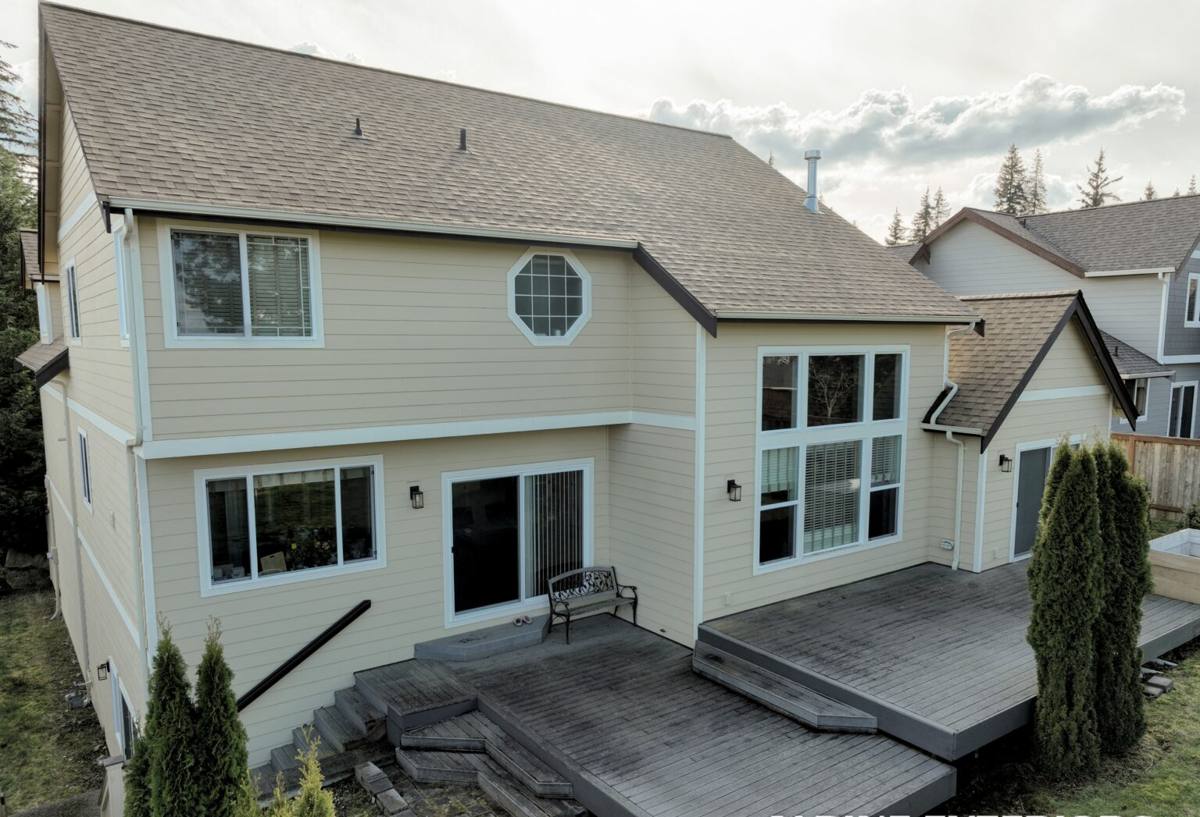
What a Correctly Built Deck Looks Like Here
Framing is where a deck's lifespan is really decided, long before anyone picks a decking color. In this climate we frame with attention to airflow underneath the structure — decks built too close to grade or without enough ventilation trap moisture and never fully dry out between rain events. Joist spacing, beam sizing, and post footings need to account for our frost depth and soil conditions, and every structural connection point is a spot where water can collect if it isn't detailed correctly.
The ledger board — where the deck attaches to the house — deserves special attention. This is one of the most common failure points on older decks we inspect, because it's a direct pathway for water into the house structure if the flashing isn't integrated properly with the home's water-resistive barrier. We treat ledger flashing as a non-negotiable detail, not an afterthought, especially on a home that's already taking on a lot of wind-driven rain.
Hardware and Fasteners: The Part Nobody Sees
Every joist hanger, post base, and fastener on a Mount Vernon deck should be rated for the corrosive environment — typically hot-dip galvanized or stainless steel, matched correctly to the decking material being used (some composite and treated-wood combinations require specific fastener coatings to avoid a chemical reaction that accelerates corrosion). Mixing incompatible metals, or using standard hardware because it's cheaper, is one of the more common shortcuts we see on decks that failed early. It's invisible on installation day and expensive a few years later.
Choosing a Decking Material for This Climate
There's no universally "best" decking material — there's a best fit for the site, the budget, and how much maintenance a homeowner actually wants to do. In a climate with this much sustained moisture, the trade-offs between materials matter more than they would somewhere drier.
| Material | Upfront Cost | Maintenance | How It Handles This Climate |
|---|---|---|---|
| Pressure-treated wood | Lower | Regular sealing/staining, typically every 1-2 years | Workable if maintenance is kept up; falls behind quickly if it isn't, especially in shaded areas |
| Cedar | Mid | Sealing/staining to preserve color and resist rot | Naturally rot-resistant compared to other softwoods, but still needs consistent upkeep in constant moisture |
| Composite decking | Higher | Occasional cleaning, no staining or sealing | Strong fit for shaded, wet lots — resists moisture absorption and moss staining better than wood |
| PVC decking | Highest | Minimal — cleaning only | Fully resists moisture absorption, though it can feel less "natural" underfoot to some homeowners |
We'll walk through these trade-offs honestly rather than pushing whatever has the best margin. A pressure-treated deck that's properly maintained can last a long time here; a composite deck installed without proper framing and drainage will still have problems no matter how good the boards are. The material is one piece of a bigger system.
Railings, Stairs, and the Details That Fail First
Railings and stair stringers are often the first parts of a deck to show wear, because they're exposed on multiple sides and get less airflow than open decking. Post bases at grade level are especially vulnerable to standing water and splash-back from rain, which is why proper standoff hardware and drainage around the base matters. We also pay attention to baluster spacing and railing height for code compliance — details that are easy to overlook on a DIY or budget rebuild but matter for both safety and resale.
Stair stringers carry real structural load and take a beating from foot traffic combined with moisture, so we treat them with the same hardware and flashing standards as the rest of the frame rather than as an afterthought bolted on at the end.
Our Process for a Mount Vernon Deck Project
- On-site assessment — we look at the existing structure (if there is one), grade and drainage around the footprint, sun and shade exposure, and how the deck ties into the house.
- Design and material selection — we talk through decking material, railing style, and layout based on how the space will actually be used, not just what looks good in a brochure.
- Permitting — most deck projects in this area require a permit, particularly anything attached to the house or built above a certain height; we handle that process rather than leaving it to the homeowner.
- Demolition (if replacing) — removal of the old structure, with an inspection of the ledger connection and any framing underneath that the old deck may have been hiding problems in.
- Framing and structural work — posts, footings, beams, joists, and ledger flashing built to hold up under sustained moisture, not just pass a one-time inspection.
- Decking, railing, and finish work — installation of the chosen decking material and railing system, with attention to fastener compatibility and drainage gaps between boards.
- Final walkthrough — we go over the finished deck together, including any maintenance recommendations specific to the material chosen.
Maintenance That Actually Extends a Deck's Life
Even the best-built deck in this climate benefits from a little seasonal attention. None of this requires a contractor — it's mostly about not letting moisture sit where it doesn't need to.
- Clear leaves, needles, and debris from between boards and along the base regularly, especially in fall — trapped organic matter holds moisture and feeds moss
- Check and clear any gaps or drainage paths under the deck so water isn't pooling against posts or footings
- Reseal or restain wood decking on the manufacturer's recommended schedule — don't wait until it's visibly gray or worn
- Inspect the ledger board area once a year for staining, soft wood, or gaps in flashing or caulking
- Wash composite or PVC decking periodically to prevent algae film buildup, which can make surfaces slippery in wet weather
- Look at fasteners and hardware for rust streaking, especially a few years after installation once any factory coating has had time to wear
Repair, Rebuild, or Replace?
Not every aging deck needs to be torn out completely. If the framing and ledger connection are sound and the problems are limited to surface decking or railings, a partial rebuild can extend a deck's life for a fraction of full replacement cost. But if we find rot in the ledger area, undersized or corroded structural hardware, or footings that were never adequate for the load, patching the visible surface just delays a bigger problem. Part of an honest assessment is telling a homeowner which category their deck falls into before any work starts, not after we've already started charging for it.
Why a Local Crew Matters for This Job
Skagit County's microclimates vary more than people expect — a lot near the river, a lot with heavy tree cover, and a more open lot a mile away can all behave differently in terms of drainage, shade, and moisture retention. Building decks in and around Mount Vernon and Anacortes repeatedly means we've seen which framing details actually hold up here versus which ones are just code minimums, and which decking materials perform as advertised once they've spent a few winters in this specific climate. That's knowledge that comes from doing the work locally, year after year, not from a spec sheet.
It also means straightforward answers about permitting through the county or city, realistic timelines that account for our wet-season scheduling reality, and a crew that isn't guessing about frost depth, drainage, or how a shaded lot near mature trees is going to affect a deck's long-term maintenance needs.
What to Expect From an Estimate
We'll walk the site with you, look at grade, drainage, sun exposure, and (for a replacement) the condition of the existing structure, and talk through material options honestly, including what each one actually costs to maintain over time — not just the upfront number. You'll get a written scope and estimate with no pressure to sign on the spot.
If you're planning a new deck or dealing with one that's showing its age — soft spots, rust staining, gaps that keep widening, or moss that won't quit — we're happy to take a look. Reach out for a free, no-pressure estimate on your Mount Vernon property.