 Anacortes Siding
 Board & Batten in a Neighborhood Called Old Town
A neighborhood that carries the name "Old Town" tends to have a housing stock that reflects it — homes built in an earlier era, closer together, many with the kind of simple, honest architecture that board and batten siding was originally designed for. The vertical-board-and-narrow-strip pattern has been part of the Pacific Northwest's building vocabulary for well over a century, and it reads as authentic on an older Anacortes home in a way that a lot of newer siding profiles don't. That's part of why we get asked about it so often in this part of town.
What we tell every homeowner up front is that board and batten is a joint-heavy profile. Every vertical seam where a batten covers the gap between two boards is a place water can try to work its way behind the wall. On a newer home with modern sheathing and house wrap, that's manageable. On an older Old Town home — where the wall assembly behind the original siding may be decades old and was never designed around today's moisture standards — getting those seams right matters even more. We install James Hardie fiber cement board and batten exclusively, and on a neighborhood like this one, that choice is about more than durability. It's about not adding new problems to a wall that may already be carrying some age.
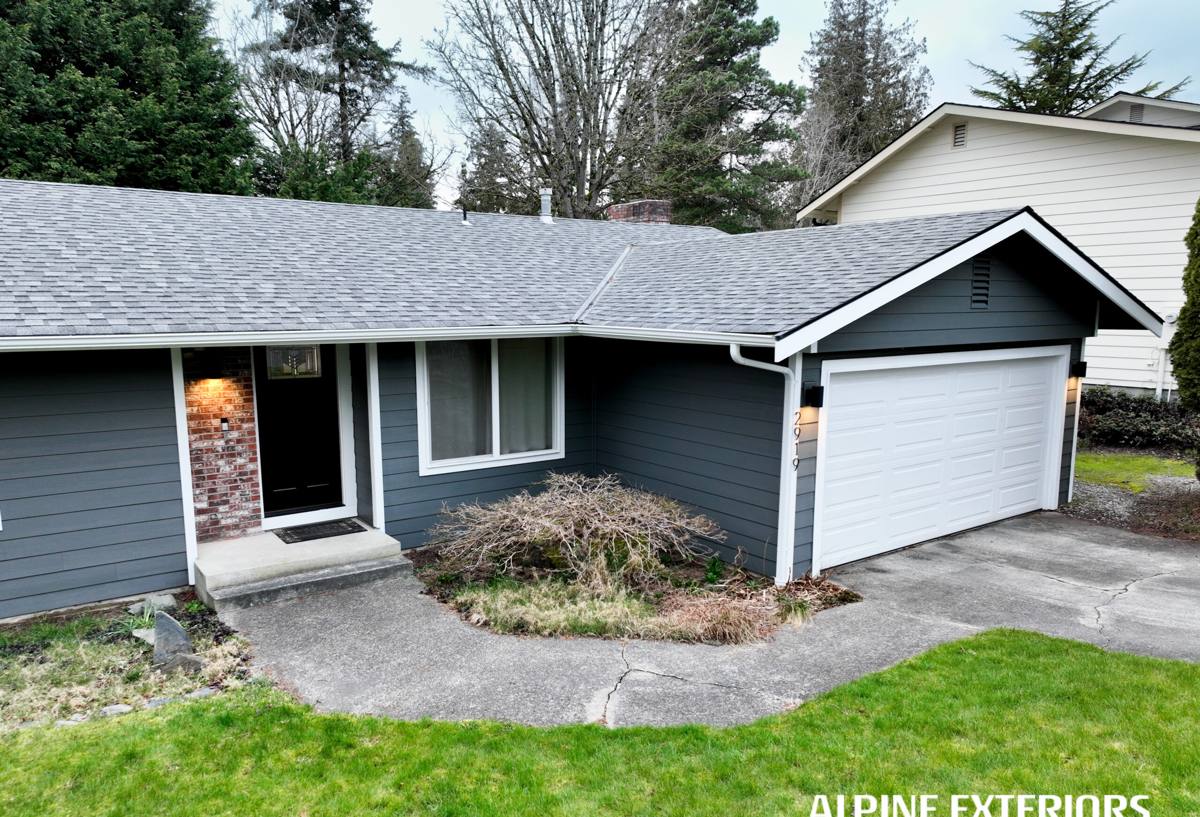
What This Climate Does to a Board & Batten Wall
Driving Rain and the Vertical Seam Problem
Anacortes sits out on Fidalgo Island with open water close by in more than one direction, and the rain here rarely falls straight down. Wind pushes it sideways, and a vertical siding profile gives that wind-driven rain a lot of seam length to test. A batten that's face-nailed too tight, caulked instead of properly lapped, or installed without room to shed water becomes the exact spot where a wall starts absorbing moisture instead of shedding it.
Salt Air and Fastener Corrosion
The salt content in the air around Anacortes and the rest of Skagit County is hard on exposed metal, and board and batten uses more fasteners per square foot than a standard lap profile because both the boards and the battens need to be individually secured. On an older home where the original fastening was never built with coastal exposure in mind, upgrading to a corrosion-resistant fastener spec during a re-side isn't optional — it's one of the most important details in the whole job.
A Long Moss Season Under Mature Trees
Older neighborhoods tend to have older, taller trees, and Old Town Anacortes is no exception in a lot of spots. Shaded, north-facing walls under mature canopy hold onto dampness far longer than sun-exposed ones, and that's exactly the condition moss and mildew need to take hold. A batten seated tight against a board with no way to dry out traps that moisture right at the joint, which over time shows up as staining, softened substrate, and paint or finish failure exactly where you can't easily see it.
The Extra Layer: Working on Anacortes' Older Homes
Lead-Safe Work Practices on Pre-1978 Siding
Many homes in Old Town Anacortes were built well before 1978, which is the cutoff year the EPA uses for its Renovation, Repair, and Painting (RRP) rule. If a home's original siding or trim was painted before that year, federal rule requires lead-safe work practices during removal and disturbance — containment, specific cleanup protocols, and certified handling. This isn't a detail we treat as paperwork; it's a real safety consideration for the crew, the homeowner, and the property, and it's one more reason we don't recommend a re-side to homeowners in this neighborhood shop around purely on price. A tear-off done carelessly on an older home is a different risk than the same job on a home built in the last twenty years.
What's Usually Hiding Behind the Original Siding
Older Old Town homes were built to the standards of their time, and that means the wall assembly behind the original siding often predates modern house wrap, rainscreen gaps, and consistent flashing details. We don't assume what we'll find until the old siding comes off — sometimes the sheathing underneath is in solid shape and just needs a proper modern weather-resistant barrier added; other times there's rot, old cracked felt paper, or window and door flashing that was never installed correctly in the first place. Either way, a board and batten install is only as good as what's underneath it, and on an older home that inspection step carries real weight.
Why Product Choice Matters More on This Profile
Board and batten amplifies whatever weaknesses a siding material already has, because there are simply more seams and more exposed edges per square foot than on a standard lap profile. That's part of why we don't offer LP SmartSide, vinyl, Cemplank, Allura, primed spruce, or cedar board and batten. Those are legitimate products, and plenty of contractors install them competently — but on a joint-heavy profile, going onto an older wall assembly, in a climate this consistently wet, we standardized on one system we're willing to stand behind completely.
| Material | Behavior at Batten Seams | Fit for an Older Wall Assembly | Realistic Lifespan Here |
|---|---|---|---|
| James Hardie fiber cement | Dimensionally stable; doesn't swell or cup at the joint | Pairs well with a properly upgraded moisture barrier | 30+ years with a correct install |
| Cedar | Traditional look but absorbs moisture at every seam without regular sealing | Adds ongoing maintenance to an already older property | 15-25 years with consistent upkeep |
| LP SmartSide (engineered wood) | More sensitive to moisture at cut edges and fastener holes | Edge sealing needs consistent attention over time | 15-25 years, climate-dependent |
| Vinyl | Can gap or warp at battens; seams less rigid | Doesn't visually suit most older Old Town home styles | 20-30 years, variable |
James Hardie's fiber cement core doesn't expand and contract with moisture the way wood-based products do, which matters most on a profile built entirely from vertical seams. The factory-applied ColorPlus finish also means the field-cut edges we prime on site are the exception rather than the rule — unlike cedar or primed wood, where every board face depends on paint holding up outdoors year after year.
What a Correct Install Involves
Substrate Inspection and Repair
Before any new siding goes up, we inspect what's actually underneath the old material — sheathing condition, evidence of past moisture intrusion, and whether framing at corners and openings is square and sound. Anything soft or compromised gets repaired or replaced before we move forward. Skipping this step is the single most common shortcut that turns a good-looking install into a problem five or ten years down the road.
Drainage Plane and Flashing at Every Seam
We install a modern weather-resistant barrier with proper lapping, and every horizontal and vertical transition — window and door openings, corners, the base of the wall — gets flashed to shed water outward rather than trap it. On board and batten specifically, this includes making sure battens have a way to breathe rather than sealing tight against the board beneath them.
Fastening Pattern and Corrosion-Resistant Hardware
We follow James Hardie's fastening specifications for board and batten, using corrosion-resistant fasteners sized and spaced correctly for both the board and batten layers. In a coastal-influenced climate like this one, the fastener spec is not a place to cut corners.
Matching Reveal and Trim to the Home's Original Character
Part of what makes board and batten work on an older home is getting the proportions right — batten spacing, board width, and trim details that feel consistent with the home's original era rather than looking like a modern add-on. We talk through these choices with homeowners before install day, not after.
Matching Historic Character Without Sacrificing Performance
A lot of homeowners in this neighborhood want to keep the look their home is known for while finally getting out from under the maintenance cycle that comes with older wood siding. James Hardie's ColorPlus finish comes in a range of colors that work well against traditional Pacific Northwest architecture — muted, classic tones that don't read as "new construction" the way some modern siding colors can. The difference is that the finish is baked on at the factory and backed by its own warranty, so the home keeps its character without the homeowner signing up for a repainting cycle every several years.
- Confirm the crew has specific experience with board and batten, not just standard lap siding — the install techniques are meaningfully different
- Ask how they handle lead-safe work practices if your home was built before 1978
- Ask what they're doing about the moisture barrier and flashing, not just the visible siding
- Get the fastening spec in writing — corrosion-resistant hardware matters more here than in a drier inland climate
- Ask to see how batten spacing and trim details will be planned before the crew is on site, not decided on the fly
Our Process for Old Town Projects
We start with an on-site inspection, not a phone estimate, because so much of the scope on an older Old Town home depends on what we find once we're actually looking at the wall — condition of the existing siding, age of the home, and anything visible from the exterior that hints at what's underneath. From there we walk the homeowner through the findings honestly, including anything that adds scope, like sheathing repair or lead-safe removal protocols, before any contract is signed. Installation follows James Hardie's specifications for board and batten, with our own added attention to flashing and drainage detail given what this climate does to a wall over time. We clean up thoroughly at the end of each work day, not just at project close, which matters more on tighter, closer-set Old Town lots than it does on larger properties elsewhere.
Why a Crew That Already Works This Neighborhood Matters
Old Town Anacortes isn't a uniform housing stock — home ages, past renovation history, and lot conditions vary block to block, and a crew that's already spent time working in this specific part of town has a better sense of what to expect before the first piece of old siding comes off. That includes knowing when a permit is likely needed for the scope of work, understanding how tight lot lines and neighboring structures affect staging and access, and recognizing the signs of an older wall assembly that needs more than a cosmetic re-side. None of that replaces a proper inspection, but it does mean fewer surprises and a more accurate estimate from the start.
If you're weighing board and batten siding for an older home in Old Town Anacortes, we're happy to take a look and give you a straight, no-pressure assessment of what your home actually needs. There's a form below to request a free estimate — no obligation, just an honest read on your project.