 Anacortes Siding
 Roofing in Skyline: A Different Set of Problems Than Inland Homes
Skyline sits close enough to the water and open enough to weather that roofs here age differently than they do a few miles inland. Salt-laden air off the sound works on exposed metal — nail heads, flashing, vent caps — faster than most homeowners expect. Driving rain, pushed sideways by wind off the water, finds any gap in flashing or underlayment that a calmer climate would never expose. And the long stretch of wet, shaded months each year gives moss and algae plenty of time to take hold on north-facing slopes and anywhere tree cover keeps a roof from drying out between storms.
None of that means a roof in Skyline needs to be exotic or expensive. It means the details — the underlayment spec, the flashing metal, the fastener choice, the airflow through the attic — have to be right for this specific setting, not just built to a generic code minimum. That's the difference between a roof that looks fine at year five and one that's already showing streaking, soft spots, or lifted shingles.
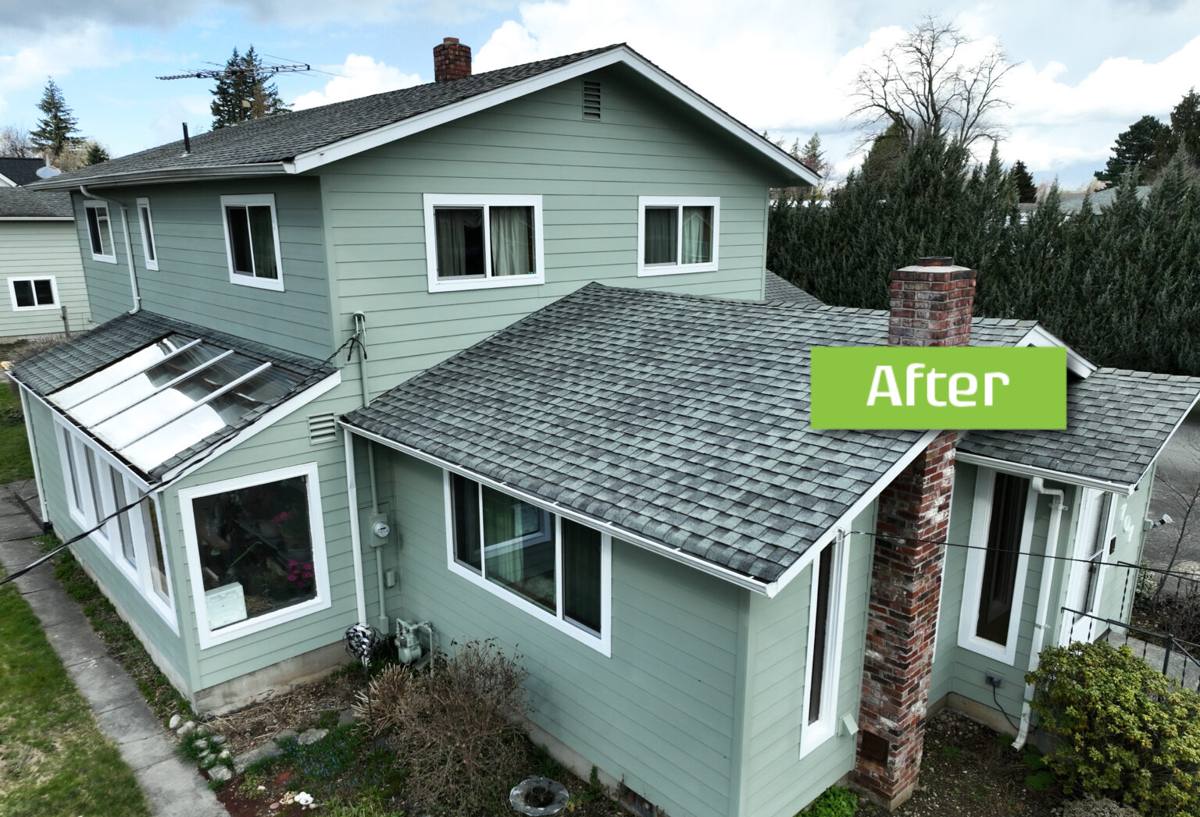
Signs a Skyline Roof Has Reached Replacement, Not Repair
Roof repair makes sense when the damage is isolated — a cracked pipe boot, a few blown-off shingles after a windstorm, a flashing leak at a chimney. Replacement is the honest call when the problems are spread across the roof or point to failure underneath the shingles themselves. Signs worth taking seriously:
- Granules collecting in gutters or at downspout splash points, meaning the shingle's protective surface is wearing through
- Shingles that are curling, cupping, or have gone brittle enough to crack when walked on
- Dark streaking or thick moss growth returning within a season or two of cleaning
- Soft or spongy spots underfoot, which usually mean the decking underneath has taken on moisture
- Daylight visible through the attic roof boards, or water staining on attic rafters and insulation
- A roof that's 20+ years old (asphalt) or showing widespread wear rather than one bad section
- Recurring leaks in different spots each winter rather than one consistent trouble area
If a roof is showing two or three of these at once, patching tends to become a cycle of chasing new leaks every wet season rather than actually solving the problem. That's usually the point where full replacement costs less over five years than repeated repair calls.
What a Correct Roof Replacement Actually Involves
Tear-Off and Deck Inspection
We remove the existing roofing down to the deck rather than layering over it. That's the only way to actually see what's underneath — and in this climate, it's common to find soft or delaminated plywood or sheathing boards near valleys, eaves, and old vent penetrations where water has been getting in slowly for years. Any compromised decking gets replaced before anything new goes down; roofing over bad decking just hides a problem that will resurface.
Underlayment and Water-Entry Points
A synthetic underlayment goes down as the roof's real waterproof layer — the shingles or metal on top are the wear surface, but the underlayment is what actually keeps water out if wind drives rain up under the top layer. At eaves, valleys, and anywhere ice or wind-driven rain is most likely to intrude, we use self-adhering ice-and-water membrane rather than felt or standard synthetic alone. Given how often this area sees sideways rain during winter storms, this detail matters more here than it would in a drier, calmer inland climate.
Flashing
Flashing around chimneys, skylights, sidewalls, and roof-to-wall transitions is where most roof leaks actually originate — not in the open field of shingles. We use corrosion-resistant metal and proper step-and-counter flashing techniques rather than relying on caulk or sealant to bridge gaps, since sealant is the first thing salt air and UV break down.
Ventilation
A roof deck that can't breathe traps moisture from inside the house, which shortens the life of the decking and the shingles from underneath — regardless of how good the outer materials are. We check that intake (soffit) and exhaust (ridge or box vents) are balanced and unobstructed, and correct it as part of the replacement when it isn't.
Material Options for a Coastal Skagit County Climate
There's no single "best" roofing material — the right choice depends on budget, roof pitch, how much shade and moss pressure the property has, and how long the homeowner plans to own the house. Here's how the common options actually compare for a Skyline property:
| Material | Typical Lifespan | Moss/Algae Resistance | Salt Air Durability | Notes |
|---|---|---|---|---|
| Architectural asphalt shingle | 25–30 years | Moderate (better with algae-resistant granules) | Good with corrosion-resistant fasteners | Best value; most common choice; needs periodic moss removal on shaded slopes |
| Standing seam metal | 40–50+ years | Excellent — moss struggles to grip smooth metal | Very good with proper coating/fastener spec | Higher upfront cost; sheds rain fast; fewer seams for wind-driven rain to exploit |
| Synthetic/composite shingle | 30–50 years | Good | Good | Mimics shake or slate look; lighter than real slate; solid middle-ground option |
| Cedar shake | 20–30 years (with upkeep) | Poor without regular treatment | Fair — needs consistent maintenance | We're honest that shake demands ongoing upkeep in a damp, mossy climate like this one |
For most Skyline homes, architectural asphalt or standing seam metal end up being the practical choice — asphalt for value and familiarity, metal for homeowners planning to stay long-term who want to largely stop thinking about moss and re-roofing. We'll walk through the honest trade-offs for your specific roof rather than pushing one product across every job.
Moss, Algae, and Salt: Why "Just Clean It" Isn't the Long-Term Fix
A lot of homeowners try to solve moss with an annual cleaning, and while that helps, it treats the symptom rather than the cause. Moss takes hold where a roof stays damp longest — heavily shaded slopes, valleys with slow drainage, and areas where debris collects and holds moisture against the shingle surface. A correct replacement addresses the conditions moss needs to grow: proper slope-appropriate materials, clean valley design, and in some cases zinc or copper strip installations near the ridge that release trace metal ions with each rain to discourage regrowth over time.
Salt air is a separate issue and mostly affects metal components — fasteners, flashing, vent caps, and gutter hardware. We spec corrosion-resistant materials (stainless or coated fasteners, properly rated flashing metal) specifically because standard galvanized hardware corrodes faster this close to the water, and a roof is only as good as its weakest metal component.
Our Replacement Process
- On-site inspection and estimate. We look at the whole roof system — shingles, decking access points, flashing, ventilation, gutters — not just the surface, and give a written estimate with no pressure to decide on the spot.
- Material selection. We walk through the realistic options for your roof's pitch, shade exposure, and budget, including honest trade-offs for each.
- Scheduling around weather. Roof replacement needs a dry work window; we plan around the forecast rather than rushing a tear-off into a storm system.
- Tear-off and deck inspection. Full removal down to the deck, with any compromised sheathing replaced before new materials go on.
- Underlayment, flashing, and ventilation work. The waterproofing layer, ice-and-water membrane at vulnerable points, and flashing details go in before the finish material.
- Installation of the new roofing. Installed to manufacturer spec so the warranty stays valid, with attention to fastening patterns appropriate for wind exposure.
- Cleanup and final walkthrough. Site debris and nails cleared with a magnetic sweep, and we walk the finished roof with the homeowner before calling the job done.
Why a Crew That Already Works Skyline Matters
Roofing crews who work this specific area regularly already know which slopes tend to hold moss longest, which older Skyline homes were built with roof vents that under-ventilate by today's standards, and how local wind patterns off the water tend to drive rain into valleys and roof-wall transitions. That's not something a crew coming from outside the area picks up on a single site visit — it comes from having replaced and repaired roofs in this exact microclimate before. It also means faster response if something needs a follow-up look after a hard winter storm, since we're not driving in from across the county.
What to Ask Before Hiring Any Roofing Contractor
Whoever you hire for a roof replacement — us or someone else — a few questions separate a solid contractor from a risky one:
- Are you licensed and insured in Washington State, and can you provide proof?
- Does the estimate include full tear-off, or is it priced as a layover?
- What underlayment and ice-and-water shield spec is included, not just the visible shingle brand?
- Who handles the manufacturer warranty registration, and is it a material-only or full system warranty?
- What happens if decking damage is found once tear-off starts — is that a change order or included in the estimate process?
A contractor who answers these clearly, in writing, before work starts is generally one worth trusting with the job.
Maintaining a New Roof in Skyline's Climate
A correctly installed roof still benefits from basic upkeep in this environment. Keeping gutters clear so water doesn't back up under the eave edge, trimming back tree limbs that shade a slope and keep it perpetually damp, and doing a light moss treatment or removal every year or two on north-facing sections will noticeably extend how long a roof looks and performs like new. None of this is heavy maintenance — it's the difference between a roof that needs attention at year 20 versus year 30.
Get a Straightforward Estimate
If your Skyline roof is showing wear, moss buildup that keeps coming back, or you're just planning ahead before the next winter storm season, we're happy to take a look and give you a straightforward, no-pressure estimate — what we're seeing, what it would take to fix it right, and what that realistically costs. Use the form below to get started.